

How to Find Safe Places to Stay While Traveling
Finding a comfortable room is important, but finding a safe place to stay should come first. Whether you are booking a hotel, apartment, hostel, guesthouse, or vacation rental, the neighborhood, property security, guest reviews, transportation options, and emergency access can all affect your experience. Learning how to find safe places to stay while traveling helps you avoid unnecessary risks while making it easier to relax and enjoy your destination. Safety is not about choosing the most expensive property or avoiding unfamiliar places altogether. It is about researching carefully, noticing warning signs, and selecting accommodation that fits both your travel style and the realities of the area you are visiting.
Modern booking platforms make it easy to compare hundreds of properties within minutes, but convenience can also encourage rushed decisions. Attractive photos, low prices, and high ratings may hide practical problems such as isolated locations, unreliable locks, poorly lit streets, or misleading descriptions. A safe accommodation choice requires looking beyond the headline score and examining patterns across recent reviews, maps, official information, and property policies. Your needs may also change depending on whether you are traveling alone, with children, by car, or arriving late at night. A thoughtful approach before booking can prevent many common problems and give you greater confidence from check-in to departure.
Research the Neighborhood Before Booking
The neighborhood around your accommodation can matter just as much as the property itself. A hotel may have excellent reviews, but if it sits in an isolated area with poor lighting, limited transportation, or little activity after dark, getting back to your room may feel uncomfortable. Start by locating the property on a map and checking what surrounds it. Look for restaurants, supermarkets, pharmacies, transportation stations, and other services that suggest regular foot traffic. Also examine how far you would need to walk from major attractions or transit stops. A convenient, active neighborhood can make daily travel feel easier and reduce the need for long walks through unfamiliar areas at night.
Do not rely entirely on labels such as “city center” or “downtown.” These descriptions can cover very large areas, and safety conditions may vary significantly from one block to another. Compare the hotel’s location with neighborhoods commonly recommended for visitors and read recent travel discussions about the immediate area. Search for specific comments about walking after dark, transportation access, street lighting, noise, and unwanted attention. Maps with street-level imagery can also help you understand whether the surroundings appear residential, commercial, industrial, or isolated. No map can guarantee safety, but combining several sources creates a much clearer picture than choosing accommodation based solely on distance from famous attractions.
Consider what the neighborhood feels like during the hours you are most likely to return. A business district may be busy and comfortable during the day but almost deserted after offices close. An entertainment district may remain lively late into the night but bring additional noise, intoxicated crowds, or traffic. Neighborhoods near major transportation hubs can be convenient while also attracting heavy foot traffic and occasional opportunistic theft. Your ideal location depends on your itinerary and comfort level. A traveler attending evening events may prioritize well-lit streets and late-night transportation, while someone planning early morning tours may care more about quick access to major roads or transit stations.
Families, solo travelers, older travelers, and people with limited mobility may have different neighborhood priorities. Families might want parks, grocery stores, pharmacies, and shorter walking distances. Solo travelers may prefer accommodation on active streets with staffed reception desks and easy transportation access. Travelers with mobility needs should check sidewalks, hills, stairs, and the distance from drop-off points to hotel entrances. These factors do not determine whether a neighborhood is safe, but they affect how exposed or stressed you may feel while moving through it. Choosing an area that works with your personal travel needs can reduce avoidable vulnerability and make the entire stay more comfortable.
Finally, remember that unfamiliar does not automatically mean unsafe. Some destinations look very different from what you are used to while still being perfectly appropriate for visitors. At the same time, popularity does not guarantee safety, and heavily touristed areas can attract pickpocketing, scams, and other opportunistic crime. Avoid judging neighborhoods solely by appearance. Focus instead on reliable information, recent visitor experiences, transportation patterns, and practical access. When you understand how an area functions, you can make decisions based on evidence rather than fear. This is one of the most important steps in learning how to choose safe accommodation while traveling.
Read Recent Reviews With Safety in Mind
Guest reviews are one of the most useful tools for evaluating accommodation safety because previous travelers often mention issues that property descriptions leave out. Instead of reading only the highest-rated comments, search specifically for words such as “safe,” “security,” “lock,” “night,” “area,” “street,” “staff,” “entrance,” and “noise.” Reviews may reveal whether guests felt comfortable returning after dark, whether doors locked properly, or whether strangers could easily enter the building. These details are often more valuable than general praise about décor or breakfast. Focus especially on reviews from travelers whose circumstances resemble yours, such as solo guests, families, or people arriving late at night.
Recency matters because hotels and neighborhoods can change quickly. A property praised for strong security several years ago may now have maintenance problems, while a previously criticized hotel may have installed better locks, lighting, or access controls. Give more weight to reviews from the past several months when possible. Look for repeated themes rather than reacting to one dramatic complaint. Every property eventually receives negative feedback, and some concerns may result from misunderstandings or unrealistic expectations. However, multiple recent guests reporting broken locks, unstaffed entrances, harassment nearby, or poor emergency response deserves serious consideration before booking.
Photos uploaded by guests can also help confirm whether the property appears secure. Look at entrances, hallways, parking areas, windows, balconies, staircases, and the surrounding street when these are visible. Promotional images rarely focus on practical details, while guest photographs may show whether the entrance opens directly onto a busy road or whether ground-floor windows seem exposed. Apartment rentals deserve particular scrutiny because entrances may be shared with residents or located in buildings without a staffed front desk. Visual information cannot replace proper research, but it can reveal potential concerns that may prompt you to ask the host additional questions.
Reviews about staff behavior are equally important. Responsive employees can make a major difference if you lose a key, notice suspicious activity, need help arranging transport, or face another unexpected problem. Look for comments about whether reception is staffed overnight and whether employees respond quickly to guest concerns. A property with excellent physical security but poor communication can still create problems during emergencies. Travelers staying in vacation rentals should evaluate how quickly hosts respond to messages and whether check-in instructions are clear. Reliable communication is part of safety because uncertainty becomes much harder to manage when you are in an unfamiliar place.
Use reviews as one part of a larger decision rather than treating them as absolute proof. Some travelers feel comfortable in environments that others find stressful, and perceptions of safety can be subjective. Cross-check guest feedback with maps, local transportation information, official travel advice, and recent destination guidance. If several independent sources point toward the same concern, take it seriously. If reviews are mixed, look for specifics instead of vague statements. The goal is not to eliminate every possible risk, which is impossible, but to identify patterns that help you choose safe lodging for travelers with greater confidence.
Check the Property’s Security Features
Basic security features should be part of your accommodation comparison rather than something you think about after arrival. Look for working room locks, controlled building access, staffed reception areas, security cameras in common spaces where appropriate, and clear emergency exits. Hotels often use key-card access for guest floors or elevators, while smaller properties may rely on locked external doors and individual room keys. Vacation rentals should provide secure entry instructions and functioning locks. If the property description does not explain how access works, ask before booking. A straightforward answer can help you understand whether the property takes guest security seriously.
Room doors deserve particular attention because they are your primary barrier while sleeping or storing belongings. Deadbolts, interior latches, or secondary locks can provide additional reassurance when available. Check the lock when you first enter the room and contact staff immediately if it does not function properly. Windows and balcony doors should also close and secure correctly, especially on lower floors or rooms accessible from shared terraces. Do not assume that a visually attractive property automatically maintains these basics. Good accommodation management includes regular maintenance of doors, windows, lighting, and access systems because security depends on small details working consistently.
Reception staffing can influence how supported you feel, particularly if you are arriving late or traveling alone. A 24-hour front desk provides an immediate point of contact if you encounter problems during the night. Smaller hotels and guesthouses may not offer round-the-clock staffing, which is not automatically unsafe, but you should understand how emergency assistance works after reception closes. Ask whether there is an overnight phone number, on-site manager, or security contact. Vacation rentals should also provide clear instructions for urgent issues. Knowing who to contact reduces uncertainty if something happens outside normal business hours.
Parking areas and entrances deserve scrutiny when traveling by car. Check whether parking is secured, monitored, underground, gated, or open to the street. Avoid leaving passports, electronics, luggage, or visible valuables inside vehicles, even when the parking area appears protected. If your hotel provides valet parking, ask how keys are managed and whether vehicles remain on-site. Properties with exterior corridors or ground-floor entrances can still be perfectly suitable, but they may offer a different level of access control compared with buildings where guests pass through a lobby. Choose the setup that matches your comfort level and the destination.
Security features should make you feel supported without creating a false sense of invulnerability. Cameras, key cards, guards, or safes cannot prevent every problem, and travelers still need to use reasonable judgment. Lock doors, keep valuables secured, avoid sharing room numbers publicly, and report broken security equipment immediately. If something feels wrong after check-in, speak with management instead of ignoring it. A reputable hotel should take concerns seriously and offer solutions when possible. Combining reliable property security with sensible personal habits creates a stronger foundation for a safe stay than relying on either one alone.
Verify That the Accommodation Is Legitimate
Fraudulent listings and misleading accommodation advertisements can create both financial and safety problems. Before booking, verify that the property exists and that the listing matches information available elsewhere. Search the property name independently, compare addresses, check recent reviews, and look for consistent photographs across reputable platforms. Hotels should usually have an established online presence, although small guesthouses may rely more heavily on booking platforms. Vacation rentals require additional care because individual hosts can create listings that are harder to verify. If the price seems dramatically lower than comparable properties in the same area, investigate carefully before providing payment details.
Pay attention to how payment is requested. Established booking platforms typically process payments through secure systems and provide clear reservation records. Be cautious if someone pressures you to move communication or payment outside the platform without a legitimate reason. Requests for wire transfers, cryptocurrency, gift cards, or unusual payment methods can be warning signs, particularly when combined with urgency. Hosts may have valid reasons for certain deposits or local payments, but these should be clearly documented in the listing terms. Keeping communication within the booking platform creates a record that can be useful if disagreements or fraudulent activity occur.
Addresses should also be checked before booking. Some vacation rentals hide exact addresses until a reservation is confirmed for privacy reasons, but you should usually receive enough location information to understand the neighborhood. If an address appears inconsistent across platforms or maps, contact the property. Search the building name or street if necessary to confirm that accommodation actually operates there. For hotels, compare contact details from multiple sources rather than relying entirely on a link received through an unsolicited message. Scammers sometimes imitate real hotel websites or booking confirmations, so using official channels and trusted platforms reduces the chance of sending information to the wrong party.
Be careful with last-minute messages claiming that your reservation has a payment problem. Fraudulent emails or messages sometimes imitate hotels and ask guests to re-enter card details through unfamiliar links. Instead of clicking immediately, open the booking platform or hotel’s official website independently and check your reservation status. Contact the property using verified contact information if you are uncertain. This simple habit can protect both your payment details and your reservation. Travel scams increasingly rely on urgency, so slowing down and verifying requests is often one of the most effective defenses.
Legitimacy matters because arriving at a fake, canceled, or completely different property can leave you stranded in an unfamiliar destination. Keep your confirmation details, payment receipts, host communication, and address available offline. If anything changes before arrival, verify the information through official channels rather than relying on a single message. Travelers who book unfamiliar independent properties should be particularly careful when cancellation terms or payment requirements seem unusual. A few minutes of verification can prevent a far more stressful problem later and should be part of every safe accommodation booking strategy.
Choose Accommodation With Reliable Transportation Access
Transportation affects safety because even a secure hotel can become inconvenient if reaching it requires long walks through unfamiliar areas. Check how you will travel between your accommodation and the airport, train station, major attractions, and evening activities. A property close to a reliable metro, bus route, taxi stand, or rideshare pickup area can make returning after dark easier. Consider service hours as well because public transportation may stop earlier than expected in some destinations. If your plans involve nightlife, evening shows, or late restaurant reservations, confirm that you will still have a practical way to return safely.
Airport arrivals require special planning, particularly when flights land late at night. Research official taxi systems, airport trains, hotel transfers, or reputable rideshare services before departure. Avoid waiting until you are exhausted in the arrivals hall to decide how to reach your accommodation. Hotels that provide transfers may be especially convenient for families, solo travelers, or visitors unfamiliar with the local language. If the hotel arranges a driver, confirm the meeting point and how the driver will identify you. Knowing exactly what happens after landing reduces the likelihood of accepting transportation from unverified individuals.
Walking routes should also be evaluated realistically. A hotel described as ten minutes from a station may require crossing large roads, navigating poorly lit alleys, climbing steep stairs, or walking beside limited sidewalks. Map services can provide useful information, but they do not always reflect construction, temporary closures, or nighttime conditions. Recent guest reviews frequently mention difficult access, which is another reason to read them carefully. If you will carry luggage, push a stroller, or return alone at night, a slightly longer route through a busy main street may be preferable to a shorter route through isolated back streets.
Travelers renting cars should think about both parking and road access. A beautiful old-town hotel may lack parking or require guests to leave vehicles several blocks away. That can become inconvenient when arriving late or carrying luggage. Ask whether parking is secure and whether access changes at certain times because some historic areas restrict vehicles. Road conditions also matter in rural destinations, where navigation apps may direct drivers onto narrow or poorly maintained routes. Choose accommodation that matches your transportation plan rather than assuming every attractive property will be equally easy to reach.
Transportation planning is particularly important when traveling somewhere for the first time. Knowing your route reduces hesitation and makes you less likely to stand in unfamiliar areas checking your phone repeatedly. Save maps offline, keep your hotel’s address written down, and understand at least one backup transportation option. If public transit closes unexpectedly, know which taxi or rideshare service is considered reliable. A safe stay begins before you walk through the hotel door, and predictable transportation is one of the most useful ways to reduce avoidable stress throughout the trip.
Be Extra Careful When Booking Vacation Rentals
Vacation rentals can provide excellent value, privacy, kitchens, and additional space, but they require different safety considerations from traditional hotels. Because many rentals operate without staffed reception desks, travelers depend more heavily on accurate listings, reliable hosts, secure entry systems, and clear communication. Review the host’s profile, property history, number of reviews, and recent guest experiences before booking. Newly listed properties are not automatically unsafe, but they provide less evidence for you to evaluate. If something about the location, check-in method, or house rules is unclear, ask the host directly before paying.
Self-check-in systems are convenient but should still feel secure. Lockboxes, electronic keypads, and smart locks can work well when managed properly. However, check whether codes are changed between guests and whether building entrances are shared with the public. Avoid sharing entry codes or property access details with anyone who does not need them. If a lockbox appears damaged or the door does not secure correctly, contact the host immediately. Never assume that an unusual access setup is normal simply because you are tired after traveling. Your first priority after arrival should be confirming that doors and windows can be locked properly.
Shared accommodations require another level of awareness. Hostels, room rentals, and homes shared with hosts or other guests can be enjoyable and affordable, but understand exactly which spaces are private and which are communal. Look for lockable bedroom doors and secure lockers if you will share dormitory facilities. Keep passports, cash, and important electronics secured rather than leaving them unattended. In private-room rentals, read reviews specifically discussing host behavior and privacy. Most hosts are professional and respectful, but clear expectations about access, common spaces, and house rules help avoid misunderstandings.
Location accuracy is especially important with rentals because a listing may advertise proximity to a famous neighborhood while actually sitting well outside it. Study the approximate map location and ask about transportation if necessary. Some rental platforms reveal the exact address only after booking, but the general location should still allow you to understand the surrounding area. Be cautious when listings use vague language such as “minutes from downtown” without explaining whether that means walking, driving, or public transportation. Convenience claims should always be checked independently.
Have a backup plan when booking independent accommodation. Save the platform’s support information and know what options exist if you cannot enter the property, the listing is significantly misrepresented, or you feel unsafe. Avoid canceling or moving the reservation outside the platform without understanding how that affects your protections. If you arrive and find serious safety problems, document them clearly and contact the host or booking service promptly. Vacation rentals can be excellent safe places to stay while traveling, but they work best when travelers verify details rather than treating them exactly like full-service hotels.
Keep Your Personal Information and Room Details Private
Privacy is an important part of accommodation safety. Avoid announcing your room number loudly in public areas or posting images that reveal your exact room location while you are still staying there. Hotel staff generally avoid speaking room numbers aloud for this reason, and travelers should follow the same principle. If someone asks where you are staying and you do not know them well, there is usually no reason to provide exact details. Sharing general information about the neighborhood is enough in most casual conversations. Small privacy habits can reduce unnecessary exposure without making travel feel restrictive.
Be cautious about what appears in social media posts. A balcony view, room number, hotel key card, building entrance, or location tag can reveal more than you intended. Posting after you leave a destination can provide additional privacy, particularly when traveling alone. If you choose to share content in real time, avoid showing information that identifies exactly where you are sleeping. Travel creators and frequent social media users may find this especially important because repeated location updates can create predictable patterns. Enjoying and sharing a trip does not require broadcasting every logistical detail.
Hotel key cards and access information should also remain private. Do not label spare keys with your room number or leave them unattended in public areas. If you lose a key card, report it to reception and request that it be deactivated rather than assuming it will not be used. Vacation-rental access codes should never be posted or sent to people outside your travel group. Good accommodation security depends partly on controlling who has entry information. Treat digital codes with the same care you would give a physical key.
Personal documents need similar attention. Passports, spare credit cards, large amounts of cash, and sensitive travel documents should not be left openly visible in your room. Use an in-room safe when you consider it appropriate, or keep important items secured within your luggage. Carry only what you need for the day when practical, while following local identification requirements. Also avoid leaving boarding passes or documents containing personal data in hotel trash without considering what information they display. Identity-related risks are less visible than physical safety concerns but can still create significant travel problems.
Privacy also includes communication with staff and other guests. If someone calls your room claiming to be hotel staff and asks for payment or personal information, verify the request directly with reception. Hotels should not need sensitive payment details through unexpected calls without explanation. If someone knocks at your door and you are uncertain who they are, confirm their identity before opening. These habits are simple, but they make it harder for opportunistic scams or social engineering attempts to succeed. Protecting information is an important part of staying safely in unfamiliar accommodation.
Inspect Your Room as Soon as You Arrive
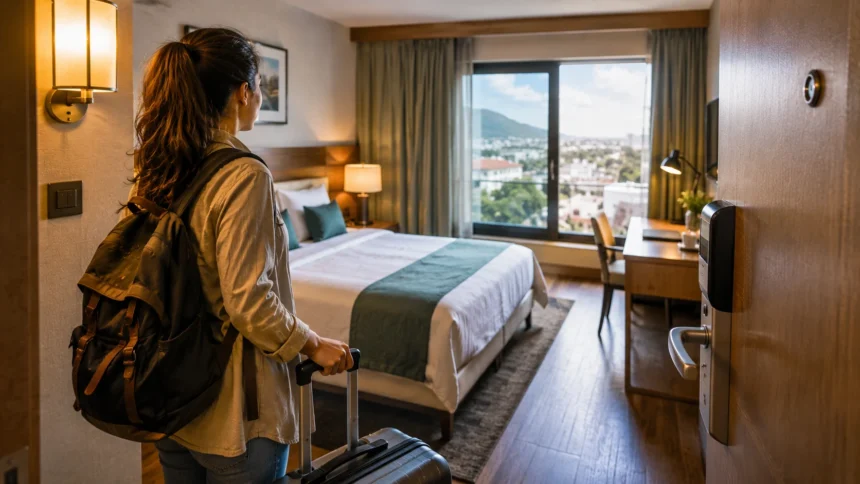
Your first few minutes in a hotel room are a good time to check important safety features. Confirm that the main door closes completely and that all locks function. Check windows and balcony doors, particularly on lower floors or rooms connected to shared outdoor spaces. Locate the emergency exit information and identify the nearest stairwell rather than assuming you will remember the hallway layout later. Make sure the telephone works if the property provides one, and save reception’s number in your phone when necessary. These simple checks take very little time and can reveal problems before you unpack.
Examine smoke detectors, sprinklers, and other visible safety equipment without tampering with them. If equipment appears damaged or missing, report it to staff. You should also notice whether hallways and exits are clearly marked and unobstructed. In unfamiliar buildings, especially older properties, understanding the evacuation route is useful because emergencies can occur at night when visibility is reduced. Avoid relying entirely on elevators because they may not operate during fires or power failures. You do not need to study the building obsessively, but basic orientation is a practical habit for any traveler.
Look for maintenance issues that could create injuries, especially when traveling with children. Loose railings, slippery bathroom floors, damaged electrical outlets, broken furniture, or unstable balcony barriers should be reported. If the problem cannot be corrected promptly, request another room when possible. Hotels occasionally have maintenance failures, and noticing them does not mean the entire property is unsafe. The important question is how quickly management responds. Professional accommodation providers should take credible safety concerns seriously rather than dismissing them.
Check where you will store valuables and luggage. Avoid placing important documents close to doors, open windows, or balconies. If you plan to use a safe, test that it locks and opens correctly before placing anything inside. Keep essential medication and travel documents somewhere you can reach quickly in an emergency. Families should also decide where children will sleep and whether beds, furniture, or windows create any concerns. Organizing the room deliberately can make it easier to maintain awareness rather than scattering belongings everywhere.
Trust specific observations rather than vague anxiety. Travel can naturally make people more alert because unfamiliar environments provide fewer predictable cues. If you notice a concrete problem such as a broken lock, damaged window, unauthorized person entering guest areas, or poor lighting, address it directly with staff. If the issue remains unresolved and you genuinely feel unsafe, changing rooms or accommodation may be appropriate. Safety decisions work best when based on identifiable concerns and available evidence rather than panic. A quick room inspection helps you distinguish real issues from normal unfamiliarity.
Plan for Emergencies Before You Need Help
Emergency planning does not need to be complicated, but basic preparation can make unexpected situations easier to manage. Save the local emergency number for the country you are visiting and know how to contact your hotel’s front desk. Keep your accommodation address in your phone and also store an offline copy in case your device loses data connectivity. Travelers staying in rentals should save their host’s contact information and the booking platform’s support details. If you have travel insurance, keep the policy information accessible. These small steps can save valuable time if you need assistance.
Know where essential services are located near your accommodation. A nearby pharmacy, clinic, hospital, police station, or 24-hour convenience store may become useful unexpectedly. Families traveling with children or people managing specific health needs may want to identify these services before arrival. This does not mean you should expect an emergency. It simply removes the need to research from scratch while already stressed. Hotel reception staff can often provide local guidance, but having basic information independently gives you an additional option.
Share your itinerary with someone you trust when appropriate, particularly during solo travel or trips to remote destinations. They do not need minute-by-minute updates, but knowing your accommodation name, destination, and expected travel dates can be useful if communication stops unexpectedly. You can also send confirmation details to a travel companion or family member before departure. Avoid publicly sharing the same information on open social platforms. There is an important difference between ensuring someone trusted knows your location and making that information visible to strangers.
Keep devices charged and carry an appropriate power bank if your itinerary involves long days away from the hotel. A working phone can provide maps, transportation apps, translation tools, emergency calls, booking confirmations, and access to banking information. Save important phone numbers separately in case your device is lost or damaged. International travelers should understand whether their mobile plan will work at the destination and consider local connectivity options if necessary. Reliable communication is one of the most useful safety resources modern travelers have.
Finally, know when to seek professional help. If you experience theft, threats, harassment, medical emergencies, or another serious incident, contact appropriate local authorities or emergency services rather than trying to manage everything alone. Hotel staff, tour operators, embassies, consulates, travel insurers, and booking platforms may also provide assistance depending on the situation. Planning does not eliminate risk, but it gives you more options when circumstances become difficult. Knowing what you would do before something happens can make decision-making faster and calmer if assistance becomes necessary.
Balance Safety With Budget and Convenience
Many travelers assume the safest accommodation must be the most expensive, but price and safety are not perfectly connected. Luxury hotels may provide extensive security and staffed services, yet smaller guesthouses can also be well managed and located in safe neighborhoods. Instead of using price as your main safety indicator, evaluate location, access control, reviews, maintenance, staff availability, and transportation. A modest hotel with excellent management may feel more secure than an expensive property in an inconvenient or poorly researched area. Focus on evidence rather than assuming a higher nightly rate automatically guarantees a safer stay.
Extremely low prices can still deserve extra scrutiny. If a property costs far less than comparable accommodation nearby, determine why. The explanation may be perfectly reasonable, such as renovations, a new listing, limited facilities, or distance from popular attractions. However, unusually low pricing combined with poor reviews, unclear addresses, unusual payment demands, or limited contact information should make you cautious. Cheap accommodation becomes expensive quickly if you need to leave and book another hotel at the last minute. Value means finding a reasonable balance between affordability and dependable standards.
Convenience can itself contribute to safety. Spending slightly more to stay close to reliable transportation may reduce late-night taxi use or long walks through unfamiliar areas. A central location can also make it easier to return to your hotel if plans change unexpectedly. However, the most central tourist district is not always the best option because busy areas may bring noise, scams, and pickpocketing. Compare several neighborhoods and calculate transportation costs alongside room prices. A hotel that appears more expensive may actually save money once daily transportation is considered.
Solo travelers may choose to spend more on properties with staffed reception, active common areas, and strong recent reviews. Families may prioritize secure entrances, elevators, nearby healthcare, and practical room layouts. Road-trip travelers may care most about safe parking and easy road access. Budget backpackers can still travel responsibly by selecting reputable hostels with lockers, controlled entry, and consistently positive feedback. Safety does not require one universal accommodation type. It requires matching the property’s features to the risks and needs created by your particular journey.
The goal is to spend strategically rather than fearfully. You do not need to purchase luxury accommodation simply because a destination is unfamiliar. Good research can identify reasonably priced properties that meet strong standards for location, security, cleanliness, communication, and transportation. Create a shortlist using these factors before comparing final prices. This prevents cost from dominating the decision too early. A safe place to stay should fit within your travel budget while still giving you confidence that the basic environment is professionally managed and appropriate for your needs.
Trust Your Judgment Without Ignoring Evidence
Personal intuition can be useful during travel, particularly when something about a situation changes unexpectedly. If you arrive at accommodation and the entrance, staff behavior, room condition, or surrounding environment differs significantly from what was advertised, pay attention. Ask questions and investigate rather than immediately dismissing your concern. At the same time, distinguish between specific warning signs and ordinary discomfort caused by being somewhere unfamiliar. Evidence-based judgment is more reliable than either ignoring your instincts completely or assuming every unfamiliar situation is dangerous.
Concrete red flags deserve action. Examples include doors that do not lock, unauthorized people entering restricted guest areas, aggressive behavior, major inconsistencies in the listing, unexpected demands for payment, or staff refusing to address basic security problems. Document concerns when practical and communicate clearly with management or your booking platform. If a serious issue cannot be resolved, consider moving to another property. Your financial investment in a reservation should not force you to remain somewhere with genuine safety problems.
General nervousness can sometimes improve once you become familiar with the area. Walking through a busy neighborhood for the first time may feel overwhelming because you do not know the streets, language, or transportation system. After learning the route and understanding local patterns, the same environment may feel much more manageable. Research can help you interpret what you are seeing rather than relying entirely on assumptions. Asking hotel staff about normal transportation practices and areas to avoid can also provide useful local perspective.
Avoid stereotypes when assessing destinations and neighborhoods. Safety varies within every city and country, and broad assumptions based on culture, income levels, architecture, or appearance can be misleading. A polished tourist district can still have significant theft problems, while a modest residential neighborhood may be stable and welcoming. Use current information, observed behavior, and practical infrastructure as your guide. Respecting local communities while maintaining awareness creates a healthier travel mindset than treating unfamiliar places with automatic suspicion.
Ultimately, knowing how to find safe places to stay while traveling is about combining preparation with adaptable judgment. Research neighborhoods, verify listings, examine recent reviews, check security features, understand transportation, protect your information, and inspect your room when you arrive. None of these steps requires paranoia or excessive planning. They simply create layers of protection that make avoidable problems less likely. When accommodation feels secure and convenient, you can spend less time worrying about logistics and more time experiencing the destination you traveled to see.
Frequently Asked Questions
How can I tell if a hotel is in a safe area?
Check recent traveler reviews, local maps, transportation access, street activity, nearby services, and reliable destination guidance. Compare several sources rather than relying only on the hotel’s own description or overall star rating.
Is it safe to book accommodation through vacation rental platforms?
Vacation rentals can be safe when you use reputable platforms, verify the listing, read recent reviews, communicate within the platform, and understand the property’s access system. Be cautious about unusual payment requests or pressure to move transactions outside the booking service.
What security features should I look for in a hotel?
Useful features include secure room locks, controlled entrances, staffed reception, well-lit hallways, functioning windows and balcony locks, clear emergency exits, and secure parking when needed. The property’s maintenance and staff responsiveness are equally important.
Should solo travelers avoid ground-floor hotel rooms?
Ground-floor rooms are not automatically unsafe, but some travelers prefer higher floors because windows or balconies may be less accessible from outside. If you are concerned, request a room that matches your comfort level and always confirm that doors and windows lock properly.
What should I do if I feel unsafe after checking into a hotel?
Identify the specific concern and report it to hotel management immediately. If the problem is serious and cannot be resolved, contact your booking provider when appropriate and consider moving to different accommodation rather than staying somewhere that presents a genuine safety issue.