
Hip Flexor Exercises: 7 Moves to Ease Tight Hips
Tight hips can make simple activities such as walking, climbing stairs, standing up, or exercising feel more difficult than they should. You may notice pulling at the front of your hip, stiffness after sitting, or discomfort when extending one leg behind you. Although occasional tightness is common, it can gradually interfere with comfortable and confident movement.
The hip flexors are a group of muscles that help bring your thigh toward your torso. They work whenever you walk, run, climb, squat, or lift your knee. When these muscles remain in a shortened position for long periods or become overworked, they may begin to feel stiff, tired, or sensitive.
The right hip flexor exercises can help restore comfortable movement, improve hip mobility, and strengthen the muscles that support your pelvis. A balanced routine should include more than deep stretching. It should also activate the glutes, strengthen the core, and teach your hips to move through a controlled range of motion.
The seven movements below are suitable for many beginners and require little or no equipment. Move slowly, focus on proper form, and avoid forcing your body into an uncomfortable position. Consistent, gentle practice is usually more helpful than performing an intense stretching session only when your hips begin to hurt.
What Are the Hip Flexor Muscles?
The term “hip flexors” describes several muscles located around the front of the hip. Their primary role is hip flexion, which happens when you lift your thigh toward your chest. These muscles also contribute to posture, pelvic control, balance, walking mechanics, and many everyday lower-body movements.
The iliopsoas is one of the most important hip flexor muscle groups. It includes the iliacus and psoas major, which connect the lower spine and pelvis to the upper thigh. Because the psoas crosses several joints and connects closely with the spine, its condition can influence how the hips and lower back feel during movement.
Other muscles that assist with hip flexion include the rectus femoris, sartorius, tensor fasciae latae, and pectineus. Each muscle has additional responsibilities, such as extending the knee, rotating the thigh, or stabilizing the pelvis. This is why effective hip mobility exercises often address several areas rather than targeting only one muscle.
When the hip flexors become stiff or overactive, nearby muscles may need to work differently to keep the body stable. The glutes, abdominal muscles, hamstrings, and lower-back muscles all interact with the hips. Improving the balance between these areas may help movement feel smoother and reduce unnecessary strain.
Why Do Hip Flexors Feel Tight?
Prolonged sitting is one of the most common reasons people experience tight hip flexors. Sitting keeps the hips in a flexed position, meaning the thighs remain closer to the torso. Remaining in this position for several hours may leave the front of the hips feeling stiff when you finally stand and attempt to extend your legs.
Repetitive activities may also contribute to hip tightness. Runners, cyclists, hikers, dancers, and athletes repeatedly lift their knees and use the hip flexors to move their legs forward. Without enough recovery, strength training, or movement variety, these muscles may feel tired and restricted even in physically active people.
Weakness in the glutes and core can create a similar sensation. When these supporting muscles do not stabilize the pelvis effectively, the hip flexors may take on more work than necessary. This can make them feel constantly tense, even though stretching alone may not resolve the underlying muscle imbalance.
Stress, limited hip rotation, previous injuries, sudden increases in training, and poor exercise technique can also affect the front of the hips. In some cases, what feels like muscle tightness may involve a joint, tendon, nerve, or another structure. Persistent or worsening symptoms therefore deserve professional assessment rather than increasingly aggressive stretching.
Signs You May Have Tight Hip Flexors
One common sign is stiffness across the front of the hip after sitting at a desk, driving, or resting for a long time. The first few steps after standing may feel restricted, and you may need time to straighten fully. The sensation often improves after walking gently or changing positions.
You may also notice difficulty moving one leg behind your body while walking or lunging. Instead of extending through the hip, your lower back may arch to create extra movement. This compensation can make the lumbar area feel compressed or tired, particularly during running, lunges, or prolonged standing.
Another possible sign is reduced comfort during a half-kneeling hip flexor stretch. You might feel an intense pull at the front of the trailing hip before moving very far. Some people also notice that one side feels significantly tighter than the other, which may affect stride length or exercise technique.
However, tightness should not automatically be treated as a diagnosis. Sharp groin pain, catching, locking, significant weakness, swelling, numbness, or difficulty bearing weight are not typical signs of simple muscle stiffness. These symptoms should be discussed with an appropriate healthcare professional before beginning a new routine.
What to Do Before Starting These Hip Flexor Exercises
Begin with five to ten minutes of comfortable movement to increase circulation and prepare your muscles. Walking, marching in place, or using a stationary bicycle at an easy pace can work well. Stretching cold muscles aggressively may feel unpleasant and can make it harder to move with control.
During each exercise, aim for a mild or moderate stretching sensation rather than pain. You should be able to breathe normally and maintain the position without shaking excessively. If you feel pinching in the hip joint, sharp discomfort, numbness, or pain that travels down your leg, stop the movement.
Keep your pelvis controlled instead of forcing your hips as far forward as possible. Many people create the appearance of a deeper hip flexor stretch by arching their lower back. A gentle abdominal brace and slight tucking of the pelvis can direct the movement toward the front of the hip more effectively.
Use a folded towel, exercise mat, chair, or wall when additional support is needed. Beginners do not need to match the deepest version of an exercise immediately. Start with a comfortable range, practise consistently, and increase the position only when you can maintain steady breathing and proper alignment.
7 Best Hip Flexor Exercises for Tight Hips
These seven moves combine static stretching, dynamic mobility, core control, and hip strengthening. This combination is important because hips can feel restricted when muscles lack strength or coordination, not only when they are physically shortened. A complete routine should therefore teach your hips to relax and work efficiently.
You do not need to perform every movement at maximum intensity. Choose a range that produces a gentle stretch or manageable muscular effort. Smooth, controlled repetitions are more useful than bouncing, rushing, or pushing through a position that causes pain.
Perform the exercises on both sides, even when only one hip feels tight. You may notice differences in strength, balance, or flexibility, but avoid forcing the more restricted side to match the other immediately. Gradual improvement is safer and more realistic than chasing perfect symmetry.
Most people can complete this routine in approximately 10 to 15 minutes. It may be used after a warm-up, following a workout, or as a movement break during the day. People recovering from injury, surgery, pregnancy-related changes, or chronic hip conditions should seek personalized guidance first.
1. Half-Kneeling Hip Flexor Stretch
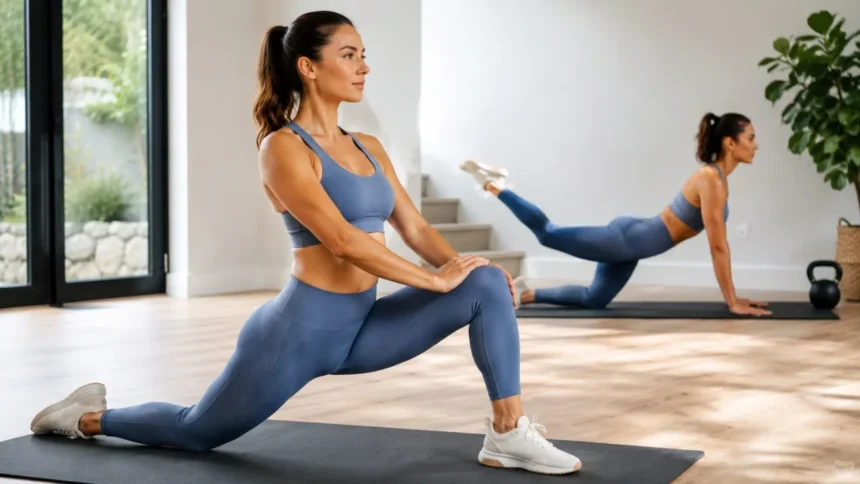
Place one knee on a padded surface and position the opposite foot in front of you. Both knees should be bent comfortably, with your front foot resting flat on the floor. Keep your torso upright and place your hands on your hips or on a stable chair for balance.
Gently tighten your abdominal muscles and squeeze the glute on the kneeling side. Slightly tuck your pelvis as though bringing the front of your belt upward. Shift your body forward only until you feel a controlled stretch across the front of the kneeling hip and upper thigh.
Hold the position for approximately 20 to 30 seconds while breathing slowly. Avoid arching your lower back, leaning your chest forward, or allowing the front knee to collapse inward. Repeat the stretch two or three times before changing sides.
For a deeper variation, raise the arm on the kneeling side and reach slightly toward the opposite side. This may lengthen the stretch along the hip and side of the torso. Keep the movement small enough that you can maintain pelvic control without creating lower-back pressure.
2. Low Lunge With an Overhead Reach
Begin in a half-kneeling position with one foot forward and the opposite knee resting on a mat. Create enough distance between your knees to feel stable rather than placing your feet in one narrow line. Keep your front heel underneath or slightly ahead of your knee.
Tuck your pelvis gently and squeeze the glute of the trailing leg. Shift forward until you feel a stretch through the front of that hip. Raise both arms overhead while keeping your ribs from flaring and your lower back from arching.
Hold the low lunge for 20 to 30 seconds and take several relaxed breaths. Think about becoming taller through the crown of your head instead of reaching backward. The goal is to lengthen the front of the hip while maintaining a stacked rib cage and pelvis.
People with balance concerns can perform this move beside a wall and raise only one arm. You may also keep both hands on the front thigh while learning the pelvic position. The overhead reach is optional and should not create shoulder or back discomfort.
3. Supine Hip Flexor Stretch
Lie on your back near the edge of a firm bed or exercise table. Bring both knees toward your chest, then hold one knee gently with your hands. Allow the opposite thigh to lower slowly toward the edge while keeping your back supported.
Continue lowering the free leg until you feel a stretch across the front of the hip or upper thigh. Keep the hanging leg relaxed and avoid forcing it downward. The knee can remain bent, particularly when you want to include the rectus femoris at the front of the thigh.
Hold the position for 20 to 30 seconds while taking slow breaths. Your lower back should remain comfortable rather than lifting dramatically away from the surface. Repeat the stretch two or three times before switching legs.
Move farther away from the edge when you need a gentler version. You can also perform the exercise fully on the floor by extending one leg while holding the other knee toward your chest. This variation offers less range but may feel safer for beginners.
4. Glute Bridge
Lie on your back with your knees bent and your feet flat on the floor. Place your feet approximately hip-width apart and keep your arms resting beside your body. Your heels should be close enough that you can press through them without your feet sliding.
Gently brace your core and squeeze your glutes before lifting your hips. Raise your pelvis until your shoulders, hips, and knees form a comfortable diagonal line. Pause briefly at the top without pushing your ribs upward or arching your lower back.
Lower your hips slowly and repeat for 8 to 12 controlled repetitions. Concentrate on feeling the buttock muscles rather than the hamstrings or lower back doing all the work. Two or three sets can help build strength around the hips and pelvis.
The glute bridge does not directly stretch the hip flexors, but it strengthens muscles that oppose hip flexion. Stronger glutes may help the pelvis remain more stable during standing, walking, and exercise. This makes the bridge a useful addition to a tight hip flexor routine.
5. Dead Bug
Lie on your back with your knees bent above your hips and your arms reaching toward the ceiling. Keep your head relaxed and gently tighten your abdominal muscles. Your lower back should feel supported without being forced aggressively into the floor.
Slowly lower one heel toward the ground while keeping the opposite leg still. Return to the starting position and repeat with the other side. Move only as far as you can without your lower back lifting or your ribs flaring.
Complete 6 to 10 repetitions on each side at a steady pace. Exhale as you lower the leg and inhale as you return. The slower you move, the more your core must work to control the pelvis and resist unwanted spinal movement.
The dead bug helps strengthen the abdominal muscles while the hips move independently. Better core control can reduce the tendency to rely excessively on the hip flexors for stability. Beginners can keep one foot on the floor and move only one leg at a time.
6. Standing Knee Raise
Stand upright beside a wall or chair and place one hand on it for balance. Keep your feet hip-width apart, soften your standing knee, and gently brace your core. Maintain a tall posture without leaning backward or shifting your weight excessively.
Lift one knee toward hip height or as high as you can comfortably control. Pause for one or two seconds, then lower the foot slowly to the floor. Keep your pelvis level and avoid swinging your leg to create momentum.
Perform 8 to 12 repetitions on each side for two controlled sets. This movement strengthens the hip flexors through an active range of motion. It can be particularly helpful when the muscles feel weak, tired, or difficult to control rather than simply shortened.
Increase the challenge by adding a light resistance band around your feet or thighs. Use resistance only when you can complete the bodyweight version without leaning or rushing. Stop if the movement causes pinching, sharp groin pain, or discomfort inside the hip joint.
7. 90/90 Hip Switches
Sit on the floor with your knees bent and your feet slightly wider than your hips. Place your hands behind you for support and keep your chest lifted. Allow both knees to move gently toward one side until your legs form comfortable bent angles.
Return through the centre and rotate both knees toward the opposite side. Keep your feet in contact with the floor and move from the hips rather than forcing the knees downward. The range may be small when you first practise the exercise.
Complete 6 to 10 slow switches on each side. You should feel the muscles around the hips working and stretching without sharp discomfort. Try to keep your torso relatively still instead of leaning dramatically with every repetition.
The 90/90 hip switch improves internal and external hip rotation, which may help the hips move more freely in daily activities. Restricted rotation can sometimes make the front of the hips feel crowded or overworked. Sit on a folded towel if remaining upright feels difficult.
A Simple 10-Minute Hip Flexor Routine
Begin with one or two minutes of marching in place or walking around the room. Follow this with the half-kneeling hip flexor stretch and supine hip flexor stretch. Hold each position for 20 to 30 seconds and complete both sides before moving on.
Next, perform eight slow 90/90 hip switches in each direction. Keep the movement controlled and pause whenever you encounter a stiff area. Do not press your knees toward the floor or use your hands to force additional hip rotation.
Move into two sets of 10 glute bridges and six to eight dead bugs per side. Rest briefly between sets when your form begins to change. These strengthening exercises help reinforce pelvic stability after the stretching and mobility work.
Finish with eight standing knee raises on each leg and another short half-kneeling stretch. The entire sequence should leave your hips feeling warmer and more mobile, not exhausted or painful. Reduce the repetitions or range when you are beginning.
How Often Should You Do Hip Flexor Exercises?
Gentle hip flexor stretches can often be performed several times per week, especially when prolonged sitting is part of your routine. Some people benefit from short daily movement breaks rather than one long weekly session. Consistency matters more than forcing an intense stretch.
Strengthening exercises such as glute bridges, dead bugs, and controlled knee raises may be performed two or three times per week. Allow enough recovery between challenging sessions, particularly if the muscles feel sore. Progress the number of repetitions gradually.
People who sit for long hours should also change position throughout the day. Stand, walk, or perform a few comfortable movements every 30 to 60 minutes when practical. A short break can interrupt prolonged hip flexion before significant stiffness develops.
Your routine should match your activity level, health history, and response to exercise. More stretching is not always better, especially when the area is irritated. If repeated stretching makes your hips feel less stable or more painful, seek individualized advice.
Common Hip Flexor Stretching Mistakes
The most frequent mistake is arching the lower back instead of extending the hip. This usually happens when someone pushes the pelvis too far forward. Tucking the pelvis gently and engaging the glute can create a more focused stretch with less spinal compression.
Another mistake is bouncing rapidly at the end of the movement. Fast, uncontrolled stretching can make it difficult to judge the appropriate range. Enter each position gradually, hold it steadily, and allow the muscles time to relax.
Many people also focus only on stretching while ignoring hip and core strength. If the glutes and abdominal muscles are weak, the hip flexors may continue working excessively. Combining flexibility work with strengthening usually creates a more balanced routine.
Finally, avoid comparing your mobility with another person’s range. Hip structure, training history, previous injuries, and natural flexibility vary considerably. A smaller pain-free movement performed with good alignment is more valuable than a deeper position achieved through compensation.
How to Prevent Tight Hips During the Day
Change your sitting position regularly instead of searching for one perfect posture. Even a well-designed chair cannot remove the effects of remaining still for several hours. Frequent movement gives the hips opportunities to extend, rotate, and support body weight.
Adjust your workstation so your feet rest securely and your hips are not significantly lower than your knees. Keep frequently used items within easy reach to reduce awkward twisting. A standing desk can help, but alternating between sitting, standing, and walking is usually more practical.
Include lower-body strength training in your weekly routine. Squats, step-ups, bridges, and properly performed lunges can strengthen the glutes and legs. Strong muscles around the hips help distribute physical demands more effectively during daily movement.
Recovery also matters for active people. Avoid increasing running distance, cycling volume, or workout intensity too quickly. Warm up before demanding exercise, use controlled technique, and allow sore muscles enough time to recover before repeating hard sessions.
When Hip Tightness May Need Professional Attention
Seek medical advice when hip discomfort follows a fall, collision, or sudden twisting injury. Inability to bear weight, visible deformity, severe swelling, or rapidly worsening pain requires prompt assessment. These symptoms should not be managed solely with home stretching.
Arrange an evaluation if you experience repeated catching, locking, giving way, or painful clicking inside the hip. Persistent groin pain may involve more than muscle tightness. A qualified professional can assess your joint movement, muscle strength, and activity history.
Numbness, tingling, significant weakness, fever, unexplained weight loss, or pain that repeatedly wakes you from sleep also deserves attention. These symptoms do not necessarily indicate a serious condition, but they should not be ignored or treated with increasingly forceful exercise.
You should also seek guidance when symptoms continue despite several weeks of gentle movement and sensible activity changes. A physical therapist or other qualified clinician can identify which muscles need mobility, which need strengthening, and which exercises may be inappropriate for your condition.
Frequently Asked Questions
Hip flexor exercises are commonly used by office workers, runners, cyclists, gym users, and anyone who feels stiff after sitting. However, the best routine depends on whether the main issue is limited mobility, weakness, poor control, or an irritated structure.
Stretching should create a mild pulling sensation rather than sharp pain. Stronger pressure does not guarantee better results, and uncomfortable pinching may indicate that the position needs to be modified. Use support and reduce the range whenever necessary.
A balanced program should include mobility and strength. Hip flexor stretches may provide temporary relief, while glute and core exercises support longer-term control. Daily movement habits also influence how quickly stiffness returns.
The following answers address common questions people ask when beginning hip flexor exercises. They provide general guidance and should not replace personalized advice for persistent, severe, or injury-related symptoms.
What is the best exercise for tight hip flexors?
The half-kneeling hip flexor stretch is one of the most accessible options. Combine it with glute bridges and core exercises to improve both flexibility and pelvic support.
How long does it take to loosen tight hip flexors?
Some people feel temporary relief after one gentle session, but lasting improvement usually requires consistent movement over several weeks. Results depend on activity habits, strength, and the cause of tightness.
Can I stretch my hip flexors every day?
Gentle, pain-free stretching can often be done daily. Avoid aggressive stretching when the area is sore, injured, unstable, or becoming more painful after each session.
Can tight hip flexors cause lower-back discomfort?
Tight or overworked hip flexors may influence pelvic position and lower-back movement. However, back discomfort has many possible causes, so persistent pain should be professionally assessed.
Is walking good for tight hip flexors?
Walking can help reduce stiffness by moving the hips through a comfortable range and interrupting prolonged sitting. Begin with an easy pace and stop if walking increases pain.
Final Thoughts
Hip flexor exercises can be valuable when sitting, repetitive activity, limited mobility, or muscle imbalance leaves the front of your hips feeling stiff. The most effective routine is usually gentle, consistent, and supported by good movement habits.
Remember that stretching is only one part of the solution. Glute strength, abdominal control, hip rotation, and regular position changes all influence how your hips feel. Combining these elements may produce better results than repeatedly stretching one tight area.
Start with the easiest versions of the seven exercises and focus on control. A mild stretch, steady breathing, and correct alignment are more important than reaching the deepest position. Increase your range or resistance only when the movement remains comfortable.
Most importantly, listen to how your body responds. Normal muscular effort should settle after exercise, while sharp, persistent, or worsening pain deserves attention. With sensible practice, these hip mobility exercises can support smoother movement and more comfortable daily activity.