

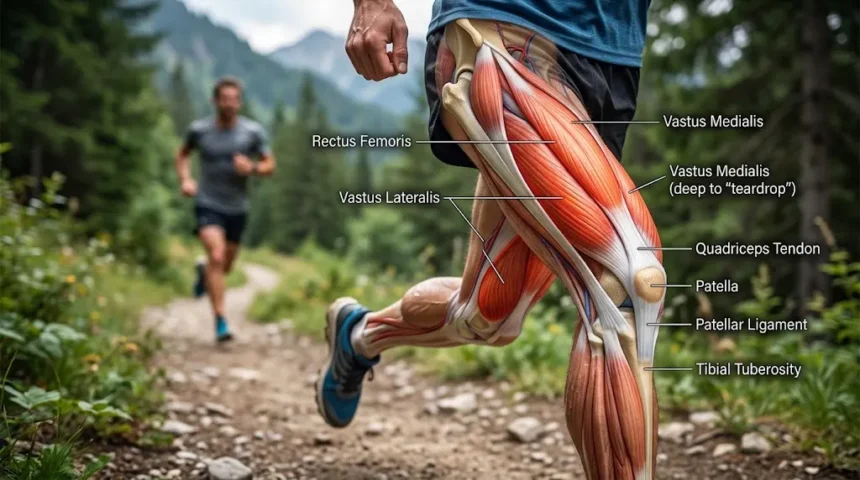
The quadriceps muscle is one of the largest and most powerful muscle groups in the human body. Located at the front of the thigh, it plays an essential role in walking, running, jumping, climbing stairs, and maintaining knee stability. Understanding its anatomy and function can help you appreciate how your legs support everyday movement.
Although commonly called a single muscle, the quadriceps consists of four major muscles that work together to straighten the knee. These muscles are important for lower-body strength, balance, and mobility. Learning how they function, what causes injuries, and how to maintain their strength can support healthy movement and physical activity.
What Is the Quadriceps Muscle?
The quadriceps muscle, also called the quadriceps femoris, is a large muscle group located on the anterior surface of the thigh. The word quadriceps means four-headed, referring to its four primary muscular components. These muscles work together to extend the knee joint and support movements that require lower-body strength and coordination.
The quadriceps connects the pelvis and femur to the lower leg through a shared tendon system. Three of its muscles originate from the femur, while the rectus femoris begins at the pelvis. This arrangement allows the muscle group to influence knee movement, with one component also contributing to hip flexion.
Because the quadriceps supports many activities, it is essential for daily mobility and athletic performance. Every time you rise from a chair, climb stairs, or straighten your leg, these muscles contribute to the movement. Their strength and coordination also help control the knee during weight-bearing activities.
Quadriceps Muscle Anatomy Explained
The quadriceps femoris consists of four main muscles: rectus femoris, vastus lateralis, vastus medialis, and vastus intermedius. Each muscle occupies a different region of the anterior thigh. Although their origins vary, they share a common attachment system that allows them to work together during knee extension.
The quadriceps muscles converge into the quadriceps tendon, which attaches to the patella, commonly known as the kneecap. The patellar ligament then connects the patella to the tibial tuberosity of the shinbone. This arrangement creates an effective mechanism for transferring muscular force across the knee joint.
The patella also improves the mechanical advantage of the quadriceps by increasing its leverage during knee extension. Surrounding connective tissues contribute to joint support and force distribution. Together, these anatomical structures allow the quadriceps to generate powerful movements while helping control the position of the knee.
Rectus Femoris: Location and Function
The rectus femoris runs along the front of the thigh and forms a prominent part of the quadriceps muscle group. Unlike the three vastus muscles, it crosses both the hip and knee joints. It originates from the pelvis near the anterior inferior iliac spine and contributes to the shared quadriceps tendon.
The rectus femoris has two primary functions: extending the knee and assisting hip flexion. This means it helps straighten the leg while also contributing to movements that bring the thigh toward the abdomen. Its two-joint arrangement makes it particularly relevant during activities involving coordinated hip and knee movement.
Running, kicking, and certain jumping movements require substantial involvement from the rectus femoris. However, its contribution changes depending on the position of the hip and knee. Because it crosses two joints, excessive loading during rapid movements can sometimes contribute to muscle strains, particularly in sports requiring repeated sprinting or kicking.
Vastus Lateralis: Anatomy and Role
The vastus lateralis is the largest of the four traditional quadriceps muscles and occupies the outer portion of the thigh. It originates from several areas of the femur, including the greater trochanter and lateral lip of the linea aspera. Its fibers travel downward to contribute to the quadriceps tendon and surrounding knee structures.
The primary function of the vastus lateralis is knee extension. It works with the other quadriceps muscles to straighten the leg during activities such as standing, walking, and climbing stairs. Its substantial muscle mass allows it to contribute significantly to the force generated during demanding lower-body movements.
The vastus lateralis also contributes to the overall control of forces acting around the kneecap. However, patellar movement depends on several muscles and anatomical factors rather than a single component. Balanced quadriceps strength and appropriate movement mechanics can help support comfortable and efficient knee function.
Vastus Medialis: Anatomy and Function
The vastus medialis is located along the inner portion of the anterior thigh. It originates primarily from the femur and contributes to the common quadriceps tendon. Its lower fibers have a distinctive oblique orientation, commonly associated with the region called the vastus medialis obliquus, or VMO.
Like the other vastus muscles, its main responsibility is extending the knee joint. It also contributes to controlling forces around the patella during movement. The orientation of its lower fibers influences the forces applied to the kneecap, although normal patellar tracking depends on the entire knee mechanism.
The vastus medialis is frequently discussed in relation to anterior knee pain and rehabilitation exercises. However, it is difficult to completely isolate this muscle from the rest of the quadriceps. Comprehensive strengthening programs generally focus on improving overall quadriceps function rather than attempting to train only one small muscular region.
Vastus Intermedius: The Deep Quadriceps Muscle
The vastus intermedius lies deep beneath the rectus femoris, making it less visible than the other quadriceps muscles. It originates from the anterior and lateral surfaces of the femoral shaft. Its fibers extend downward and join the shared quadriceps tendon that attaches to the kneecap.
The primary function of the vastus intermedius is knee extension. It contributes to straightening the leg during walking, running, standing, and other activities requiring coordinated lower-body movement. Although hidden beneath the rectus femoris, it provides an important contribution to the quadriceps group’s overall force production.
Because the vastus intermedius works alongside the other quadriceps muscles, it is activated during many common strengthening exercises. Squats, leg extensions, and controlled sit-to-stand movements all involve this muscle. Maintaining overall quadriceps strength supports its function without requiring exercises designed exclusively for this deeper muscular component.
What Is the Main Function of the Quadriceps Muscle?
The primary quadriceps muscle function is knee extension, which means straightening the leg at the knee joint. This movement is essential for standing upright, walking, climbing stairs, and pushing against the ground. All four traditional quadriceps muscles contribute to this action by transferring force through the quadriceps tendon and patellar ligament.
The quadriceps also helps control knee bending during weight-bearing movements. For example, when lowering yourself into a chair, the muscles work eccentrically to manage the descent. This controlled lengthening helps prevent the knee from bending too quickly and supports smooth movement under the body’s weight.
Another important function is assisting knee stability during dynamic activity. The quadriceps works with the hamstrings, calf muscles, ligaments, and surrounding tissues to manage forces at the joint. Its contribution changes throughout different activities, but adequate strength remains important for efficient movement and lower-limb control.
How the Quadriceps Supports Knee Stability
The quadriceps supports knee stability by helping control the position and movement of the joint. During standing and walking, these muscles generate forces that influence how the femur, patella, and tibia interact. Their coordinated activity contributes to controlled knee extension and helps manage the demands of weight-bearing movement.
The quadriceps also contributes to patellar mechanics through its tendon attachments. As the muscles contract, they transmit force through the kneecap and the patellar ligament. Proper knee function depends on this interaction, along with joint anatomy, surrounding connective tissues, and coordinated muscular activity.
Knee stability is not controlled by the quadriceps alone. Ligaments, menisci, joint surfaces, and other muscles also play essential roles. Strengthening the quadriceps can support overall knee function, but rehabilitation programs should address the broader lower-limb system rather than focusing exclusively on one muscle group.
Role of the Quadriceps in Walking and Running
During walking, the quadriceps helps control the knee as the foot contacts the ground and the body begins supporting weight. Its activity is particularly important during early stance, when the knee bends slightly to absorb loading. The quadriceps helps regulate this movement and contributes to stable forward progression.
Running increases the forces acting on the lower limbs, placing greater demands on the quadriceps. These muscles help control knee movement during landing and contribute to coordinated leg motion throughout the running cycle. Their activity varies with running speed, terrain, technique, and the specific phase of movement.
The quadriceps also works with the glutes, hamstrings, and calf muscles during propulsion and landing. Efficient running depends on how these muscle groups coordinate rather than on quadriceps strength alone. Gradual conditioning and balanced strength training can help prepare the legs for increased running demands.
Importance of the Quadriceps for Everyday Activities
The quadriceps is essential for many movements that people perform without thinking about them. Rising from a chair, climbing stairs, and getting out of a vehicle all require knee extension strength. The quadriceps helps generate the force needed to move the body upward and maintain control throughout these actions.
Descending stairs can place considerable demands on the quadriceps because the muscles must control knee bending while supporting body weight. This eccentric muscle activity helps regulate movement and prevents the body from dropping too quickly. Weakness may make these activities more difficult or lead to greater reliance on supporting surfaces.
Quadriceps strength is also important for functional independence as people age. Reduced muscle strength can affect mobility, balance, and confidence during daily activities. Regular physical activity and appropriate resistance training can help preserve muscle capacity and support comfortable movement throughout different stages of life.
Quadriceps vs Hamstrings: Key Differences
The quadriceps and hamstrings are major muscle groups located on opposite sides of the thigh. The quadriceps occupies the front of the thigh and primarily extends the knee. The hamstrings lie along the back of the thigh and generally contribute to knee flexion and hip extension.
These muscle groups often work together to coordinate lower-limb movement. During walking, running, and jumping, they help control knee and hip positions through different phases of activity. Their combined contributions support efficient movement, although the specific roles of individual muscles depend on joint position and physical demands.
Balanced lower-body training should address both the quadriceps and hamstrings. Focusing exclusively on one muscle group may leave other important movement capacities underdeveloped. Exercises such as squats, leg curls, bridges, and appropriate hip-hinge movements can help strengthen the surrounding muscular system.
Common Quadriceps Muscle Injuries
Quadriceps strains occur when muscle fibers experience excessive force or are stretched beyond their capacity. These injuries often develop during sprinting, kicking, jumping, or sudden acceleration. Symptoms may include pain in the front of the thigh, tenderness, swelling, and difficulty performing movements that require strong muscle contraction.
Quadriceps contusions are another common injury, especially in contact sports. They occur when a direct impact damages muscle tissue and produces pain, swelling, or bruising. The severity can vary, and more significant injuries may temporarily limit knee movement or make walking uncomfortable.
Other problems affecting the quadriceps mechanism include quadriceps tendinopathy and tendon tears. These conditions involve the tendon connecting the muscle group to the patella rather than the muscle fibers themselves. Persistent pain, sudden weakness, or an inability to actively straighten the knee requires medical assessment to identify the underlying problem.
Signs of Weak Quadriceps Muscles
Quadriceps weakness may make everyday activities such as standing from a chair or climbing stairs more challenging. Some people notice that their legs fatigue quickly or feel less stable during weight-bearing movements. Reduced knee extension strength may also affect walking mechanics and the ability to perform certain exercises.
Weakness can develop after prolonged inactivity, injury, surgery, or conditions affecting nerves and muscles. Pain and swelling around the knee may also temporarily reduce quadriceps activation. This means a muscle can appear weak even when the underlying problem involves the joint or surrounding tissues.
Persistent weakness deserves attention, particularly when it affects mobility or follows an injury. A healthcare professional can assess knee extension strength, joint movement, and neurological function. Identifying the cause helps determine whether targeted strengthening, rehabilitation, or additional medical treatment is necessary.
Best Exercises to Strengthen the Quadriceps
Squats are commonly used to strengthen the quadriceps and other lower-body muscles. Begin with a comfortable stance and slowly bend your hips and knees as though sitting into a chair. Keep the movement controlled and use a depth that feels manageable while maintaining balance and comfortable joint alignment.
Step-ups are another practical strengthening exercise because they resemble everyday movements such as climbing stairs. Using a stable, low platform, step upward in a controlled manner and lower yourself carefully. This movement challenges the quadriceps while also involving the glutes and other muscles responsible for lower-body stability.
Seated knee extensions and sit-to-stand exercises can also improve quadriceps strength. These movements may be especially useful when more demanding exercises are not appropriate. Start with manageable resistance and gradually increase the challenge as strength improves, avoiding movements that cause sharp pain or worsening joint discomfort.
How to Stretch the Quadriceps Safely
A standing quadriceps stretch is a familiar exercise for the front of the thigh. Stand near a stable support, bend one knee, and gently bring the heel toward the buttock. Keep the thighs relatively aligned and avoid arching the lower back while maintaining a comfortable stretch.
A side-lying quadriceps stretch provides another option for people who find balancing on one leg difficult. Lie comfortably on your side and gently bend the upper knee, bringing the foot backward within a manageable range. Avoid pulling forcefully or placing unnecessary pressure on the knee joint.
Stretching may help improve flexibility and tolerance to certain movements, but it is not necessary to force a greater range. Gentle, consistent practice is generally preferable to aggressive stretching. People with recent quadriceps injuries, knee surgery, or significant pain should seek professional guidance before beginning a stretching routine.
Quadriceps Tendon and Patellar Ligament Explained
The quadriceps tendon is a strong connective tissue structure that attaches the quadriceps muscles to the patella. It transfers muscular force to the kneecap during knee extension. Without this connection, the quadriceps could not effectively straighten the knee or support many essential lower-body movements.
The patellar ligament, often called the patellar tendon in clinical practice, connects the patella to the tibial tuberosity. Together, these structures form the knee’s extensor mechanism. Their arrangement allows force generated by the quadriceps to reach the lower leg and produce controlled movement.
Problems affecting either structure can interfere with knee function. Overuse-related tendon pain may develop gradually, while significant tendon tears can cause sudden weakness and difficulty extending the knee. Understanding these attachments helps explain why quadriceps health depends on both muscular strength and the condition of surrounding connective tissues.
How to Prevent Quadriceps Injuries
Preventing quadriceps injuries involves preparing the muscles for physical demands and avoiding sudden increases in training intensity. Rapid changes in sprinting volume, jumping activity, or resistance loads may exceed the muscles’ current capacity. Gradually increasing exercise demands allows the tissues to adapt more effectively.
A suitable warm-up can help prepare the lower body for demanding activity. Start with gentle movements and progress toward exercises resembling the planned workout or sport. Strength training, mobility exercises, and appropriate recovery can support muscle function, although no single routine guarantees complete injury prevention.
Recognizing early signs of excessive loading is another important part of injury management. Persistent thigh soreness, reduced performance, or recurring discomfort may suggest that activity demands need adjustment. Allowing appropriate recovery and seeking advice when symptoms continue can help support a safer return to regular movement.
Quadriceps Muscle Function in Sports Performance
The quadriceps plays an important role in sports that involve jumping, running, and rapid changes in direction. Activities such as football, basketball, cycling, and athletics require coordinated knee extension and controlled lower-body movement. The quadriceps contributes to force production while helping manage the loads generated during these activities.
During landing, the quadriceps works eccentrically to control knee bending and absorb part of the mechanical demand. It also contributes during takeoff and acceleration alongside the hip and ankle muscles. Athletic performance therefore depends on coordinated movement rather than the strength of one muscle group alone.
Athletes often strengthen the quadriceps through squats, lunges, step-ups, and progressive resistance training. Exercise selection should match the demands of the sport and the individual’s current abilities. Appropriate programming can improve strength and movement capacity while allowing the muscles and tendons sufficient time to recover.
When to Seek Medical Help for Quadriceps Pain
Mild quadriceps soreness after unfamiliar exercise often improves with appropriate rest and a gradual return to activity. However, persistent pain, significant swelling, or repeated discomfort should not be ignored. A healthcare professional can evaluate whether symptoms originate from the muscles, tendons, knee joint, or another structure.
Sudden thigh pain accompanied by weakness or difficulty walking may indicate a muscle injury. Significant injuries can sometimes involve the quadriceps tendon or surrounding tissues. An inability to actively straighten the knee, a visible change in knee shape, or substantial loss of function requires prompt medical evaluation.
Other warning signs include rapidly increasing swelling, severe pain, or symptoms that interfere with normal daily movement. Medical assessment can help identify the cause and determine whether imaging, rehabilitation, or additional treatment is appropriate. Early recognition of significant injuries may reduce the risk of complications and support recovery.
Conclusion
The quadriceps muscle is a powerful group of four primary muscles located at the front of the thigh. These include the rectus femoris, vastus lateralis, vastus medialis, and vastus intermedius. Together, they produce knee extension and support essential movements such as walking, standing, climbing stairs, and running.
Understanding quadriceps anatomy and function helps explain the muscle group’s importance for knee stability and lower-body strength. Its relationship with the patella, tendons, and surrounding muscles allows coordinated movement during everyday activities and athletic performance. Healthy quadriceps function contributes to mobility, balance, and physical independence.
Maintaining quadriceps strength involves regular activity, appropriate resistance training, and attention to muscle recovery. Exercises such as squats, step-ups, and knee extensions can support strength when performed with suitable technique. Persistent pain or weakness should receive professional evaluation to identify the cause and guide appropriate treatment.
Frequently Asked Questions
What is the main function of the quadriceps muscle?
The main function of the quadriceps muscle is knee extension, which means straightening the leg. It also helps control knee bending, supports joint stability, and contributes to walking, running, and stair climbing.
What are the four muscles of the quadriceps?
The four traditional quadriceps muscles are the rectus femoris, vastus lateralis, vastus medialis, and vastus intermedius. They work together through a shared tendon system to extend the knee.
What causes quadriceps muscle pain?
Quadriceps pain may result from muscle strains, contusions, excessive exercise loading, or tendon problems. Persistent pain, significant swelling, or sudden weakness should be evaluated by a healthcare professional to identify the underlying cause.
How can I strengthen my quadriceps at home?
You can strengthen your quadriceps through controlled squats, sit-to-stand exercises, step-ups, and suitable knee extensions. Start with manageable movements and gradually increase the difficulty as your strength and comfort improve.
Why are strong quadriceps important for knee health?
Strong quadriceps help control knee movement, support weight-bearing activities, and contribute to joint stability. They also make everyday tasks such as standing from a chair, walking, and climbing stairs easier.