

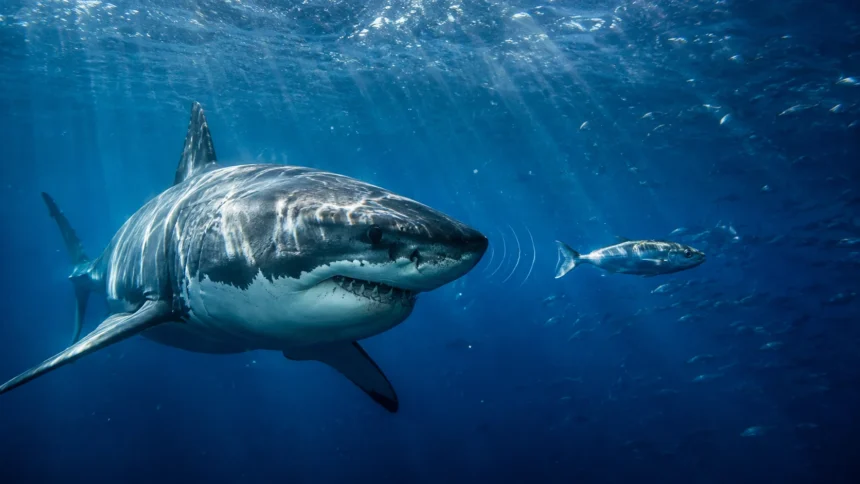
How Do Sharks Detect Their Prey? A Simple Look at Their Senses
Sharks are highly adapted marine predators, but they do not rely on a single extraordinary sense to find food. Instead, they combine smell, hearing, vision, water-pressure detection, touch, and the ability to sense weak electrical fields. Together, these systems allow sharks to locate potential prey even when visibility is poor.
Different senses become useful at different distances. A shark may first notice low-frequency sounds or unusual movements from far away, then use smell and vision as it approaches. At very close range, specialized organs called the ampullae of Lorenzini can detect the tiny electrical signals produced by living animals.
This multisensory hunting system is one reason sharks are effective predators in oceans ranging from shallow reefs to deep, dark waters. Their sensory abilities have evolved over millions of years to work under conditions where light, sound, currents, and visibility can change dramatically.
Understanding how sharks detect their prey also helps clear up several myths. Sharks are not simply following drops of blood from enormous distances. Their hunting behavior is much more sophisticated, relying on multiple environmental clues that are continuously compared and interpreted by the nervous system.
How Do Sharks Find Their Prey?
Sharks find prey by combining information from several sensory systems rather than depending on one signal. They can detect chemicals dissolved in seawater, hear certain underwater sounds, see movement and contrast, sense water displacement, and detect extremely weak electrical fields around nearby animals.
Which sense matters most depends on the situation. In open water, sound and smell may help a shark investigate activity from farther away. Closer to its target, vision and the lateral line provide more detailed information about location, movement, and direction.
At very short distances, electroreception becomes particularly useful. Living animals naturally generate weak electrical fields through muscle contractions, nerve activity, and other biological processes. Sharks can detect these signals using sensory pores concentrated around the head and snout.
The result is a layered hunting system. If visibility is poor, other senses can compensate. If an animal is hidden beneath sand or remains nearly motionless, electrical signals may still reveal its location. Sharks therefore hunt by integrating several clues instead of relying on one perfect sense.
1. Sharks Use Smell to Detect Chemical Clues
A shark’s sense of smell, or olfaction, helps it detect chemicals dissolved in seawater. Water enters the shark’s nostrils, called nares, and passes across sensory tissues containing receptors that respond to different chemical molecules.
The nostrils are used for smelling rather than breathing. Unlike humans, most sharks do not draw air or water through their noses into their respiratory system. Instead, seawater moves across the olfactory organs, allowing chemical information from the environment to be analyzed.
Odors released by injured or living animals can provide clues that food may be nearby. However, the popular claim that sharks can detect a single drop of blood from miles away greatly exaggerates their abilities. Detection depends on concentration, currents, distance, species, and environmental conditions.
Smell is therefore best understood as one part of shark prey detection. A chemical trail may encourage a shark to investigate an area, but the animal normally combines that information with movement, sound, vision, and other sensory signals before locating the exact source.
2. Sharks Can Detect Underwater Sounds
Sound travels efficiently through water, making hearing useful for animals searching across relatively large distances. Sharks possess inner-ear structures capable of detecting underwater vibrations and sounds, particularly some low-frequency signals associated with movement and struggling animals.
An injured or rapidly moving fish can create irregular sounds and vibrations in the surrounding water. These disturbances may attract the attention of a shark and encourage it to swim toward the source to investigate whether potential prey is present.
Sharks do not have visible external ears like mammals. Their hearing organs are located inside the head and are connected with structures involved in balance and orientation. This system helps sharks detect acoustic information while navigating through a three-dimensional underwater environment.
Sound may provide an early clue during a hunt, especially when the source is too far away to see clearly. As the shark moves closer, other senses become increasingly important for determining exactly what produced the sound and whether it is suitable prey.
3. Sharks Sense Water Movement With the Lateral Line
The lateral line system allows sharks to detect movement, pressure changes, and vibrations in the surrounding water. It consists of sensory canals running along portions of the body and head, containing specialized receptor cells that respond when water movement bends tiny structures inside them.
A swimming fish pushes water around its body and produces pressure waves. Even if the animal is difficult to see, these movements can create detectable disturbances. Sharks use their lateral line to gather information about nearby motion and the direction from which that motion is coming.
This ability becomes especially useful in dark, cloudy, or turbulent water. Vision may become less reliable under those conditions, but water movement remains available as a sensory signal. A suddenly accelerating or struggling animal can produce particularly noticeable disturbances.
The lateral line also contributes to navigation and awareness of the shark’s immediate surroundings. It can help detect objects, currents, nearby animals, and changes in water flow, making it useful for both hunting and moving safely through complex marine environments.
4. Sharks Use Vision More Than Many People Think
The idea that sharks have poor eyesight is misleading. Many shark species possess well-developed eyes adapted to the particular environments in which they live. Vision can help sharks detect movement, shapes, contrast, and potential prey as they approach hunting areas.
Some sharks are especially adapted for low-light conditions. Their eyes may contain structures that help maximize available light, making it easier to see at dawn, dusk, in deeper water, or in otherwise dim environments where many hunting opportunities occur.
Visual abilities vary among species because sharks inhabit very different ecosystems. A shark living in bright, shallow tropical water encounters different visual conditions from one living hundreds of meters below the ocean surface. Eye structure and sensitivity therefore differ accordingly.
During the final stages of an approach, vision can help a shark judge the direction, speed, size, and movement of another animal. It is usually used together with other senses rather than functioning as the shark’s only method of identifying prey.
5. Sharks Detect Electricity With the Ampullae of Lorenzini
Perhaps the most unusual shark sense is electroreception. Sharks can detect extremely weak electrical fields through specialized sensory organs called the ampullae of Lorenzini, which appear externally as small pores concentrated around the snout and head.
Every living animal generates tiny electrical signals because nerves and muscles depend on electrical activity. The heartbeat and muscle contractions of a fish, for example, can create weak bioelectric fields that spread into the surrounding seawater.
When a shark gets very close to prey, the ampullae of Lorenzini can detect these electrical signals. This ability is particularly valuable when an animal is hidden beneath sand, buried in sediment, or otherwise difficult to locate through vision alone.
Electroreception acts almost like a short-range biological detector. It gives sharks information that humans cannot directly perceive and helps explain how some species can accurately locate hidden animals even when visual or chemical clues are limited.
How Do the Ampullae of Lorenzini Work?
The ampullae of Lorenzini consist of small pores connected to jelly-filled canals beneath the shark’s skin. At the end of these canals are specialized receptor cells that respond to extremely small differences in electrical potential in the surrounding water.
The jelly inside the canals conducts electrical signals toward the sensory cells. When nearby electrical fields change, the receptors send information through nerves to the shark’s brain, where the signals can be interpreted alongside information from other senses.
These sensory organs are concentrated around the head because that location helps sharks investigate objects directly in front of them. During the final stage of an attack, the snout may pass very close to prey, making electrical information especially useful for precise localization.
Scientists also believe electroreception may contribute to navigation in some sharks because movement through Earth’s magnetic field can produce detectable electrical effects. However, its role in locating nearby animals remains one of the best-known functions of this remarkable sensory system.
Can Sharks Detect a Heartbeat?
Sharks can detect weak electrical signals produced by living organisms, including activity associated with muscles and the heart, when they are sufficiently close. Their electroreceptors are sensitive to biological electrical fields that would be completely imperceptible to humans.
This does not mean a shark can hear or sense a human heartbeat from miles away. Electroreception is primarily useful over relatively short distances because electrical fields become weaker as the shark moves farther from their source.
The ability becomes particularly valuable when prey is hidden. A fish buried beneath the seafloor might avoid visual detection and create little obvious movement, yet its biological processes continue producing electrical signals that a nearby shark can potentially detect.
This is why bottom-feeding sharks and rays can locate concealed animals with impressive precision. Instead of relying entirely on sight, they can investigate the electrical information coming from beneath sand or sediment before striking.
How Do Sharks Detect Prey in Dark Water?
Darkness removes some of the visual information available during hunting, but sharks have several other ways to compensate. Hearing, smell, the lateral line, and electroreception remain functional even when sunlight is weak or completely absent.
A shark may first detect low-frequency sounds created by movement. As it approaches, water disturbances provide additional information through the lateral line, while dissolved chemical cues can help confirm that an animal or potential food source is nearby.
Some sharks also possess visual adaptations suited to low-light environments. Their eyes can be highly sensitive to contrast and limited illumination, helping them detect silhouettes or movement even when humans would struggle to see clearly underwater.
At very close range, electroreception gives sharks another layer of information independent of visible light. This combination allows sharks to hunt effectively at night, in murky coastal water, and in deeper ocean habitats where darkness is common.
How Do Sharks Detect Prey Hidden Under Sand?
Animals such as rays, crustaceans, and bottom-dwelling fish sometimes hide beneath sediment to avoid predators. Camouflage can make them difficult to see, but their bodies continue producing movement, chemical traces, and weak electrical fields.
A shark swimming close to the seafloor can investigate these signals using several senses. The lateral line may detect small movements in the surrounding water, while smell can provide chemical clues that an animal is nearby.
Electroreception becomes particularly important during close investigation. The ampullae of Lorenzini can detect bioelectric activity coming from an animal even when the prey itself is covered by sand and cannot be seen directly.
Once the shark pinpoints the source, it may use its snout, mouth, or body movements to expose the hidden animal. This ability demonstrates how different sensory adaptations allow sharks to locate prey in situations where eyesight alone would be ineffective.
Can Sharks Really Smell Blood From Miles Away?
The popular belief that sharks can smell a single drop of blood from miles away is an exaggeration. Sharks do have highly developed olfactory systems, but real-world detection depends on how much chemical material is present and how ocean water carries it.
Currents play an especially important role. Odor molecules do not spread evenly in every direction. Instead, water movement creates chemical plumes that can become diluted, broken apart, or transported away from the shark depending on local conditions.
A shark that detects an interesting odor may follow changes in chemical concentration while using other environmental information to investigate its source. Smell provides direction and motivation, but it does not function like a perfectly accurate long-distance GPS system.
Blood can certainly provide a chemical cue, particularly when associated with potential prey, but sharks respond to many different odors. Their behavior depends on species, hunger, experience, environmental conditions, and the combination of sensory information available at the time.
Do Sharks Detect Fear in Humans?
There is no good reason to believe sharks possess a special biological sense that allows them to directly detect the emotion of fear in humans. Fear itself does not produce a unique signal that sharks can identify as an emotional state.
However, a frightened person may change their behavior. Rapid kicking, splashing, irregular swimming, or sudden movements can create underwater vibrations and visual signals that a shark can detect through hearing, vision, and the lateral line.
This distinction is important because detecting movement is not the same as detecting fear. Sharks respond to physical information available in their environment rather than reading human emotions or intentions in the way popular stories sometimes suggest.
Remaining calm around wildlife is still sensible because controlled movement can reduce unnecessary disturbance. However, the scientific explanation involves the shark’s response to sensory cues such as motion and water displacement rather than a mysterious ability to sense fear.
Which Shark Sense Is the Strongest?
There is no single shark sense that is always the strongest because usefulness changes with distance, environment, species, and prey type. A sensory ability that is valuable in open water may be less useful when hunting close to the seafloor.
Sound and some vibrations can provide information from farther away, helping sharks notice activity before they can identify exactly what is happening. Smell can then provide chemical information carried through the surrounding water.
At closer range, vision and the lateral line become increasingly useful for tracking location and movement. These systems allow a shark to judge how another animal is swimming and how its position changes during an approach.
Finally, electroreception can help during extremely close encounters. Rather than ranking the senses from strongest to weakest, it is more accurate to think of sharks as using a sequence of complementary systems that together create a highly effective hunting strategy.
How Sharks Combine Their Senses During a Hunt
A shark hunt can begin with a distant disturbance. A fish behaving irregularly might produce sounds and water vibrations that attract a shark’s attention. The shark may then change direction and investigate the area where the disturbance originated.
As the shark moves closer, chemical cues may become more useful. Odors carried by currents can help indicate whether food or an animal is nearby, although the shark must continuously move and sample its environment to interpret the chemical trail.
Once potential prey comes within visual and lateral-line range, the shark can gather more precise information about its position, direction, and movement. These signals allow the predator to adjust its speed and approach as conditions change.
During the final moments, electroreception can provide close-range confirmation of a living target. This layered process shows why shark hunting is better understood as sensory integration rather than as dependence on smell, vision, or any other single ability.
Do All Sharks Hunt the Same Way?
Sharks include hundreds of species occupying environments ranging from coral reefs and coastal shallows to the open ocean and deep sea. Because their habitats and diets vary widely, they do not all use their senses in exactly the same way.
A great white shark searching for seals near the ocean surface faces different hunting challenges from a nurse shark searching for crustaceans near the seafloor. Their body shapes, hunting strategies, movement patterns, and reliance on particular sensory cues therefore differ.
Hammerhead sharks provide an especially interesting example because their widely separated sensory structures may help them scan broad areas close to the seafloor. Their unusual head shape supports a distinctive combination of vision, smell, maneuverability, and electroreception.
Some species are active pursuit predators, while others search slowly for hidden animals or feed opportunistically. Shark sensory systems share important features, but evolution has modified those systems according to the ecological demands faced by different species.
How Great White Sharks Detect Prey
Great white sharks use multiple senses when hunting fish, seals, sea lions, and other prey. Vision is especially important during close approaches near the surface, where the contrast between an animal and the brighter water above can provide a clear visual target.
They can also detect movement and underwater vibrations before reaching visual striking distance. Irregular activity at the surface may attract investigation, while smell provides additional chemical information about animals or food in the surrounding water.
As a great white closes the distance, its lateral line provides information about nearby water movement. This allows the shark to track changes in the direction and motion of prey as both animals move rapidly through the water.
At very close range, the ampullae of Lorenzini can provide electrical information. The shark therefore does not rely exclusively on dramatic visual attacks; multiple sensory systems contribute to finding, approaching, identifying, and ultimately capturing prey.
How Hammerhead Sharks Find Hidden Prey
Hammerhead sharks are famous for their unusual flattened heads, known as cephalofoils. This shape spreads sensory structures across a wider area and may provide several advantages when sharks search for animals near the ocean floor.
The ampullae of Lorenzini are distributed across the underside of the head, allowing hammerheads to scan for weak electrical fields produced by animals hidden beneath sediment. Rays and other bottom-dwelling prey can therefore be located even when visually concealed.
The broad head also changes the position of the eyes and nostrils, influencing how sensory information is collected. Depending on the hammerhead species, this arrangement can contribute to visual coverage, odor sampling, maneuverability, and prey detection.
Hammerheads are an excellent example of how evolution can shape sensory anatomy around a particular lifestyle. Their distinctive appearance is not simply unusual decoration; it is connected with how these sharks explore and interact with their marine environment.
Can Sharks Detect Magnetic Fields?
Evidence indicates that sharks can respond to magnetic fields, and their electroreceptive system may contribute to this ability. Earth’s magnetic field provides a relatively stable environmental signal that could help sharks orient themselves while traveling through the ocean.
Sharks are capable of long-distance movements, sometimes returning to seasonal feeding, breeding, or nursery areas. Navigation across large stretches of seemingly featureless ocean requires information beyond what can be obtained from nearby visual landmarks.
Magnetic sensing may work alongside other navigational information such as water temperature, currents, smell, sunlight, and learned environmental cues. Researchers continue investigating exactly how sharks combine these signals during long-distance movements.
Magnetic-field detection is not primarily a method for detecting individual prey animals, but it highlights the extraordinary sensitivity of the shark sensory system. The same general electroreceptive abilities useful at close range may also contribute to broader orientation and navigation.
Why Shark Senses Are So Effective
Water presents unique challenges for predators. Visibility can disappear quickly, odors move unpredictably with currents, and prey can escape vertically as well as horizontally. Depending on only one sense would make hunting unreliable under constantly changing ocean conditions.
Sharks solve this problem through sensory redundancy. If one source of information becomes weak, another can remain useful. Darkness reduces vision but not electroreception, while a hidden animal may still produce chemicals, vibrations, or electrical signals.
Each sensory system also works best at a different scale. Sound can draw attention toward distant activity, smell can help investigate chemical trails, the lateral line detects nearby water movement, vision identifies shapes, and electroreception provides precise information at close range.
This combination has helped sharks successfully occupy marine ecosystems for hundreds of millions of years. Their sensory abilities are not supernatural, but they are remarkably well adapted to extracting information from an environment humans often experience as dark, noisy, and difficult to navigate.
Common Myths About How Sharks Find Prey
One common myth is that sharks can smell one tiny drop of blood from miles away. Sharks have sensitive olfactory systems, but scent detection is limited by concentration, currents, dilution, species differences, and other environmental conditions.
Another myth suggests sharks depend almost entirely on smell. In reality, they use hearing, vision, the lateral line, electroreception, touch, and chemical sensing together. Removing one source of information does not necessarily leave a shark unable to locate prey.
It is also incorrect to assume every unusual movement automatically causes a shark to attack. Sharks investigate environmental signals for many reasons, and responses differ among species and situations. Detection of movement simply provides information that may deserve investigation.
Finally, sharks are not mindless hunting machines. They are animals interpreting changing sensory information and making behavioral decisions. Understanding their real biology provides a more accurate and fascinating picture than myths portraying them as creatures driven entirely by blood or instinctive aggression.
Why Understanding Shark Senses Matters
Learning how sharks detect prey helps scientists understand predator-prey relationships in marine ecosystems. Sensory biology influences where sharks hunt, what they eat, how they respond to environmental changes, and how they interact with other species.
This knowledge can also contribute to conservation. Human activities can introduce underwater noise, chemical changes, electromagnetic fields, habitat disruption, and fishing equipment into shark environments. Understanding sensory behavior helps researchers examine how these factors may influence different species.
Better knowledge can also improve public understanding of shark behavior. Exaggerated stories about blood detection or human targeting can create unnecessary fear. Scientific explanations show that sharks respond to complex environmental cues rather than automatically treating people as preferred prey.
Sharks are important predators in many marine ecosystems, and their remarkable senses are central to their survival. Studying these systems gives researchers insight not only into sharks themselves but also into how animals evolve to gather information from challenging environments.
Final Thoughts: How Do Sharks Detect Their Prey?
Sharks detect prey using a sophisticated combination of senses. They can smell chemicals dissolved in seawater, hear underwater sounds, see movement and contrast, sense pressure changes through the lateral line, and detect weak electrical fields through the ampullae of Lorenzini.
These senses generally become useful at different stages of a hunt. Distant sounds or chemical clues may trigger investigation, while vision and water movement provide more precise information as the shark moves closer to its target.
At close range, electroreception gives sharks an extraordinary advantage. Biological electrical signals can reveal prey that is difficult to see, including animals partially or completely hidden beneath sand. This ability adds another layer of information to an already sophisticated sensory system.
So, how do sharks detect their prey? They do it by combining multiple clues rather than relying on one superpower. Their integrated senses make them highly capable hunters and provide a remarkable example of how evolution equips animals to survive in demanding environments.
Frequently Asked Questions
How do sharks detect prey from far away?
Sharks can detect underwater sounds, vibrations, and chemical clues that may indicate animal activity. They then move closer and use additional senses to determine the source.
Can sharks really smell blood?
Yes, sharks can detect chemicals associated with blood, but claims that they can detect a single drop from miles away are exaggerated. Detection depends strongly on concentration and water currents.
What are the ampullae of Lorenzini?
The ampullae of Lorenzini are specialized electroreceptors around a shark’s head and snout. They detect weak electrical fields produced naturally by living animals.
Can sharks find prey in complete darkness?
Yes. Sharks can use hearing, smell, the lateral line, and electroreception when vision is limited, allowing some species to hunt effectively in dark or murky water.
Do sharks sense fear?
Sharks are not known to directly detect the emotion of fear. They can, however, notice physical signals associated with movement, such as splashing, vibrations, and changes in swimming behavior.