

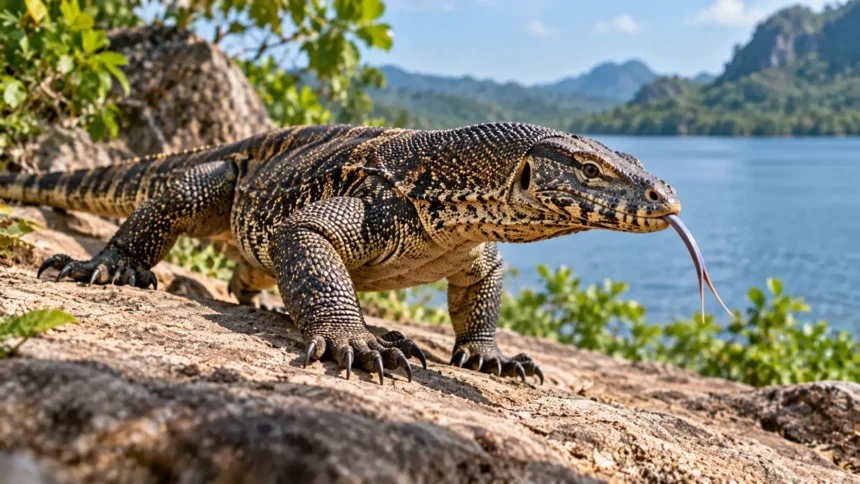
Monitor Lizard: Facts, Size, Diet & Are They Dangerous?
Monitor lizards are some of the most distinctive reptiles on Earth, ranging from small desert and tree-dwelling species to the enormous Komodo dragon. These active lizards belong to the genus Varanus and are recognized by their elongated bodies, muscular limbs, strong claws, long tails, and deeply forked tongues. They occur naturally across much of Africa, Asia, Australia, and numerous islands, where different species have adapted to forests, deserts, wetlands, grasslands, and rocky environments. Most monitor lizards are predators or opportunistic scavengers, although diet varies considerably among species. Their intelligence, sensory abilities, speed, and adaptability make them unusually capable hunters. Understanding monitor lizard facts reveals a group far more diverse than their intimidating appearance might suggest.
Monitor lizards vary dramatically in size, which is one reason general statements about them can be misleading. Some dwarf monitors are small enough to live among rocks, tree hollows, or narrow crevices, while the Komodo dragon can grow to around three meters in exceptional cases. Large water monitors and Nile monitors can also reach impressive lengths, although much of that measurement comes from their elongated tails. Body mass varies even more substantially between small and giant species. Their diet likewise changes with body size and habitat, ranging from insects and other invertebrates to fish, eggs, birds, mammals, reptiles, carrion, and occasionally plant material. These differences make each monitor species worth considering individually.
Whether monitor lizards are dangerous is another question that requires context. Most wild monitors prefer escaping from people rather than deliberately attacking them, but a cornered or handled animal can defend itself using powerful jaws, claws, and its muscular tail. Large species can cause serious injuries, and the Komodo dragon deserves particular caution because of its size, predatory abilities, and venomous bite. Smaller species pose far less physical danger but should still be treated as wild animals rather than handled unnecessarily. The safest approach is to observe monitor lizards from a respectful distance and allow them an escape route. Learning how these reptiles behave helps replace exaggerated fear with practical caution.
What Is a Monitor Lizard?
A monitor lizard is a member of the genus Varanus, the living genus associated with the family Varanidae. Around 90 species are currently recognized, although the precise number can change as scientists describe new species and revise relationships among previously known populations. Monitor lizards are part of the squamate group that also includes other lizards and snakes. They are especially well known for their elongated necks, powerful legs, long tails, and forked tongues. Despite sharing a recognizable body plan, monitor species have evolved into remarkably different ecological roles. Some spend much of their time on the ground, while others specialize in trees, rocky areas, burrows, wetlands, or semiaquatic environments.
One of the most recognizable monitor lizard features is the long, deeply forked tongue that repeatedly flicks in and out of the mouth. The behavior may remind people of snakes because both groups use tongue flicking to gather chemical information from their surroundings. Odor particles collected by the tongue are transferred to a specialized sensory structure in the roof of the mouth. This system helps monitor lizards locate prey, investigate unfamiliar objects, identify other animals, and navigate their environment. Their vision is also important, particularly because many species are active hunters during daylight hours. Combining visual and chemical information gives monitors an effective sensory system for finding opportunities that less active reptiles might miss.
Monitor lizards are generally considered unusually active compared with many other reptiles. Instead of simply remaining motionless and waiting indefinitely for food, numerous species move through their territories while investigating burrows, vegetation, water edges, trees, or other potential feeding locations. Their strong limbs allow them to walk considerable distances and accelerate quickly when hunting or escaping danger. Some species are capable climbers, while water-associated monitors are powerful swimmers. Their muscular tails can assist with swimming, balance, climbing, and defense depending on the species. This combination of movement and sensory exploration explains why monitors are frequently described as active foragers rather than passive predators.
Intelligence is another characteristic frequently associated with monitor lizards. Captive individuals can learn routines, investigate environmental enrichment, distinguish familiar situations, and display flexible problem-solving behavior. Scientists are careful about comparing intelligence directly across very different animal groups, but monitors clearly demonstrate complex behavior for reptiles. Their active lifestyles may favor strong learning abilities because they need to locate food, recognize threats, navigate changing habitats, and respond to competitors. Young animals also must quickly learn how to survive in environments containing larger predators, including adult monitors in some species. Behavioral flexibility contributes to the success of several monitor species in environments strongly influenced by human activity.
The common name “monitor lizard” covers animals that can be surprisingly different from one another, so recognizing the group is more useful than imagining one standard monitor. A small Australian dwarf monitor occupies a completely different ecological niche from a Southeast Asian water monitor or an Indonesian Komodo dragon. Tree monitors possess adaptations suited to climbing, while semiaquatic species have bodies and tails that function efficiently in water. Desert monitors must cope with extreme heat and scarce resources. These variations demonstrate how evolution can modify one general reptilian body plan for many environments. When discussing monitor lizard behavior, size, diet, or danger, the species and habitat therefore matter enormously.
How Big Do Monitor Lizards Get?
Monitor lizard size ranges from remarkably small species to the largest living lizards on the planet. Some dwarf monitors reach only a few dozen centimeters in total length and weigh very little compared with their giant relatives. At the opposite extreme, an adult Komodo dragon can approach three meters from snout to tail and may weigh many tens of kilograms. Most monitor species fall somewhere between these extremes, which means seeing the word “monitor” does not automatically indicate an enormous reptile. Total length can also make monitors appear heavier than they actually are because their tails often account for a substantial portion of their measurement. Body condition, sex, age, and habitat further influence individual size.
The Komodo dragon is widely recognized as the largest living lizard by overall body mass. Mature animals have massive heads, thick limbs, muscular necks, and heavy bodies designed for overpowering substantial prey. Their long tails add considerably to total length but are also functional tools for balance and movement. Exceptional individuals can become extremely large, although popular descriptions sometimes exaggerate the normal size of wild dragons. Most adults are smaller than record-setting specimens. Even so, encountering a mature Komodo dragon at close range is very different from encountering an ordinary garden lizard, and strict distance rules around wild animals are essential for human safety.
The Asian water monitor is another giant member of the group and ranks among the world’s longest living lizards. Large individuals can exceed two meters in total length, although the lengthy tail accounts for much of that measurement. These monitors have muscular bodies, strong limbs, and laterally compressed tails that help them move efficiently through water. Their size varies across geography, age groups, and local environmental conditions. Asian water monitors are particularly interesting because they can live surprisingly close to people in parts of South and Southeast Asia. In cities with suitable waterways and food sources, residents may occasionally see impressive adults moving through canals, parks, wetlands, or drainage areas.
Nile monitors are also large reptiles with strong swimming ability and elongated muscular bodies. Adults commonly become substantial enough that they should never be treated casually, particularly when cornered or handled. Their powerful tails, sharp claws, and jaws make them effective predators as well as capable defensive animals. Nile monitors are naturally associated with large parts of Africa, especially environments near water, but introduced populations have also become established in some regions outside their native range. Their size helps them exploit diverse prey, including animals protected by shells or nests. Nevertheless, they remain considerably lighter than the heaviest Komodo dragons, highlighting the enormous size variation within Varanus.
Smaller monitor species demonstrate that being a monitor is about ancestry and anatomy rather than simply becoming gigantic. Spiny-tailed monitors of Australia, for example, are relatively compact reptiles adapted to rocky and dry environments. Tree monitors from New Guinea and nearby islands have more slender bodies, elongated limbs, sharp claws, and tails useful for navigating vegetation. Dwarf species may spend much of their lives in spaces inaccessible to larger predators. Smaller body size also changes their diet because insects and other invertebrates become proportionally important food sources. The remarkable size range among monitors is one of the group’s defining biological features and allows related species to occupy very different ecological niches.
Where Do Monitor Lizards Live?
Monitor lizards have a broad natural distribution across the Old World, particularly Africa, southern and Southeast Asia, Australia, New Guinea, and numerous surrounding islands. They are absent as native animals from most of Europe and the Americas, although introduced populations occur in some locations. Australia is especially rich in monitor diversity, where these reptiles are commonly known as goannas and occupy habitats ranging from deserts to tropical forests. Southeast Asia contains many water-associated and forest species, while Africa supports several well-known terrestrial and semiaquatic monitors. Island environments have also played an important role in monitor evolution. Some species occur naturally within extremely restricted geographic ranges, making habitat protection particularly important for their survival.
Water monitors demonstrate how successfully some members of the group have adapted to aquatic environments. They are frequently associated with rivers, mangroves, marshes, lakes, canals, and other areas containing dependable water. Their muscular, laterally compressed tails function as effective swimming tools, while strong limbs allow them to move easily between land and water. These monitors may retreat underwater when disturbed or search along shorelines for prey and carrion. In some parts of Asia, they have adapted to heavily modified landscapes and can live near urban waterways. Human food waste can attract them, however, which may increase encounters and create management problems when animals become accustomed to searching around developed areas.
Other monitors are strongly adapted to arid environments where water and shade can be difficult to find. Desert species regulate their activity according to temperature and may use burrows or sheltered locations during periods of extreme heat. Their movements often concentrate around times when conditions allow efficient foraging without excessive heat stress. Australian monitors occupy some of the driest landscapes on the continent and have evolved behaviors that help them exploit scattered prey resources. Strong digging ability allows many species to investigate burrows or create their own shelter. Desert monitors demonstrate that the family is not dependent on tropical wetlands despite the popular association between giant monitors and water.
Tree monitors occupy another ecological extreme and spend much of their lives above the ground. Species associated with New Guinea and nearby islands may possess slender bodies, curved claws, and tails that provide additional control while climbing branches. Their coloration can also be striking, with some tree monitors showing green, blue, black, or patterned scales that differ dramatically from the brown and gray colors associated with many terrestrial species. Living in trees changes the kinds of prey available, encouraging diets rich in insects, spiders, small vertebrates, and other arboreal animals. Tree hollows may provide important shelter. These monitors reveal how diverse Varanus becomes when species specialize in different three-dimensional habitats.
Human-altered environments can benefit certain adaptable monitor species while harming others. Agricultural land, canals, rubbish areas, livestock facilities, and urban edges may provide food opportunities for monitors capable of tolerating people. However, roads, habitat destruction, direct persecution, pollution, and wildlife trade can create significant threats. Species with restricted island distributions may be especially vulnerable because losing a relatively small amount of habitat can affect a large proportion of their global population. Introduced monitors can create another ecological problem when they establish populations outside their native ecosystems and prey upon vulnerable wildlife. Monitor lizard conservation therefore involves both protecting native populations and responsibly managing introduced ones.
What Do Monitor Lizards Eat?
Most monitor lizards are carnivorous or strongly predatory, but their exact diet depends on body size, habitat, age, and species. Common prey across the group includes insects, spiders, crabs, mollusks, fish, frogs, reptiles, birds, eggs, and small mammals. Large monitors can overpower substantially larger prey than smaller species, while juveniles often begin life eating insects and other manageable animals. Many monitors are also opportunistic scavengers that readily consume carrion when they discover it. Scavenging is energetically efficient because the lizard gains food without needing to overpower healthy prey. This broad appetite allows adaptable monitors to take advantage of changing food availability throughout seasons and habitats.
Insects and other invertebrates are especially important for smaller monitor species and juveniles. Beetles, grasshoppers, crickets, spiders, centipedes, and similar prey provide concentrated nutrition that a small lizard can capture without taking excessive risk. Dwarf monitors may actively search beneath rocks, bark, vegetation, or soil for hidden animals. Their forked tongues help them detect chemical cues even when prey cannot be seen directly. Powerful claws are useful for digging into potential hiding places. Insect-based diets should not be mistaken for simplistic feeding behavior because monitors can actively investigate complicated environments to locate prey, demonstrating the exploratory style that distinguishes them from many more sedentary reptiles.
Semiaquatic species naturally include substantial amounts of aquatic or shoreline prey in their diet. Water monitors may consume fish, frogs, crabs, reptiles, birds, eggs, small mammals, and carrion encountered around wetlands. Nile monitors similarly exploit aquatic environments and are capable of eating crustaceans and hard-shelled animals that require considerable jaw strength. Both species may raid nests when the opportunity arises. Eggs provide calorie-rich food that can be swallowed relatively quickly, making nests valuable targets for an intelligent and persistent predator. The ability to move comfortably through both terrestrial and aquatic environments gives these monitors access to a wider variety of food than strictly land-dwelling hunters.
Komodo dragons occupy a very different feeding niche because mature individuals can prey upon sizeable mammals. Adults may consume deer, wild pigs, and other large animals available within their island ecosystems, while carrion also forms an important part of their feeding strategy. Younger dragons eat smaller prey, including insects, reptiles, birds, and small mammals, before becoming capable of tackling larger animals. Komodo dragons use stealth and powerful biting attacks rather than endlessly chasing fast prey across long distances. Their serrated teeth can create severe wounds, while biologically active oral secretions contribute to their predatory system. Their feeding ecology makes them apex predators within the limited ecosystems where they naturally occur.
Although most monitors are predominantly carnivorous, the group contains interesting dietary exceptions. Some species consume fruit in addition to animal foods, showing that the evolutionary history of monitors has produced more feeding diversity than the label “carnivorous lizard” suggests. Diet may also shift according to season and local resource availability. An opportunistic predator benefits from being able to use whatever nutritious food can be safely obtained. Human environments sometimes provide artificial food sources, including discarded meat and other rubbish, but feeding wild monitors intentionally is unwise. Regular feeding can encourage animals to associate people with food, increasing close encounters and potentially creating safety or wildlife-management problems.
How Monitor Lizards Hunt and Survive
Monitor lizards use an unusually active hunting strategy compared with many reptiles. Rather than relying entirely on ambush, numerous species move steadily through the environment while flicking their tongues and investigating possible hiding places. They may search beneath vegetation, enter shallow burrows, climb trees, explore water margins, or dig into nests while looking for prey. Their elongated necks allow the head to reach into spaces while the body remains outside. Strong forelimbs and claws can pull apart loose material or expose hidden animals. Once prey is located, monitors can accelerate quickly and use their jaws and limbs to secure it before the animal escapes.
The forked tongue plays a central role in this active hunting style. A monitor repeatedly extends its tongue to collect tiny chemical particles from the air, ground, vegetation, or nearby objects. When the tongue returns to the mouth, this information is analyzed through specialized sensory structures. The two tongue tips help provide directional information, allowing the lizard to follow chemical trails toward food. This system is particularly valuable when a carcass, nest, or concealed animal cannot be detected visually. Monitor lizards therefore combine sensory systems rather than depending on eyesight alone. Their persistent investigative behavior can make them highly effective at discovering resources hidden from many competing predators.
Monitor lizard tails serve several survival functions depending on habitat. Semiaquatic monitors use laterally compressed tails to propel themselves through water, while tree species may depend on long tails for balance and additional control on branches. Terrestrial monitors can use the tail as part of their defensive display when threatened. A large monitor may whip its tail with considerable force if escape is prevented. Unlike many small lizards that can voluntarily shed their tails to escape predators, monitor lizards generally retain their powerful tails rather than dropping them readily. Because the tail represents such an important tool for movement, defense, and balance, preserving it provides substantial survival advantages.
Strong claws are equally important. Tree-dwelling monitors use them to grip bark and climb, while ground-dwelling species can excavate soil, open nests, tear into decaying wood, and defend themselves. Large monitors can cause deep scratches if handled improperly, which is one reason wildlife professionals use caution around restrained individuals. Claws also support the physical control of prey. Some monitors use their forelimbs while biting or manipulating food, giving them more options than predators that rely only on their jaws. Their sturdy limbs additionally allow many species to lift the body well off the ground and move with surprising speed when sufficiently motivated.
Monitor behavior also includes sophisticated methods of avoiding predators and environmental danger. Smaller species may quickly climb trees, enter crevices, disappear into burrows, or dive into water when approached. Juvenile Komodo dragons spend significant time in trees, which can reduce the risk of being eaten by much larger dragons. Many monitors rely on camouflage until a threat becomes too close, after which they may sprint toward shelter. If cornered, defensive displays can include hissing, body inflation, open-mouth postures, tail movements, scratching, and biting. These behaviors are generally warnings or defensive responses rather than evidence that the animal actively wants to attack a human.
Are Monitor Lizards Dangerous to Humans?
Monitor lizards can be dangerous under certain circumstances, but the level of risk varies enormously by species. A small monitor cannot cause the same degree of physical injury as a mature water monitor, Nile monitor, or Komodo dragon. Most wild monitors are wary of humans and usually attempt to escape when given enough space. Problems are more likely when someone corners, captures, feeds, teases, or attempts to handle an animal. A frightened monitor can defend itself rapidly using teeth, claws, and its tail. People should therefore avoid interpreting a calm-looking wild reptile as permission to approach or touch it.
The bite is usually the most significant immediate hazard posed by a large monitor lizard. Monitor teeth are designed for gripping or damaging prey, and some species have sharp teeth capable of producing deep lacerations. Large individuals also possess strong jaw and neck muscles, increasing the amount of mechanical injury they can cause. A monitor may hold, twist, or pull after biting rather than delivering a simple quick nip. Such wounds can bleed heavily and may require professional medical assessment. Scratches from the claws can also be substantial. Any serious bite from a large wild animal should be treated as a genuine injury rather than dismissed because the animal is a lizard.
Monitor-lizard venom is a more complicated subject than older descriptions suggested. Research has identified toxin-producing oral glands and biologically active compounds across members of the varanid lineage, including effects on processes such as blood clotting. However, this does not mean every monitor bite causes the dramatic medical syndrome associated with a highly venomous snake. For most species, the immediate mechanical damage from teeth and claws remains an obvious practical concern, while the clinical contribution of oral toxins can vary. The Komodo dragon has a particularly well-developed predatory system involving severe biting trauma and venom-related effects. Calling all monitors harmless or describing every species as extremely venomous would both oversimplify the evidence.
Komodo dragons require far greater caution than ordinary monitor species because their exceptional size allows them to injure or kill large animals. Wild dragons should only be viewed under established local safety guidance, particularly in areas where they are naturally encountered. Human attacks are uncommon relative to routine coexistence, but documented serious and fatal incidents mean the risk cannot be treated casually. A Komodo dragon can move quickly over short distances despite its heavy appearance. Visitors should never approach one for a photograph, offer food, or attempt to provoke a reaction. Professional guides understand local animal behavior and are better positioned to manage encounters safely.
For ordinary encounters with wild monitor lizards, distance is the simplest safety measure. Do not block the animal’s escape route, grab its tail, attempt to pick it up, or allow children or pets to chase it. If a monitor enters a yard or building, giving it a safe exit is preferable when circumstances allow. Wildlife authorities or trained animal professionals should handle situations involving trapped, injured, or unusually large animals. People bitten by a monitor should clean the wound appropriately and seek medical care when the injury is significant or there is concern about contamination, bleeding, or deeper tissue damage. Respectful coexistence prevents most conflicts before they begin.
Common Monitor Lizard Species and Their Differences
The Komodo dragon, Varanus komodoensis, is the most famous monitor lizard because it is the largest living member of the group. It occurs naturally on only a limited number of Indonesian islands and occupies dry tropical landscapes containing grassland, woodland, and other habitats. Adult dragons are powerful predators capable of killing sizeable mammals, while young animals occupy different niches and eat smaller prey. Their enormous size has made them cultural icons as well as important subjects of conservation work. Despite the word “dragon,” they are true monitor lizards rather than a separate kind of reptile. Their extreme body size represents one endpoint of the enormous ecological range found within Varanus.
The Asian water monitor, Varanus salvator and closely related forms depending on current taxonomy, is among the largest and most adaptable monitors. These reptiles occur across broad areas of South and Southeast Asia and are strongly associated with water. They swim efficiently, climb when necessary, and exploit an enormous range of prey and carrion. Water monitors sometimes survive remarkably well in urban environments containing canals, parks, and fragmented wetlands. Their ability to live near people can create striking encounters, especially when adults grow to impressive lengths. Although large individuals deserve space, they normally prefer escape when people do not corner or deliberately interact with them.
The Nile monitor, Varanus niloticus, is one of Africa’s best-known monitor lizards. It is strongly associated with rivers, lakes, wetlands, and nearby terrestrial environments, where it hunts an extraordinarily broad range of animals. Powerful jaws allow Nile monitors to exploit hard-shelled prey, while strong claws make them effective nest raiders and diggers. They are excellent swimmers and can escape threats by entering water. Introduced populations outside Africa demonstrate how adaptable predators can create ecological challenges when released into environments where native prey did not evolve alongside them. Their size and defensive abilities also make them unsuitable animals for casual or inexperienced handling.
The savannah monitor, Varanus exanthematicus, is a heavy-bodied African species frequently recognized in discussions about reptile keeping. Wild savannah monitors inhabit seasonal grasslands and other relatively open environments, where invertebrates form an important part of their natural diet. Their thick bodies sometimes lead people to assume that they routinely hunt large vertebrates, but their natural feeding ecology includes substantial amounts of insects and similar prey. Captive care is considerably more complicated than simply providing a large tank and occasional food. Like other monitors, they require appropriate temperatures, space, nutrition, behavioral opportunities, and experienced husbandry. Their presence in the pet trade should not create the impression that they are easy beginner reptiles.
Tree monitors provide a dramatic contrast to these heavier terrestrial species. Green, blue, and black tree monitors from New Guinea and surrounding regions have slender bodies adapted to life among branches. Long toes and sharp claws support climbing, while elongated tails help with movement and balance through vegetation. Their striking coloration has made them highly recognizable among reptile enthusiasts, but wild populations depend on healthy forest ecosystems. Smaller Australian monitors offer yet another variation, with compact bodies suited to rocky or arid habitats. Together, giant dragons, aquatic monitors, grassland species, and arboreal specialists demonstrate why “monitor lizard” describes an evolutionary family of lifestyles rather than one standardized animal.
Monitor Lizard Conservation and Living Alongside Them
Conservation status differs greatly among monitor species because their geographic ranges and threats are not the same. Some widespread monitors remain relatively common, while species restricted to individual islands or specialized habitats can face far greater vulnerability. Forest clearing, wetland loss, agricultural expansion, roads, hunting, and wildlife trade may affect populations depending on the region. Climate and environmental changes can add further pressure where species already occupy narrow ranges. Conservation planning therefore has to consider each monitor individually rather than treating the whole genus as equally secure. Protecting nesting areas, prey resources, vegetation, and connected habitat can be just as important as protecting the lizards directly.
Wildlife trade is an important issue for several monitor species because these reptiles may be sought for skins, meat, traditional uses, or the exotic pet market. Legal trade can exist under wildlife regulations, while illegal collection and trafficking create additional conservation concerns. Buyers interested in captive reptiles need to understand the origin of an animal rather than assuming every specimen was responsibly bred. Wild-caught animals may experience stress and can contribute to pressure on vulnerable populations. Exotic pets can also become invasive when owners release animals they can no longer manage. Responsible ownership therefore involves legal sourcing, realistic long-term planning, secure housing, and never releasing captive monitors into local ecosystems.
Monitor lizards also provide useful ecological functions in their native habitats. Predatory species help influence populations of insects, rodents, crustaceans, reptiles, and other animals, while scavenging monitors consume carrion that might otherwise remain in the environment. Eggs and juvenile monitors also provide food for other predators, making them participants in complex food webs rather than simply top-level hunters. Their ecological role changes with species and life stage. Removing a major predator or scavenger can sometimes have effects beyond the animal itself. Conservation efforts are therefore about maintaining ecological relationships as much as preserving visually impressive reptiles.
Coexisting with monitors becomes especially important in regions where adaptable species live close to towns and cities. Residents can reduce conflict by securing rubbish, avoiding intentional feeding, supervising small pets where large monitors occur, and keeping a respectful distance from wild reptiles. Feeding may seem compassionate, but it can cause monitors to approach people more confidently and associate human activity with an easy meal. That change increases the chance of future conflict. Photographing animals from a reasonable distance is safer for both the observer and the reptile. In most situations, a monitor passing through an area does not need to be captured simply because its appearance is intimidating.
Perhaps the most useful monitor lizard fact is that these animals deserve neither casual handling nor exaggerated fear. They are highly adapted predators with impressive physical abilities, but most spend their lives hunting natural prey, avoiding danger, reproducing, and responding to their environment rather than seeking confrontations with humans. Large species can defend themselves seriously, which makes respectful distance essential. Smaller species contribute to extraordinarily diverse reptile communities across several continents and islands. Understanding their size, diet, habitat, sensory abilities, and defensive behavior helps people respond more intelligently when they encounter one. Monitor lizards are best appreciated as complex wild animals whose remarkable diversity extends far beyond the famous Komodo dragon.
Frequently Asked Questions About Monitor Lizards
Are monitor lizards poisonous or venomous?
Monitor lizards are not poisonous in the sense of being dangerous to touch or eat because of toxins in their tissues. Research has identified venom-related oral secretions in varanid lizards, but their medical significance varies, and bites from large species are also dangerous because of severe mechanical injury.
What is the largest monitor lizard?
The Komodo dragon is the largest living monitor lizard and the largest living lizard overall. Exceptionally large individuals can approach about three meters in total length, although normal adult sizes vary considerably.
What do monitor lizards eat?
Most monitor lizards eat animal prey such as insects, spiders, fish, frogs, reptiles, birds, eggs, mammals, crustaceans, and carrion. Diet varies by species, age, habitat, and body size, and a few monitor species also consume fruit or other plant material.
Will a monitor lizard attack a human?
Most monitor lizards prefer to escape from people when given enough space and do not normally hunt humans. However, a threatened or cornered large monitor can bite, scratch, or strike with its tail, and Komodo dragons require particularly strict safety precautions.
How fast can monitor lizards move?
Monitor lizards can move surprisingly quickly over short distances when chasing prey or escaping danger. Speed differs among species and situations, so people should never rely on outrunning or approaching a large monitor simply because it initially appears slow.