

How Does Social Media Affect Attention?
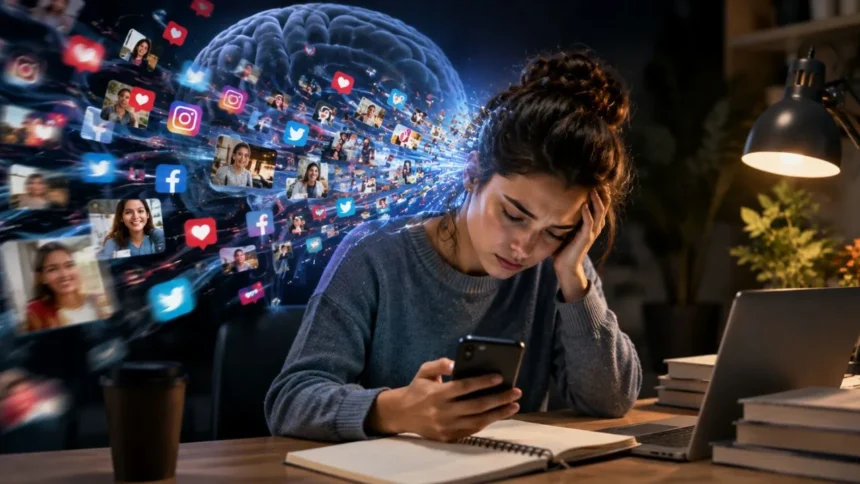
Social media can affect attention by encouraging frequent checking, rapid content switching and repeated responses to notifications. These behaviors may make it harder to remain focused on one activity without interruption. The effect is not identical for everyone, but attention problems are reported more consistently among people who use social platforms heavily or problematically.
Short-form videos, personalised feeds and endless scrolling expose users to a continuous stream of changing information. Each post may introduce a different topic, emotion, sound or visual style within seconds. Research has associated heavier short-form video use with poorer attention and inhibitory control, although many studies cannot prove that platform use alone caused those differences.
Social media also competes with schoolwork, reading, conversations and professional tasks. Even when a person does not open an application, a notification badge or the expectation of a new message may pull attention away from the current activity. Experimental research on social media notifications has found distraction under some conditions, but the results have not been identical across every experiment.
This article explains how social media affects attention, sustained concentration, working memory and learning. It also examines notifications, short-form videos, media multitasking, sleep and problematic use. The final sections provide realistic ways to protect focus without assuming that everyone must permanently delete every social media account.
What Is Attention?
Attention is the ability to select information that matters while ignoring competing sights, sounds, thoughts and activities. It allows someone to follow a conversation, read a chapter or complete a task without responding to every possible distraction. Attention is limited, so several activities competing at once can reduce the mental resources available to each one.
Sustained attention refers to maintaining focus over an extended period. Selective attention involves concentrating on relevant information while filtering out distractions. Divided attention describes trying to manage more than one stream of information, while attentional control helps a person deliberately move or return focus according to current goals.
Working memory is closely connected with attention because it temporarily holds information needed for an ongoing task. When attention repeatedly shifts away, parts of that information may be lost or replaced. Research has linked frequent attention lapses and heavier media multitasking with poorer memory performance, although individual differences remain important.
Attention naturally changes with sleep, stress, motivation, task difficulty and the surrounding environment. A person who struggles to concentrate after scrolling has not necessarily developed a permanent attention disorder. Social media is one possible influence among many, so persistent or severe problems should not be diagnosed from screen habits alone.
Why Social Media Captures Attention
Social platforms are filled with cues that signal possible social or emotional rewards. A new message may contain approval, useful information, entertainment or an urgent request. Because the user cannot know the result before checking, uncertainty can make the notification or application feel especially difficult to ignore.
Feeds also present highly varied content without requiring the user to search for each new item. A person can move instantly from humour to news, personal updates, controversy and advertising. This rapid novelty gives attention frequent new targets and may make a slower activity feel less stimulating by comparison.
Algorithms generally organise content according to predicted engagement rather than presenting every available post equally. This creates a personalised stream designed to keep the individual interested. The result may be useful when it surfaces relevant information, but it can also extend a session far beyond the time the user originally intended to spend.
Social rewards, emotional content and unpredictable updates can therefore keep attention attached to the platform. The issue is not that every post is uniquely powerful; it is that new opportunities appear continuously. Without a natural stopping point, the user must repeatedly decide to leave rather than simply reaching the end.
Notifications Interrupt Concentration
Notifications can pull attention away from work before the user consciously decides whether the message is important. A sound, vibration, banner or badge signals that new information is available. The person may then look at the phone, think about the possible message or experience an urge to check while trying to continue the original task.
A 2024 series of experiments found that social media logos with notification badges reduced change-detection performance in one experiment, although the effect was not reproduced in the following two experiments. These mixed findings suggest notifications can be distracting, but their impact depends on the task, design and individual situation.
The interruption continues beyond the few seconds spent reading the message. After checking social media, the user must remember what they were doing, restore the previous goal and rebuild concentration. Frequent interruptions can therefore fragment a task even when each individual check appears brief.
Turning the phone face down may not remove every distraction when the person still expects updates. A useful approach is to disable nonessential alerts, remove notification badges and choose specific checking periods. This reduces the number of times social media is allowed to decide when attention should change.
Short Videos and Attention Span
Short-form video feeds provide rapid, continuous and highly varied stimulation. Users can move to another video with one swipe whenever interest declines. This design may encourage quick evaluations and frequent switching rather than remaining with one piece of information long enough to understand it deeply.
A 2025 meta-analysis covering 71 studies and more than 98,000 participants found that increased short-form video use was associated with poorer cognitive outcomes. The strongest associations involved attention and inhibitory control, but the researchers also noted that further studies are required to clarify causation and the effects of different content types.
An experimental study published in 2024 reported that watching short videos negatively affected performance on an attention-network task compared with other conditions. Another small EEG study found a reduced attention-related P300 response among heavy short-video social media users, although its sample included only 29 participants and cannot establish broad causality.
These findings do not prove that watching a few short videos permanently reduces attention span. The greater concern involves extended, repetitive or compulsive use that replaces activities requiring sustained focus. Content quality, viewing duration, personal vulnerability and what the user does immediately afterward may all influence the outcome.
Rapid Switching Trains a Pattern
Short-form platforms allow the user to change context every few seconds. One clip may discuss exercise, the next may show comedy and the next may present upsetting news. The brain must repeatedly interpret a new setting, speaker, goal and emotional tone without developing a continuous understanding of one subject.
A 2025 experimental study examined context switching within short-form videos and reported that rapid switching could negatively affect prospective memory, which involves remembering to carry out a planned action. The findings support concern that fragmented viewing may interfere with the mental processes used to retain intentions while performing another task.
Research published in 2026 also found that participants who watched short videos before a prospective-memory task showed lower accuracy than those who watched longer videos. The effect depended partly on how much attention the memory task required, demonstrating that short-form exposure may not affect every cognitive activity in exactly the same way.
Repeated switching does not necessarily create irreversible cognitive damage. It may instead strengthen an expectation that information should change whenever interest falls. Rebuilding sustained focus therefore involves practising the opposite pattern by staying with one meaningful activity through mild boredom, effort or delayed reward.
Social Media and Sustained Attention
Sustained attention is required for reading, studying, writing, driving and completing detailed work. Social media can compete with this ability when users repeatedly pause a longer task to check updates. The work period becomes a series of short intervals rather than one continuous period of concentration.
Research on media multitasking has repeatedly found an association between heavier multitasking and poorer sustained-attention performance. A 2023 study and meta-analysis reported a negative relationship of moderate size, while earlier studies found greater response variability and more everyday attention failures among heavier media multitaskers.
However, association does not show which factor came first. People who naturally find sustained attention difficult may be more attracted to frequent media switching. Social media use may also worsen existing distractibility, creating a two-way relationship in which attention difficulties and heavy checking reinforce each other.
The practical concern is whether platform use repeatedly interrupts important tasks. Someone who uses social media intentionally after finishing work may experience less disruption than someone who checks it throughout every activity. Patterns of use can therefore matter as much as the total number of minutes recorded each day.
Media Multitasking Reduces Focus
Media multitasking occurs when a person uses social media while watching a lecture, reading, working or engaging with another form of media. Although it may feel efficient, the brain usually switches attention between the activities instead of processing both at full depth simultaneously.
Every switch requires the person to update the current goal and decide which information should receive priority. This creates extra mental work and can reduce understanding of the primary task. Research has linked heavier media multitasking with weaker sustained attention, more memory failures and poorer performance in several cognitive areas.
The effect becomes especially important during learning. A student may read the same page for twenty minutes while repeatedly replying to messages, but the amount of deeply processed information may be limited. The long period spent near the textbook does not necessarily represent an equally long period of focused study.
Single-tasking does not require avoiding social media for the entire day. It means separating social use from activities that deserve complete attention. A person can study for a defined period, record unrelated thoughts on paper and check social platforms during a planned break rather than mixing both continuously.
Social Media and Working Memory
Working memory holds a limited amount of information for immediate use. It allows someone to remember the beginning of a sentence, follow several instructions or connect one part of an argument with another. Distraction can replace information held in this temporary mental workspace.
When a social media interruption occurs, the new post or message introduces additional information that competes with the original task. Returning to the task requires reconstructing the previous mental context. Repeated interruptions can therefore make complex activities feel more difficult and increase errors or forgotten steps.
A 2026 study examining social media scrolling and working memory reported poorer performance among students who used social media, particularly short-form video content. Other research has linked heavier media multitasking with attention lapses that predicted memory failure, supporting the connection between unstable attention and weaker recall.
This does not mean social media removes a person’s ability to remember. The immediate problem may be that information was never maintained or encoded properly because attention kept moving. Protecting the learning period from interruptions gives working memory a better opportunity to organise and retain the material.
Social Media and Learning
Learning requires attention long enough to select, organise and connect new information. Social media can interfere when it interrupts lectures, reading or practice. Even educational content may produce shallow understanding when the learner moves rapidly between unrelated explanations without reviewing or applying them.
Short videos can still support learning when they present a clear idea and hold the viewer’s attention. A 2025 study found that moment-to-moment attentional state during short educational videos predicted quiz performance, while trait inattention did not predict immediate retention. This suggests format and active engagement can make short content useful for some learners.
The difference lies partly in how the content is used. Watching one focused explanation, taking notes and practising the concept differs from scrolling through dozens of disconnected educational clips. The second activity may create familiarity with many topics without developing the deeper knowledge required to explain or use them.
Students can improve learning by separating discovery from study. Social media may help them find an idea, expert or resource, but the next step should involve a longer article, lesson, book or practice task. Saving useful posts for a planned review period also prevents the search for information from becoming an extended scrolling session.
Problematic Use and Inhibitory Control
Inhibitory control helps a person resist an automatic response when it conflicts with a goal. On social media, this may mean closing the feed, ignoring a notification or stopping after the intended checking period. Weak control can make a minor urge feel difficult to interrupt once the application is open.
A 2025 study of 503 university students found that problematic social media use was associated with attentional impulsivity and cognitive instability. However, problematic use was not significantly related to performance on the study’s Go/No-Go or Iowa Gambling tasks, showing that self-reported difficulties do not always match every objective measure.
This distinction is important because problematic social media use is not the same as ordinary daily use. It involves patterns such as loss of control, repeated failed attempts to reduce use or interference with responsibilities. Someone can spend time online without experiencing serious functional impairment.
When use feels automatic, the solution should not depend only on making stronger promises. Removing the application from the home screen, logging out and setting a fixed purpose before opening it add useful stopping points. These changes allow the user to interrupt the routine before the feed captures extended attention.
Boredom and Continuous Scrolling
People often open social media because they feel bored and expect rapid content to make the moment more interesting. The strategy works briefly because the feed supplies endless novelty. However, repeatedly switching whenever a video becomes slow may reduce tolerance for ordinary moments that contain less stimulation.
A 2024 experimental study found that participants who could switch freely between online videos experienced more boredom than those who watched the videos without switching. The researchers concluded that attempts to escape boredom through digital switching may sometimes intensify the feeling instead of resolving it.
This creates a difficult loop. Boredom prompts scrolling, scrolling encourages rapid switching and rapid switching may make slower activities feel even less satisfying. The person then returns to the platform whenever reading, work or conversation fails to provide immediate novelty.
Building attention requires allowing some low-stimulation moments to remain unfilled. Waiting in a queue, eating without a screen or walking without opening an application can rebuild comfort with a slower pace. The aim is not to eliminate entertainment but to stop treating every quiet moment as a problem requiring digital stimulation.
Sleep Can Affect Attention
Late-night social media use can affect attention indirectly by reducing sleep time or delaying the moment a person begins sleeping. A feed has no natural endpoint, making “one more post” easy to repeat. Emotional or stimulating content may also make it harder to disengage and settle into a sleep routine.
Sleep loss can weaken attention, reaction time, working memory and emotional regulation the following day. A person may then use more social media because focused work feels difficult when tired. This can create a cycle in which evening scrolling reduces sleep and reduced sleep makes attention harder to manage.
Notifications can add another problem when they remain active overnight. Even when they do not fully wake the user, the expectation of messages may encourage checking during the night or immediately after waking. Moving the phone away from the bed reduces convenient access to the platform.
Create a consistent stopping point before sleep and use a separate alarm clock when possible. Night modes can reduce visual brightness, but they do not address time displacement or emotionally engaging content. A complete boundary is usually more effective than relying on the screen’s colour setting alone.
Effects on Children and Teenagers
Children and teenagers are still developing the executive skills used to plan, resist distractions and regulate attention. Social media may compete with homework, sleep, physical activity and face-to-face interaction. Younger users may also find personalised rewards and social feedback particularly difficult to manage independently.
Research has associated problematic social media use with inattention and impulsivity-related outcomes among adolescents. However, recent analyses continue to emphasise that much of the evidence is cross-sectional, meaning it cannot determine whether social media caused the attention problems or whether existing difficulties increased problematic use.
Rules based only on total screen time may miss important differences. Video calling a relative, creating a project, reading educational material and compulsively scrolling before sleep are not equivalent activities. Parents should consider timing, content, emotional effects and whether use interferes with school, sleep or family responsibilities.
Shared routines are generally more realistic than demanding perfect self-control from a young person. Keeping devices outside the bedroom, protecting homework periods and discussing why platforms are difficult to stop can build practical awareness. Adults should model the same boundaries instead of checking their own phones throughout every conversation.
Does Social Media Cause ADHD?
Social media does not currently have enough evidence to be described as a proven cause of attention-deficit/hyperactivity disorder. ADHD is a neurodevelopmental condition involving persistent patterns of inattention, impulsivity or hyperactivity across important areas of life. It cannot be diagnosed from heavy phone use or a recently reduced attention span.
Social media can produce behaviors that resemble some ADHD symptoms, including frequent task switching, restlessness and difficulty resisting distractions. It may also make existing attention challenges more visible. People who already experience impulsivity or boredom may be especially drawn to rapidly changing content.
Research has found relationships between problematic social media use and ADHD-related symptoms, but directionality remains uncertain. In some cases, attention difficulties may increase the likelihood of excessive use, while excessive or poorly timed use could intensify everyday concentration problems. Both processes may occur together in different individuals.
Anyone experiencing long-term attention difficulties across school, work, home and relationships should seek a qualified assessment. Deleting an application cannot confirm or rule out ADHD. Professional evaluation considers developmental history, symptom duration, functioning and other possible explanations such as anxiety, depression, stress or sleep problems.
Can Social Media Improve Attention?
Social media is not automatically harmful to attention. Intentional use can direct focus toward an educational explanation, professional discussion, creative demonstration or important community update. Short content may introduce a subject in an accessible way and encourage someone to continue learning elsewhere.
Interactive platforms can also provide useful feedback and social accountability. A study group, professional community or shared project may help members remain engaged with a goal. The benefit depends on whether the platform supports the task or continuously pulls the user toward unrelated content.
The same feature can produce different results according to use. Notifications from an emergency group may be valuable, while promotional alerts create unnecessary interruptions. A short tutorial followed by practice may support learning, while an hour of rapidly changing clips may leave little information available for recall.
The practical goal is therefore not to classify social media as entirely good or bad. It is to choose a purpose, control the environment and recognise when the platform stops serving that purpose. Attention improves when the user decides what to focus on instead of allowing the feed to make every decision.
How to Protect Your Attention
Begin by turning off alerts that do not require an immediate response. Keep calls or important messages active while disabling likes, recommendations, follower updates and promotional notifications. Removing badges from application icons can also reduce visual reminders that invite checking.
Create periods when social media is unavailable during focused work. Place the phone in another room, use a website blocker or sign out of the relevant accounts. A physical distance is often more effective than leaving the device within reach and repeatedly resisting the urge to touch it.
Set a clear reason before opening an application. You might reply to messages, publish a post or check one saved account. Close the platform when that action is complete rather than continuing into the recommended feed. A timer can provide an external stopping cue when the application has none.
Practise sustained attention separately. Read several pages, complete one task or watch a full educational lesson without switching. Begin with a manageable period and increase it gradually. Attention is easier to protect when focused work becomes a repeated routine rather than an occasional test of endurance.
Create a Healthier Social Media Routine
Review which platforms provide genuine value and which mainly consume time. Removing one low-value application may be easier than trying to regulate several feeds simultaneously. Keep the services that support communication, learning or work, but change how and when they are accessed.
Schedule checking periods around existing responsibilities. For example, review social media after completing a work block rather than whenever an urge appears. Predictable access reduces fear that messages will never be seen while protecting longer periods for uninterrupted concentration.
Avoid beginning and ending the day with scrolling. The first habit can make attention reactive before important priorities are considered, while the second can interfere with sleep. Replace these periods with a simple routine such as planning the day, reading or preparing for rest.
Track results instead of assuming the plan is working. Notice whether reading becomes easier, tasks finish faster and bedtime improves. Adjust the boundaries when they are too strict to maintain or too loose to protect attention. Sustainable limits are more useful than a temporary digital detox followed by the previous pattern.
When to Seek Support
Consider professional support when social media use repeatedly interferes with work, education, sleep or relationships. Other warning signs include losing control of time, hiding usage, feeling unable to reduce it or becoming significantly distressed when access is unavailable.
Attention problems may also come from anxiety, depression, trauma, sleep disorders, medication effects or ADHD. A clinician can explore these possibilities instead of assuming that social media is the only cause. Treating the underlying condition may make digital habits easier to manage.
Parents should seek guidance when a young person’s online use is connected with severe sleep loss, school refusal, bullying, self-harm, unsafe contact or major emotional changes. Immediate safety concerns require urgent local professional help rather than relying only on device restrictions.
Support does not necessarily mean abandoning technology. A therapist, doctor or school professional may help create boundaries, address emotional triggers and develop attention strategies. The goal is to restore control and functioning so social platforms become optional tools rather than constant demands.
FAQs
Does social media shorten your attention span?
Heavy or problematic social media use is associated with poorer attention in several studies, especially for short-form video and media multitasking. However, research does not prove that all social media use permanently shortens attention span.
Why do short videos affect concentration?
Short videos encourage frequent novelty and rapid context changes. Extended viewing may make slower tasks feel less stimulating and has been associated with poorer attention and inhibitory control.
Do social media notifications reduce focus?
They can interrupt a task, trigger checking and require attention to be rebuilt afterward. Experimental evidence is mixed, suggesting the effect depends on the person, notification and activity.
Can deleting social media improve attention?
It may reduce interruptions and create more time for focused activity, but deletion alone does not address sleep, stress or established checking habits. Structured limits may be sufficient for many users.
How can students avoid social media distractions?
Turn off notifications, keep the phone away from the study area and check social platforms during planned breaks. Study one task at a time instead of combining messages with reading or lectures.
How Does Social Media Affect Attention? Final Takeaways
Social media can affect attention by creating frequent opportunities to switch, check and respond. Notifications, endless feeds and short-form videos compete with sustained concentration. The strongest concerns involve heavy, fragmented or problematic use rather than every form of social communication online.
Research associates short-form video use and media multitasking with poorer attention, inhibitory control and memory outcomes. However, many studies are correlational, and experimental results are not always consistent. Existing attention difficulties may increase social media use just as social media patterns may intensify distraction.
Protecting focus does not always require leaving every platform. Disable unnecessary alerts, separate social media from learning and work, and enter applications with a clear purpose. Practising longer periods of single-tasking can help slower activities feel more manageable again.
Persistent attention problems should be assessed in their full context. Sleep, stress, mental health and neurodevelopmental conditions may all contribute. By creating deliberate boundaries and seeking support when needed, users can receive the benefits of social media without allowing it to control every shift in attention.