

Sciatic nerve pain can interrupt nearly every part of the day. Sitting at a desk, getting out of bed, driving, walking, or bending to put on shoes may trigger burning pain that travels from the lower back into the buttock and leg. When discomfort appears suddenly, it is understandable to search for a natural method that offers fast relief.
A gentle 10-minute movement routine may help some people reduce muscle tension, restore comfortable motion, and settle irritated nerve symptoms. It is not a guaranteed cure, and it cannot correct every cause of sciatica within minutes. However, brief movement can be more helpful than remaining still for long periods when symptoms are mild and no medical warning signs are present.
The routine in this guide combines relaxed breathing, small pelvic movements, a gentle sciatic nerve slider, and comfortable walking. None of the movements should be forced, bounced, or pushed through sharp pain. The purpose is to help your body move more calmly, not to stretch the sciatic nerve as far as possible or prove how flexible you are.
Before starting, remember that sciatica is a symptom rather than one specific disease. It may be related to a herniated disc, spinal stenosis, injury, or another condition affecting a nerve root. Seek professional care when symptoms are severe, worsening, persistent, or accompanied by numbness, weakness, bladder changes, bowel changes, or other concerning signs.
Can You Really Relieve Sciatica in 10 Minutes?
Some people feel noticeably better after ten minutes of gentle movement, especially when stiffness, prolonged sitting, or protective muscle tension is contributing to their discomfort. A short routine may help you find a more comfortable position, decrease fear around movement, and interrupt the cycle of sitting still while the back and hips become increasingly tight.
That does not mean the underlying cause has disappeared. A compressed or inflamed nerve root may need days or weeks to settle, while persistent symptoms may require an examination, physical therapy, medication, or another treatment. Relief following a short routine should be viewed as a useful response, not proof that the condition has been permanently corrected.
Results also differ from person to person. One movement may feel comfortable for someone with a disc-related problem but unpleasant for someone whose symptoms are associated with spinal narrowing. Age, activity level, medical history, pain sensitivity, and the location of nerve irritation can all influence which positions help and which positions make symptoms worse.
The safest promise is that the routine gives you ten minutes to move gently and observe your response. Your goal is not necessarily to become completely pain-free. A meaningful improvement may be easier walking, less intense leg pain, reduced tingling, or discomfort that moves away from the foot and closer toward the lower back.
What Is Sciatic Nerve Pain?
Sciatica describes symptoms caused by irritation or compression affecting the sciatic nerve pathway or the spinal nerve roots that form it. The pain commonly begins in the lower back or buttock and travels down one leg. Some people feel discomfort only in the thigh, while others experience symptoms extending into the calf, foot, or toes.
The sensation may feel sharp, burning, electric, aching, or similar to a sudden jolt. Sciatic nerve pain can also occur with tingling, pins and needles, reduced sensation, or leg weakness. Symptoms are usually stronger on one side, although pain affecting both legs requires greater caution, particularly when it appears with bladder, bowel, or saddle-area changes.
A herniated or slipped disc is a common cause of lumbar radiculopathy and sciatica. Disc material can irritate or place pressure on a nearby nerve root. Other potential causes include spinal stenosis, age-related changes, spondylolisthesis, traumatic injury, and less commonly a growth, infection, or another condition affecting the spine or surrounding structures.
Not every pain in the buttock or leg is true sciatica. Hip problems, muscle injuries, sacroiliac joint irritation, circulation problems, and peripheral nerve conditions can produce similar symptoms. This is why self-diagnosis based only on the location of pain may be misleading, especially when symptoms are unusual, severe, recurrent, or steadily worsening.
Check for These Warning Signs Before Exercising
Do not begin a home stretching routine when you have recently developed difficulty controlling your bladder or bowels. Inability to start urinating, unexpected leakage, loss of awareness when passing urine, or loss of bowel control may indicate serious nerve compression. These symptoms require urgent medical assessment rather than another attempt at home treatment.
Seek emergency care for numbness around the genitals, anus, inner thighs, or the area that would contact a bicycle saddle. Rapidly increasing weakness in one or both legs is also an important warning sign. Do not wait to see whether these symptoms improve after sleeping, stretching, applying heat, or taking an over-the-counter pain reliever.
Prompt medical attention is also important when sciatic pain begins after a serious fall, vehicle collision, or other significant trauma. Contact a healthcare professional when back and leg pain occurs with fever, unexplained weight loss, a history of cancer, immune suppression, prolonged steroid use, or pain that is unusually intense at night.
Even without emergency symptoms, arrange an evaluation when the pain keeps getting worse, limits normal activity, or fails to improve after several weeks. New numbness, foot weakness, repeated falls, or difficulty walking also deserves professional assessment. A clinician can determine whether the symptoms are consistent with sciatica and recommend an appropriate treatment plan.
Prepare Safely for the 10-Minute Sciatica Routine
Choose a quiet area with enough space to lie down, sit, stand, and walk safely. Use a supportive bed, exercise mat, or carpeted floor if getting down is comfortable for you. Keep a stable chair nearby and wear clothing that does not restrict your hips, knees, or waist during gentle movement.
Rate your symptoms before beginning on a scale from zero to ten. Also notice where the discomfort ends: lower back, buttock, thigh, calf, ankle, or foot. Location can be as important as intensity because pain spreading farther down the leg may suggest that a movement is irritating the nerve rather than calming it.
Move within a comfortable range and keep every repetition slow. Mild stiffness or a gentle pulling sensation may be acceptable, but sharp, electric, or increasing leg pain is a signal to stop. You should never force the leg straight, hold your breath, bounce into a stretch, or ask another person to push your body farther.
Skip the routine until you receive professional guidance if you are pregnant, recently had surgery, have severe osteoporosis, experienced a recent fracture, or have a significant neurological or medical condition. A physical therapist or qualified healthcare professional can modify exercises according to your diagnosis, mobility, health history, and current level of irritation.
Minutes 0–2: Begin With Supported Breathing
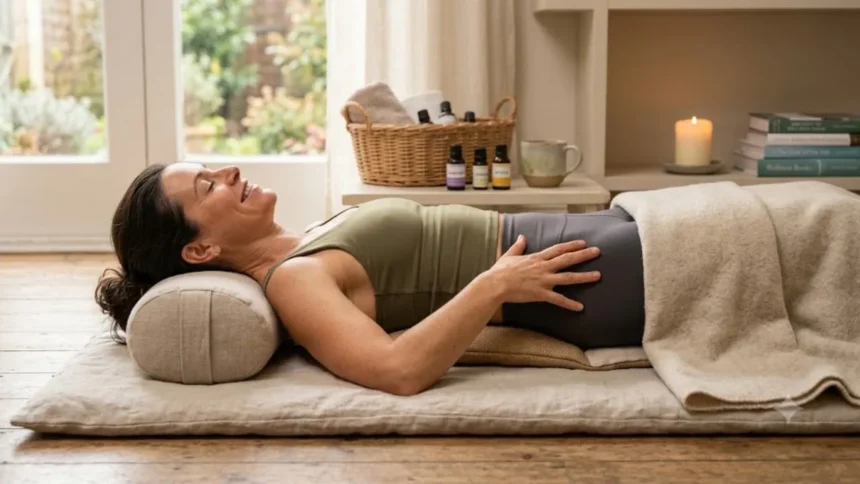
Lie on your back with your knees bent and feet supported, or use another position that feels comfortable. You may place a pillow under your knees if keeping your legs bent reduces tension. If lying down increases your leg symptoms, sit upright in a supportive chair instead of forcing yourself into the suggested position.
Place one hand gently over your abdomen and allow your shoulders and jaw to relax. Breathe in slowly through your nose without trying to take the largest breath possible. Let the abdomen expand naturally, then exhale slowly and comfortably while keeping the lower back, buttocks, and legs as relaxed as you can.
Continue this breathing pattern for approximately two minutes. Slow breathing does not remove pressure from a spinal nerve, but it may help reduce protective muscle tension and create a calmer starting point for movement. Pain often causes people to brace their abdomen, hold their breath, and move more rigidly than they realize.
Notice whether your symptoms remain stable, decrease, or spread farther down the leg. If simply lying in the position causes rapidly increasing pain, numbness, or weakness, stop and change position. The opening stage should feel restful and controlled, not like a test of endurance or an intense abdominal exercise.
Minutes 2–4: Try Gentle Pelvic Rocking
Remain on your back with your knees bent and your feet resting comfortably. Imagine your pelvis as a small bowl of water. Slowly tilt the bowl toward you so that the lower back gently approaches the supporting surface, then return to a relaxed neutral position without creating a large arch.
Repeat the movement slowly for eight to ten repetitions over approximately two minutes. The motion should be small and smooth. Avoid squeezing the buttocks forcefully, lifting your hips into a bridge, or pressing the lower back down as hard as possible, because excessive effort may increase tension instead of encouraging comfortable mobility.
Pelvic rocking can help you explore gentle lower-back motion without loading the spine heavily. Some people find that it reduces stiffness after prolonged sitting or sleeping. Others may discover that flexing the lower back increases leg symptoms, in which case the movement should be reduced or removed from the routine.
Pay close attention to the direction of your symptoms. Stop when pain becomes sharper, travels farther toward the foot, or causes increased tingling or numbness. A movement that makes the leg feel worse is not beneficial merely because it appears in a general exercise guide or has helped another person.
Minutes 4–6: Perform a Gentle Sciatic Nerve Slider
Sit near the front of a stable chair with both feet on the floor. Keep the movement relaxed rather than holding a rigid posture. Slowly straighten the knee of the affected leg only as far as is comfortable while lifting your head and looking slightly forward, then bend the knee and return the foot to the floor.
As the foot returns, allow your chin to lower gently toward your chest. This coordinated movement lets one end of the nerve pathway relax while the other moves, which is why it is often described as a nerve slider or nerve glide. It is not intended to create a strong hamstring or calf stretch.
Perform five to ten slow repetitions during the two-minute period. Keep the ankle relaxed initially rather than pulling the toes forcefully toward you. There should be no bouncing, long hold, or attempt to fully straighten the knee when doing so reproduces strong leg pain, burning, tingling, or an electric-shock sensation.
Stop immediately if the nerve slider increases pain or causes symptoms to remain worse afterward. Nerve-related exercises can irritate symptoms when performed aggressively or used for the wrong condition. A physical therapist can determine whether nerve gliding is appropriate and show you the correct range, speed, and number of repetitions.
Minutes 6–9: Take a Short, Comfortable Walk
Stand up slowly using the chair for support if necessary. Walk around the room or along a safe, level hallway for approximately three minutes. Use a natural stride that does not increase your symptoms and avoid deliberately taking long steps, marching your knees high, or forcing yourself to stand unusually straight.
Gentle walking can reduce the stiffness that develops during prolonged sitting or bed rest. It also gives you an opportunity to assess how the earlier movements affected your function. The walk should feel easy enough that you can breathe normally and speak without straining or becoming significantly short of breath.
Shorten your steps and slow down when discomfort begins to increase. Stop if you develop sudden weakness, loss of balance, dizziness, severe pain, or rapidly spreading numbness. Walking through mild, stable discomfort may be manageable for some people, but pushing through escalating nerve pain is not the objective of this routine.
If walking feels better than sitting, consider repeating several short walks throughout the day rather than completing one demanding session. Frequent, manageable movement may be more tolerable during a sciatica flare-up. Gradually increase duration only when symptoms remain stable and your healthcare professional has not advised you to limit activity.
Minutes 9–10: Rest and Reassess Your Symptoms
Return to the most comfortable position you found during the routine. This may be standing, sitting with lower-back support, lying with your knees bent, or lying on your side with a pillow between your knees. Spend the final minute breathing normally and allowing unnecessary tension to settle.
Rate your pain again and compare it with your starting number. More importantly, check whether the symptoms have changed location. Less pain in the foot or calf with more centralized discomfort near the buttock or back may be a more encouraging response than a small numerical change with pain spreading farther down the leg.
The routine can be considered useful when you feel the same or better and can move more comfortably afterward. It should not leave you with stronger pain, new weakness, increased numbness, or symptoms extending into a previously unaffected area. Stop using any individual movement that repeatedly creates an unfavorable response.
Do not repeat the sequence continuously in an attempt to force a faster result. Give your body time to respond and keep later activity light. When the routine provides temporary relief but symptoms repeatedly return, seek guidance about a more individualized sciatica exercise program rather than increasing repetitions without professional advice.
Why Gentle Movement May Help Sciatic Pain
Pain often encourages people to avoid movement because they fear causing additional injury. A brief reduction in activity may be understandable during an intense flare, but spending long periods completely inactive can increase stiffness, reduce confidence, and weaken the muscles that support ordinary movement. Gentle activity is usually preferable when serious causes have been excluded.
Movement may help maintain mobility in the lower back, hips, and legs without placing the body under heavy load. It can also reduce the discomfort associated with remaining in one position for too long. This does not mean every movement is harmless or that more exercise always produces a better result.
The effect of exercise depends partly on the cause and behavior of the symptoms. Some people improve with movements that extend the lower back, while others feel better in more flexed positions. A physical therapist can identify patterns, test strength and mobility, and choose exercises based on the individual rather than a generic diagnosis.
The most useful home routine is one that makes daily movement easier without creating a delayed flare-up. Track how you feel during the routine, immediately afterward, and later that day. This symptom-response approach is more valuable than following a fixed number of repetitions while ignoring what your body is communicating.
Use Heat or Cold for Additional Comfort
A heat pack may help relax tight muscles and make gentle movement feel more comfortable. Apply warmth to the lower back or buttock rather than placing extreme heat directly over numb skin. Follow the product instructions, use a protective layer, and avoid falling asleep while using an electric heating pad.
Some people prefer cold during the first few days of a painful flare, particularly when the area feels acutely irritated. Wrap an ice or cold pack in a towel instead of placing it directly against the skin. Limit exposure according to professional or product guidance and inspect the skin regularly.
Heat and cold are comfort measures rather than treatments that correct a herniated disc or permanently release a compressed nerve. One person may respond better to warmth, while another prefers cold or alternating applications. Use the option that feels soothing without burning, freezing, or damaging the skin.
Avoid temperature therapy when sensation is reduced unless a healthcare professional has advised you how to use it safely. Diabetes, circulation problems, neuropathy, skin conditions, and certain medications may increase the risk of injury. Stop if the skin becomes blotchy, painful, excessively pale, blistered, or unusually numb.
Avoid Prolonged Sitting During a Sciatica Flare
Sitting can aggravate sciatic pain for many people, particularly when the chair is low, soft, or provides little support. Avoid remaining in one position for hours while working, driving, or watching television. Set a reminder to stand, change position, or take a brief walk at regular intervals.
Choose a chair that allows your feet to rest comfortably on the floor. Keep the hips and knees in a position that does not increase leg symptoms, and consider placing a small rolled towel behind the lower back. The most helpful posture is often one you can vary rather than hold rigidly all day.
When driving, move the seat close enough that you can reach the pedals without twisting or stretching the affected leg. Keep the backrest supportive and avoid placing a bulky wallet or object beneath one side of the pelvis. On longer journeys, stop periodically when it is safe to walk and change position.
Do not assume that standing all day is the perfect alternative. Prolonged standing can also increase discomfort, especially when you remain motionless or place most of your weight on one leg. Alternate among sitting, standing, and walking so that no single position becomes the source of continuous irritation.
Find a More Comfortable Sleeping Position
Many people with sciatic nerve pain struggle to find a sleeping position that does not trigger the leg. Side sleeping with a pillow between the knees may help keep the hips and pelvis more comfortably aligned. Adjust the pillow thickness until the upper leg feels supported rather than pulled downward.
Back sleeping may feel better with a pillow beneath the knees. This position can reduce the amount of effort required from the lower-back and hip muscles. Use enough support to feel comfortable without forcing the knees tightly toward the chest or creating pressure behind the legs.
Stomach sleeping can increase symptoms for some people because it may place the lower back and neck in an uncomfortable position. If it is the only position in which you can sleep, a thin pillow beneath the lower abdomen or pelvis may help. Stop using any modification that makes leg symptoms stronger.
The mattress does not need to be the firmest available, and replacing it is not always necessary. Look for a surface that supports you without creating painful pressure. Because sleep disturbance can heighten pain sensitivity and fatigue, discuss persistent nighttime pain or unexplained pain that wakes you repeatedly with a healthcare professional.
Lift, Bend, and Move With Less Irritation
During an active flare-up, avoid unnecessary heavy lifting and repeated twisting. When an object must be moved, keep it close to your body and use your legs rather than rounding the back while reaching forward. Turn by moving your feet instead of holding the feet still and twisting through the spine.
Break large loads into smaller ones whenever possible. Ask another person to help with heavy, awkward, or unstable objects. Trying to protect the back by holding your breath and becoming completely rigid can also be unhelpful, so breathe normally and move in a controlled manner.
For light objects, use a countertop, chair, or stable surface for support when necessary. A hip-hinge movement may help you bend while keeping the load close, but no single lifting technique is suitable for every condition. Choose the method that does not reproduce or intensify your leg symptoms.
As pain settles, gradually return to ordinary tasks instead of avoiding bending forever. Long-term fear of normal movement can reduce strength and confidence. A physical therapist can help you rebuild lifting capacity safely when work, caregiving, exercise, or household responsibilities regularly require demanding physical activity.
Build a Longer-Term Sciatica Recovery Plan
A ten-minute routine is a starting point, not a complete rehabilitation program. Longer-term recovery may include walking, strength training, mobility work, and exercises for the trunk, hips, and legs. The best combination depends on the cause of the symptoms, physical capacity, health conditions, and personal goals.
Increase activity gradually instead of moving from complete rest to an intense workout. A short daily walk may be more appropriate initially than running, heavy lifting, or a demanding fitness class. Progress only when your symptoms remain stable during the activity and do not become substantially worse later.
Physical therapy can be especially valuable when pain returns repeatedly or limits work, sleep, and daily activities. A therapist can assess strength, reflexes, sensation, movement patterns, and symptom behavior. They can then provide an individualized program rather than asking you to rely on random sciatica stretches found online.
Recovery also includes managing factors that place repeated strain on the body. Workstation setup, lifting habits, physical conditioning, smoking, sleep, stress, and prolonged inactivity may influence back health. No lifestyle change guarantees that sciatica will never return, but consistent movement and general health habits can support resilience.
Be Careful With “Natural Sciatica Cures”
The word “natural” does not automatically mean safe, effective, or appropriate. Aggressive massage, forceful spinal twisting, inversion devices, unregulated supplements, and painful stretching can aggravate symptoms or delay proper diagnosis. Be particularly cautious when a treatment promises to permanently cure every type of sciatica within minutes.
No food, drink, oil, herb, or household remedy can reliably remove every form of nerve compression. Some comfort strategies may help a person relax or manage pain, but testimonials cannot establish that the method treats the underlying problem. Look for realistic explanations rather than dramatic before-and-after claims.
Manual therapy or massage may help some people when provided by an appropriately qualified professional and used as part of a broader treatment plan. It should not replace exercise, education, medical assessment, or emergency care when warning signs are present. Inform the practitioner about numbness, weakness, medications, and existing diagnoses.
Be skeptical of anyone who insists that pain during treatment proves the nerve is “releasing” or the body is “detoxifying.” Increased pain may indicate irritation rather than healing. A responsible provider should explain expected responses, respect your limits, and refer you for medical evaluation when symptoms fall outside their professional scope.
When Professional Sciatica Treatment May Be Needed
Contact a healthcare professional when home care does not improve symptoms after a few weeks or when the pain interferes significantly with work, sleep, walking, or self-care. An examination can help distinguish lumbar nerve irritation from hip, joint, muscular, vascular, or other neurological problems that may require different management.
Imaging is not automatically necessary for every case of back and leg pain. A clinician may first assess strength, sensation, reflexes, walking, and movements that reproduce symptoms. Imaging may become more useful when serious disease is suspected, neurological problems are progressing, or the result would affect the treatment decision.
Treatment may include education, activity modification, physical therapy, and carefully selected medication. Medicines can have important risks and may not offer the same benefit for every person with sciatica. Discuss over-the-counter and prescription products with a qualified professional, particularly if you have kidney, stomach, liver, heart, bleeding, or medication-related concerns.
Injections or surgery may be considered when severe symptoms do not improve with appropriate conservative care or when significant nerve problems develop. Surgery is more urgent when there is severe weakness or loss of bladder or bowel control. Most people do not need an operation, but the decision should be based on diagnosis and clinical findings.
Common Mistakes That Can Make Sciatica Worse
One common mistake is staying in bed for days because movement feels uncomfortable. Excessive bed rest can contribute to stiffness, weakness, and reduced tolerance for activity. Rest briefly when needed, but return to manageable movement as soon as it is safe rather than waiting to feel completely pain-free.
Another mistake is stretching the painful leg aggressively. Sciatic symptoms do not always come from a muscle that needs to be lengthened. Pulling hard on an irritated nerve pathway may increase burning, tingling, numbness, or radiating pain, particularly when the stretch is held for a long time.
People may also repeat an exercise simply because it has been labeled a “sciatica cure.” Exercises are not universally helpful, even when they appear gentle. Stop movements that consistently send pain farther down the leg, increase neurological symptoms, or leave you noticeably worse for an extended period afterward.
The most dangerous mistake is ignoring new bladder, bowel, saddle-area, or weakness symptoms. These warning signs should never be treated with a ten-minute online routine. Fast assessment matters because serious nerve compression can result in permanent problems when urgent symptoms are dismissed or medical care is delayed.
Final Thoughts on the 10-Minute Natural Method
A gentle ten-minute routine can provide a practical starting point when sciatic nerve pain is mild, stable, and free from warning signs. Breathing, small pelvic movements, careful nerve sliding, and comfortable walking may help reduce stiffness and make movement feel less threatening. Results will vary according to the cause and severity of symptoms.
Do not judge the routine only by whether every trace of pain disappears. Look for modest improvements such as easier walking, reduced leg intensity, greater comfort when changing position, or symptoms moving away from the foot. These changes may indicate that your chosen movements are more suitable than exercises that increase radiating pain.
Continue normal activities as much as you comfortably can, but avoid forcing yourself through escalating symptoms. Use heat or cold carefully, change sitting positions regularly, sleep with appropriate support, and increase exercise gradually. Consistency is generally more valuable than completing one intense session in search of immediate results.
Most importantly, treat your symptoms as individual health information rather than a challenge to overcome at home. A routine may help you feel better, but it cannot replace diagnosis or personalized treatment. Seek professional care when pain persists, worsens, causes weakness, or appears with any urgent neurological warning signs.
Frequently Asked Questions
Can sciatica really go away in 10 minutes?
A gentle routine may reduce stiffness or pain temporarily, but it cannot guarantee that the underlying cause will disappear. Recovery often takes time and depends on what is irritating the nerve.
Is walking good for sciatic nerve pain?
Short, comfortable walks can help many people stay active and reduce stiffness. Stop or shorten the walk if pain spreads farther down the leg, weakness develops, or symptoms become significantly worse.
Should I stretch the painful leg when I have sciatica?
Aggressive stretching can irritate an already sensitive nerve. Use only gentle, pain-free movements, and consider professional guidance when stretching produces burning, tingling, numbness, or stronger radiating pain.
Is heat or ice better for sciatica?
Some people prefer cold during an early flare, while others find gentle heat more soothing. Protect the skin, limit exposure, and avoid extreme temperatures when the area has reduced sensation.
When should I see a doctor for sciatica?
Seek care when symptoms worsen, persist for several weeks, or interfere with daily life. Get urgent help for bladder or bowel changes, saddle numbness, sudden weakness, or symptoms after serious trauma.