

Introduction
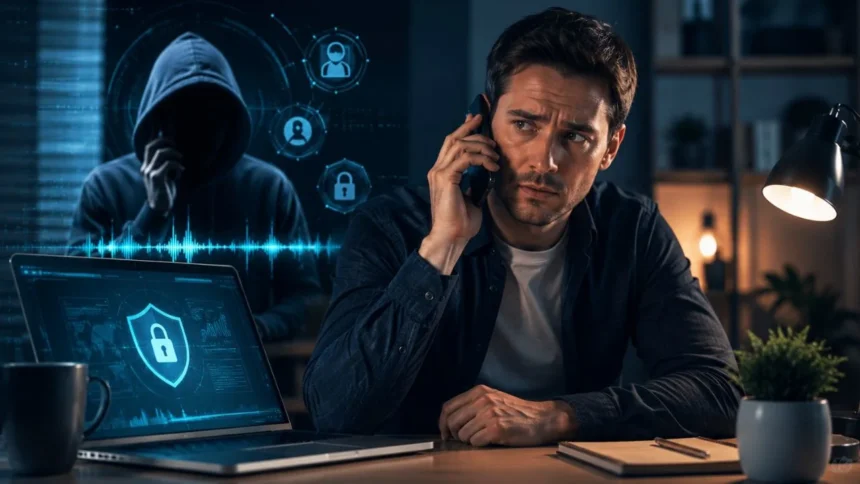
A phone call from a bank, government department, employer, or family member may seem trustworthy. However, the person speaking may not be who they claim to be. Cybercriminals increasingly use convincing phone conversations, automated messages, and voice recordings to manipulate people into sharing private information or sending money.
This type of cybercrime is known as a vishing attack. The word vishing combines voice and phishing. Instead of relying mainly on fraudulent emails, attackers use telephone calls, voice messages, or Voice over Internet Protocol services to create a believable story and pressure the target into acting quickly.
Vishing is particularly dangerous because people often treat spoken communication as more genuine than an email or text message. A confident caller can answer questions, change the story, and react to hesitation in real time. These human interactions make voice phishing an effective form of social engineering.
Modern vishing scams have also become harder to recognize because attackers can spoof caller ID information and generate realistic voices with artificial intelligence. Understanding how these scams operate can help individuals and businesses protect their accounts, money, customer data, and digital identities.
What Is a Vishing Attack?
A vishing attack is a social engineering attack conducted through a phone call, voice message, or internet-based calling service. The attacker pretends to represent a trusted person or organization and tries to persuade the victim to reveal sensitive information, approve a transaction, visit a fraudulent website, or install malicious software.
The FBI describes vishing as a phishing variation that happens through telephone calls, voice email, or VoIP calls. Like traditional phishing, it depends on impersonation and psychological manipulation. The main difference is the communication channel, since the criminal uses spoken words rather than relying entirely on written messages.
A vishing scam may target bank account details, card numbers, passwords, personal identification information, security answers, or one-time verification codes. Some attackers ask victims to transfer money, purchase gift cards, send cryptocurrency, or install remote-access software that gives the criminal control of a computer or mobile device.
The attacker’s goal is not always immediate financial theft. A criminal may collect employee information, internal contact details, login credentials, or business procedures for a larger cyberattack. The stolen information can later support account takeover, identity theft, business email compromise, data theft, or unauthorized access to company systems.
How Does a Vishing Attack Work?
A typical vishing attack begins with research. Criminals may collect names, job titles, phone numbers, social media posts, leaked passwords, company details, or information from previous data breaches. These details help them create a story that sounds personal, relevant, and believable to the intended victim.
The attacker then contacts the target while pretending to be a bank employee, technical support agent, government officer, delivery company, manager, customer, or family member. The caller may already know several facts about the person, which can make the conversation appear legitimate before any sensitive information is requested.
Next, the criminal introduces urgency, fear, authority, or financial opportunity. The target may be told that an account has been compromised, a payment is overdue, a relative is in danger, or a business system requires immediate verification. This emotional pressure reduces the time available for careful thinking.
Finally, the caller asks the target to complete an action. That action might involve sharing an OTP, confirming a password, transferring money, clicking a link, downloading software, or approving a login request. Once the information or access is obtained, the attacker can steal funds, enter accounts, or continue the attack.
Why Vishing Attacks Are So Convincing
Vishing succeeds because it targets human judgment rather than attacking technology directly. Most people want to cooperate when a caller appears helpful, professional, or concerned. Criminals exploit this instinct by presenting themselves as someone who can solve an urgent financial, legal, technical, or personal problem.
Authority is another strong influence. A caller claiming to represent a bank, police department, tax agency, or senior manager may sound difficult to challenge. The victim may follow instructions because refusing feels risky, disrespectful, or likely to create further problems.
Attackers also create urgency to prevent independent verification. Statements such as “your account will be closed,” “you must pay today,” or “someone is currently withdrawing your money” push the target toward an emotional decision. The FTC warns that honest organizations generally allow people time to consider an offer or verify a request.
The conversational nature of a phone call also benefits the attacker. Unlike a suspicious email that can be reviewed carefully, a caller can change tactics immediately. If the victim asks a question, the criminal can provide a prepared answer, apply more pressure, or use sympathy to keep the conversation moving.
Common Types of Vishing Attacks
Bank impersonation is one of the most familiar vishing techniques. The caller claims that suspicious activity has been detected and asks the victim to confirm account details, card information, login credentials, or an OTP. The criminal may then use those details to access the real account and transfer money.
Government impersonation scams use fear and authority. Attackers may pretend to represent a tax authority, police department, immigration office, court, or benefits agency. They might threaten arrest, fines, deportation, or account suspension unless the target provides information or makes an immediate payment.
Technical support vishing involves a caller claiming that the victim’s computer, internet connection, subscription, or business account has a serious problem. The caller may request remote access, ask the person to install software, or demand payment for a fake repair. Legitimate security alerts do not normally require users to call an unknown number.
Family emergency scams use emotional pressure. A criminal may pretend to be a relative, lawyer, doctor, or police officer and claim that someone needs urgent financial help. AI voice cloning can make these calls more convincing by imitating the voice of a person the victim knows.
Vishing vs Phishing vs Smishing
Phishing is the broader category of scams that use impersonation to steal information, money, or account access. Traditional phishing usually arrives through email and may direct the recipient to a fake login page. The message often pretends to come from a known company, service provider, colleague, or financial institution.
Vishing is voice phishing. It uses live calls, recorded messages, voice notes, or VoIP services to communicate with the target. The attacker may request information directly or use the call to persuade the person to visit a malicious website, approve a login, or install remote-access software.
Smishing is phishing delivered through SMS or multimedia text messages. A smishing message may include a fake delivery notice, payment alert, job offer, account warning, or shortened link. The message may also instruct the recipient to call a number, which turns the incident into a combined smishing and vishing attack.
All three methods rely on social engineering, impersonation, urgency, and trust. The communication channel is different, but the objective is usually similar. The criminal wants the target to reveal sensitive data, open a harmful link, send money, or provide access to an account or device.
Common Warning Signs of a Vishing Scam
An unexpected request for sensitive information is one of the clearest warning signs. Legitimate organizations should not need callers to reveal complete passwords, PINs, card security codes, or one-time verification codes. A caller asking for these details should be treated as suspicious, regardless of the number shown.
Urgency and threats are also common. A scammer may say that an account will be frozen, an arrest warrant will be issued, or money will disappear unless the victim acts immediately. These statements are designed to create panic and prevent the person from checking whether the claim is genuine.
Unusual payment instructions are another serious warning. Requests for gift cards, cryptocurrency, payment apps, wire transfers, or cash deliveries are frequently connected to fraud. The FTC advises that demands for these difficult-to-reverse payment methods are a strong indication of a phone scam.
A professional tone or familiar caller ID does not prove that a call is genuine. Criminals can fake the name and number displayed on a phone, a practice known as caller ID spoofing. A call that appears to come from a local number, government department, or bank may originate from anywhere.
How Caller ID Spoofing Supports Vishing
Caller ID spoofing allows criminals to change the number or name displayed on the recipient’s phone. The caller may make the call appear to come from a bank, government office, local business, or familiar area code. This visual detail can make the target more willing to answer and trust the conversation.
Some attackers copy the real customer service number of an organization. When the victim checks the screen, the displayed number may match the number printed on a card or shown on an official website. However, the displayed information does not confirm where the call actually originated.
VoIP services make it easier for attackers to place large numbers of calls from different locations. Criminal groups can use automated dialing systems, prerecorded messages, and temporary phone numbers to contact many targets at a relatively low cost. They may then direct responsive victims to live fraud operators.
People should therefore avoid using caller ID as their main verification method. When a call involves money, account access, or personal data, hang up and contact the organization independently. Use the number printed on an official document, payment card, account statement, or verified website.
How AI Voice Cloning Is Changing Vishing
AI voice cloning has introduced a more convincing form of voice phishing. Attackers can use audio samples to create synthetic speech that resembles a real person. The generated voice may imitate a relative, executive, public official, colleague, or other trusted individual during a call or voice message.
The FBI warned in 2025 that malicious actors were using AI-generated voice messages to impersonate senior officials and build trust with targeted individuals. In some cases, the attackers attempted to move victims to another messaging platform before sending malicious links or requesting sensitive information.
Voice cloning is particularly effective in emergency and executive impersonation scams. An employee may hear what sounds like a manager requesting an urgent payment. A parent or grandparent may hear what sounds like a relative asking for financial help after an accident, arrest, or medical emergency.
Recognizing synthetic audio by sound alone is becoming less reliable. Unnatural pauses, unusual wording, audio delays, or changes in tone may raise suspicion, but high-quality cloned voices can sound realistic. Independent verification is more dependable than trying to judge whether a familiar voice sounds slightly different.
Why Verification Code Scams Are Dangerous
A verification code, also called an OTP or one-time password, provides an additional security layer during login. Even when a criminal has obtained a password, the account may remain protected because the attacker still needs the temporary code sent to the account owner’s phone or email.
Vishing criminals try to overcome this protection by calling the account owner. They may claim to be investigating fraud, reversing a payment, confirming an identity, or protecting the account. During the call, they trigger a real login attempt and ask the victim to read the code that arrives.
Once the victim shares the code, the attacker may complete the login and take control of the account. The criminal could change passwords, add new payment details, transfer funds, access private information, or use the compromised account to target additional people.
A verification code should only be entered by the person who requested it on the genuine service or application. It should never be read aloud to a caller. The FTC advises people to hang up and contact the organization directly through a trusted number when an unexpected caller requests a code.
How to Protect Yourself From Vishing Attacks
The safest response to a suspicious call is to pause and end the conversation. Do not allow the caller’s urgency to control your decision. A legitimate bank, employer, or government department should allow you to verify the request through an official and independently confirmed communication channel.
Never provide passwords, PINs, complete payment card details, account security answers, or verification codes during an unexpected call. Avoid confirming personal information that the caller already mentions. Even a simple confirmation can help criminals validate stolen data and prepare more targeted scams.
Contact the organization by using a number you already trust. This could be the number on the back of a bank card, inside an official mobile application, or on a verified account statement. Do not call a number supplied by the suspicious caller or included in an unexpected message.
Protect accounts with multi-factor authentication and use phishing-resistant authentication where it is available. Review account activity regularly, enable transaction alerts, limit public personal information, and keep devices updated. These measures cannot stop every call, but they can reduce the damage caused by stolen information.
How Businesses Can Prevent Vishing Attacks
Businesses should include vishing in their cybersecurity awareness training rather than focusing only on email phishing. Employees need practical examples of fake IT support calls, executive impersonation, password reset requests, supplier fraud, payroll changes, and calls asking for customer or employee information.
Clear verification procedures can prevent rushed decisions. Sensitive actions such as payment changes, password resets, data disclosure, and account recovery should require confirmation through a second trusted channel. An employee should never approve a high-risk request based only on an incoming phone call.
Help desk teams need stronger identity checks because they are common targets of social engineering. Attackers may impersonate employees and request password resets or changes to multi-factor authentication. Staff should follow documented identity verification steps, even when the caller claims that the matter is urgent.
Organizations should also make reporting simple. Employees should know where to report a suspicious call, voice message, login prompt, or payment request. Security teams can then warn other staff, review access logs, block affected accounts, and investigate whether the attacker contacted additional employees.
What to Do After a Vishing Attack
If sensitive information was shared, act immediately. Contact the affected bank, employer, service provider, or account administrator through a trusted channel. Explain exactly what information was disclosed and ask them to secure the account, review recent activity, and block unauthorized transactions.
Change exposed passwords and avoid reusing the new password on other accounts. Sign out of active sessions, remove unfamiliar devices, and review recovery email addresses and phone numbers. When possible, replace text-based authentication with an authenticator application, security key, or another stronger method.
When money has been transferred, contact the bank, card issuer, payment service, or transfer company as quickly as possible. Report the transaction as fraudulent and ask whether it can be stopped or reversed. Speed matters because criminals may move stolen funds through several accounts.
Document the caller’s number, time of contact, claimed identity, payment instructions, and information requested. Report the incident to the appropriate fraud or cybercrime authority in your country. Businesses should also preserve call records and system logs for internal investigation and possible law-enforcement reporting.
The Role of Cybersecurity Awareness
Technology can block some fraudulent calls, but it cannot make every decision for the person receiving them. Cybersecurity awareness helps people recognize manipulation, question unexpected requests, and verify identities before disclosing information or approving financial actions.
Effective awareness training should focus on realistic situations rather than definitions alone. Employees and individuals benefit from learning how urgency, authority, fear, sympathy, and familiarity are used during social engineering attacks. Recognizing these emotional triggers can create a valuable moment of hesitation.
Training should also explain that anyone can become a target. Vishing victims are not necessarily careless or unfamiliar with technology. Skilled attackers prepare convincing stories, use stolen personal information, impersonate trusted organizations, and adjust their approach according to the victim’s responses.
A healthy security culture allows people to stop, question, and report suspicious requests without fear of embarrassment. When verification becomes normal, attackers lose one of their biggest advantages. A brief independent phone call can prevent identity theft, bank fraud, data loss, or a wider organizational breach.
Final Thoughts on Vishing Attacks
A vishing attack uses voice communication to manipulate people into sharing information, transferring money, or providing access to accounts and systems. It is a form of phishing and social engineering that can affect individuals, families, employees, financial institutions, and organizations of every size.
The most effective vishing attacks do not sound obviously fraudulent. They may use accurate personal information, familiar phone numbers, professional language, or AI-generated voices. Their success often depends on making the target feel frightened, helpful, hurried, or unable to challenge authority.
The best defense is independent verification. Do not trust a call simply because the speaker sounds familiar or the displayed number looks correct. End the conversation and contact the person or organization through a communication channel that you have used and confirmed before.
Vishing will continue to change as criminals gain access to better automation, voice-generation tools, and stolen data. However, the basic protection remains simple: slow down, protect sensitive information, question unexpected requests, and verify before taking action.
Frequently Asked Questions
What is a vishing attack in simple words?
A vishing attack is a fraudulent phone call or voice message designed to trick someone into sharing private information, sending money, or giving access to an account.
What information do vishing attackers usually request?
Attackers commonly request passwords, card details, bank information, PINs, identity details, security answers, and one-time verification codes.
Can a vishing call appear to come from my bank?
Yes. Criminals can use caller ID spoofing to display a bank’s name or phone number. Always hang up and call the bank using an independently verified number.
How can I identify an AI-generated voice scam?
Unusual pauses, unnatural wording, or audio delays may raise suspicion, but they are not reliable proof. Verify the request by contacting the person through a known number.
What should I do if I shared an OTP with a caller?
Contact the affected company or bank immediately, change the account password, review recent activity, remove unknown devices, and report unauthorized transactions.