
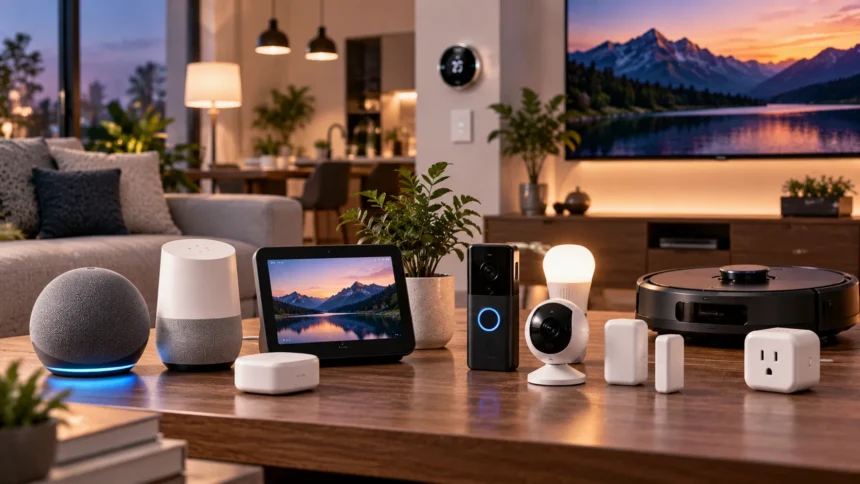
Smart home technology in 2026 is less about filling your house with gadgets and more about choosing devices that genuinely save time, improve security, reduce energy waste, or make everyday routines easier. Smart speakers, thermostats, locks, lights, cameras, plugs, and robot vacuums can now communicate more smoothly than earlier generations.
The biggest improvement is broader support for standards such as Matter and Thread. These technologies are helping devices from different manufacturers work together through platforms including Amazon Alexa, Google Home, Apple Home, and Samsung SmartThings. However, compatibility, subscriptions, privacy, and hub requirements still vary enough that careful buying decisions matter.
The best smart home devices to buy in 2026 are therefore products that combine useful automation with dependable hardware and flexible ecosystem support. Rather than buying everything at once, start with devices that solve a real problem in your home and gradually expand your setup around a compatible platform.
What to Look for in Smart Home Devices in 2026
Compatibility should be your first consideration because a smart device is only convenient when it works with the platform you already use. Check support for Alexa, Google Home, Apple Home, SmartThings, Matter, or Thread before buying. Matter has improved cross-platform interoperability, although some advanced manufacturer-specific features may still require the original brand’s app.
Think about whether the device depends on the cloud or can continue performing basic automations locally. Cloud-based systems can provide powerful remote features, but internet outages or service changes may affect functionality. Devices offering reliable local control can make lights, switches, sensors, and automations feel faster while reducing dependence on an external server.
Finally, consider ongoing costs alongside the purchase price. Security cameras and video doorbells often reserve extended video history, advanced detection, or cloud storage for paid plans. A cheaper device can ultimately cost more than a premium alternative if several years of subscription fees are required, so compare long-term ownership rather than the initial price alone.
Best Smart Speakers and Home Hubs
Smart speakers remain one of the easiest ways to begin building a connected home because they provide voice control for lights, plugs, thermostats, routines, timers, and entertainment. In 2026, current ecosystem choices include Amazon’s Echo Dot Max, Google’s newer Google Home Speaker, and Apple’s HomePod mini. Your existing phone and services should strongly influence which ecosystem you choose.
Amazon’s Alexa ecosystem remains particularly broad for people who want extensive smart-device compatibility, while Apple users may appreciate tighter integration between HomePod and Apple Home. Google’s current smart-home approach makes the most sense for households already using Google services. Switching ecosystems later is possible, but selecting one primary platform keeps routines and device management simpler.
Smart speakers can handle voice commands and casual communication, but they are not necessarily replacements for dedicated recording equipment. If your smart-home space also doubles as an office, studio, or content-creation room, dedicated podcast microphones can provide clearer audio for meetings and recordings than relying on a distant smart speaker microphone.
Best Smart Thermostats for Comfort and Energy Control
A smart thermostat can be one of the most practical home automation upgrades because heating and cooling operate every day. The Ecobee Smart Thermostat Premium and Google Nest Learning Thermostat 4th Gen remain prominent 2026 choices, with Consumer Reports including Ecobee, Nest, Honeywell Home, Mysa, and Sensibo models among its current tested recommendations.
Ecobee’s Premium model is particularly useful for homes that benefit from room-based sensing and broader smart-home integration. Google’s fourth-generation Nest Learning Thermostat offers an updated interface, remote temperature sensing, and Matter support, making it an appealing option for Google-centered homes. HVAC compatibility should always be verified before replacing your existing thermostat.
Do not assume every home will achieve identical energy savings simply by installing a connected thermostat. Results depend on your climate, insulation, HVAC system, schedule, and existing temperature habits. The biggest convenience comes from automated scheduling, remote adjustments, occupancy-aware control, and better visibility into how your heating and cooling system is being used.
Best Smart Lighting Systems
Philips Hue remains one of the strongest smart-lighting ecosystems in 2026 because of its extensive range of bulbs, lamps, accessories, scenes, and automation options. TechRadar continues to identify Hue as a leading overall smart-lighting system, while alternatives from Govee, Nanoleaf, IKEA, and GE provide attractive choices at different prices and compatibility levels.
Smart lighting becomes much more useful when you move beyond simply turning bulbs on from your phone. Motion sensors, schedules, sunrise routines, presence detection, and scene automation can create lighting that adjusts automatically throughout the day. Bedrooms, hallways, entrances, and living spaces are usually better places to start than replacing every bulb simultaneously.
Matter is also making it easier to mix compatible lighting from multiple manufacturers. You might use premium Hue products in frequently used rooms while choosing less expensive Matter-compatible bulbs elsewhere. However, advanced effects and specialized features can remain exclusive to each manufacturer’s app, so one ecosystem may still provide a simpler experience for large installations.
Best Smart Locks for Keyless Entry
Smart locks remove the need to search for keys and can make it easier to provide temporary access to relatives, visitors, cleaners, or service professionals. Strong 2026 choices include the Schlage Encode Plus for households that value established lock hardware and Apple Home Key support, while the Aqara U200 offers a feature-rich alternative for broader smart-home setups.
Before buying, check whether the lock replaces your entire deadbolt or works with existing hardware. Also consider fingerprint access, keypad entry, phone unlocking, physical backup keys, and remote control. Features that sound impressive on a product page matter less than consistent locking, reliable battery alerts, and a design that operates smoothly with your actual door.
Security should remain more important than convenience. Use strong account passwords, enable multi-factor authentication when available, and keep firmware updated. A smart lock should also provide a dependable backup method for situations involving a dead battery, network problem, or lost phone so that digital convenience does not create an unnecessary access problem.
Best Security Cameras and Video Doorbells
Google’s third-generation wired Nest Cam is a notable current choice for indoor monitoring, with improved 2K video and limited onboard event storage. For buyers trying to avoid monthly subscriptions, Eufy continues to offer several cameras with local-storage options. Your decision should consider video quality, nighttime performance, storage, alerts, privacy, and subscription requirements together.
At the front door, Google’s third-generation wired Nest Doorbell is among the prominent 2026 options, while Blink and Eufy provide alternatives for people prioritizing price or subscription-free features. Doorbell cameras are particularly useful for monitoring deliveries and identifying visitors, but cloud storage plans can significantly change their long-term cost.
Privacy deserves additional consideration whenever you place internet-connected cameras around your property. Avoid pointing indoor cameras toward private spaces unless there is a clear reason, review account permissions, and use strong authentication. Local storage may appeal to privacy-conscious users, although it still needs to be configured securely and protected from physical theft or unauthorized account access.
Best Smart Plugs for Simple Automation
Smart plugs are among the cheapest and easiest ways to make ordinary appliances controllable through schedules, apps, or voice commands. Current 2026 recommendations include models such as the TP-Link Tapo P110M and Kasa KP125M, which combine broad ecosystem compatibility with useful features such as Matter support and energy monitoring on supported configurations.
They work particularly well with lamps, fans, coffee-making equipment that safely supports switched operation, holiday lights, and other simple appliances. Scheduling a lamp to switch on before sunset or automatically turning off devices overnight provides immediate practical value without installing permanent electrical hardware or replacing the appliance itself.
Always check the smart plug’s maximum electrical load before connecting an appliance. High-power heaters, air conditioners, motors, and some kitchen appliances may exceed what a particular plug is designed to handle. Smart plugs should also never be used to bypass appliance safety controls or automate equipment that requires supervision while operating.
Best Robot Vacuums for Automated Cleaning
Robot vacuums have become some of the most sophisticated smart-home devices available. The Roborock Saros 20 is a major 2026 flagship, combining strong floor-cleaning performance with automated dust emptying, mop washing, drying, water management, and advanced navigation. Independent testing has found especially strong hard-floor cleaning and capable pet-hair performance.
Premium robots can now vacuum, mop, identify floor types, raise their chassis, navigate thresholds, clean edges, and maintain much of their own docking equipment. The tradeoff is price: advanced models can cost significantly more than traditional robot vacuums. For smaller homes, a simpler self-emptying model may provide most of the practical convenience for considerably less money.
Do not assume that even the smartest robot can navigate every household completely unattended. Cables, small toys, pet accidents, unusual furniture, and difficult floor transitions can still cause problems. The Saros 20, for example, performs strongly in many cleaning tests, but independent evaluations have reported inconsistent avoidance of certain small obstacles and pet waste.
Matter and Thread Are Worth Understanding
Matter is an interoperability standard designed to make smart-home products work across multiple major ecosystems. A Matter-certified device may be controllable through platforms such as Apple Home, Google Home, Alexa, or SmartThings instead of being locked entirely into one manufacturer’s ecosystem. This makes it an important feature to consider when buying devices intended to remain in your home for years.
Thread is a low-power mesh networking technology commonly used by newer smart-home products. Devices can communicate through a Thread network rather than adding every accessory directly to Wi-Fi, helping create responsive local connections. Some Matter devices use Thread, while others use Wi-Fi or Ethernet, so seeing the Matter logo does not automatically tell you how the product connects.
A Thread Border Router may be required for Matter-over-Thread accessories to join the wider home network. Some smart speakers, hubs, and streaming devices can provide this functionality, depending on model and generation. Checking your existing hardware before buying new sensors, plugs, or lights can prevent you from discovering afterward that another hub or border router is required.
How to Build a Smart Home Without Overspending
Start with one problem rather than buying an entire ecosystem in a single weekend. If you frequently forget lights, begin with smart bulbs or plugs. If energy management is your priority, consider a thermostat. If home access or package monitoring matters most, a smart lock or video doorbell will probably provide greater everyday value than decorative connected gadgets.
Choose a primary ecosystem early, but favor products with broad compatibility whenever practical. Matter-supported devices can provide additional flexibility if you later change phones or voice assistants. At the same time, do not pay extra for compatibility you will never use; households committed to one platform may benefit more from features designed specifically for that ecosystem.
Automation should reduce effort instead of creating more maintenance. A simple routine that turns off downstairs lights and adjusts the thermostat at bedtime can be more useful than dozens of complicated automations requiring constant troubleshooting. Build gradually, observe which devices you actually use, and expand only when another connected product solves a clear everyday problem.
Smart Home Privacy, Security, and Subscription Costs
Every internet-connected device creates another account, application, or network endpoint that needs basic security. Use unique passwords, enable multi-factor authentication, update firmware, and remove devices from your accounts before selling or giving them away. Security cameras, smart locks, and doorbells deserve particular attention because compromise could expose sensitive information about your home.
Subscription costs can also accumulate surprisingly quickly. One camera service, professional security monitoring plan, cloud video package, and premium automation service can turn inexpensive hardware into a substantial annual expense. Before choosing a device, identify which features continue working without a subscription and which capabilities disappear if you stop paying.
Privacy-conscious buyers should look for clear data policies, useful local-control options, and meaningful control over recording and cloud storage. Consumer Reports now includes data privacy and security considerations when evaluating connected cameras and other smart-home equipment, reflecting how important these factors have become alongside hardware performance.
Conclusion
The best smart home devices to buy in 2026 are the ones that make everyday routines simpler without locking you into unnecessary complexity. Smart speakers, thermostats, lighting, locks, cameras, plugs, and robot vacuums each solve different problems, so the ideal combination depends on your home and priorities.
Matter and Thread are making compatibility less confusing, but checking platform support before purchasing remains essential. Consider long-term subscription costs, privacy, local control, and whether the product provides meaningful everyday value rather than choosing devices purely because they are new or heavily advertised.
Begin with one or two useful devices and expand gradually. A carefully planned smart home with a reliable thermostat, lighting routine, lock, and cleaning automation can be more useful than dozens of disconnected gadgets. The goal should be a home that quietly works around your routines rather than one that constantly demands your attention.
FAQs
What is the best smart home device to buy first?
A smart speaker, smart plug, or smart bulb is usually an easy starting point because installation is simple and affordable. A thermostat may provide more value if energy management is your main priority.
Is Matter important for smart home devices in 2026?
Yes. Matter can improve compatibility between devices and major smart-home platforms, reducing ecosystem lock-in. However, advanced features may still require the manufacturer’s own app, and some Matter devices also require suitable hubs or Thread infrastructure.
Do smart home devices work without the internet?
Some devices and local automations can continue operating without internet access, especially when using local hubs or Thread networks. Cloud-dependent features, remote access, voice services, and notifications may stop until connectivity returns.
Are smart security cameras worth buying without a subscription?
Yes, particularly models that provide microSD, base-station, or other local storage. However, subscriptions may add longer video history, cloud backups, advanced AI detection, and other features, so compare exactly what remains available for free.
Can different smart home brands work together?
Often, yes. Alexa, Google Home, Apple Home, SmartThings, and Matter can connect many products from different manufacturers. Compatibility still varies, so check the exact model and supported features before purchasing.