

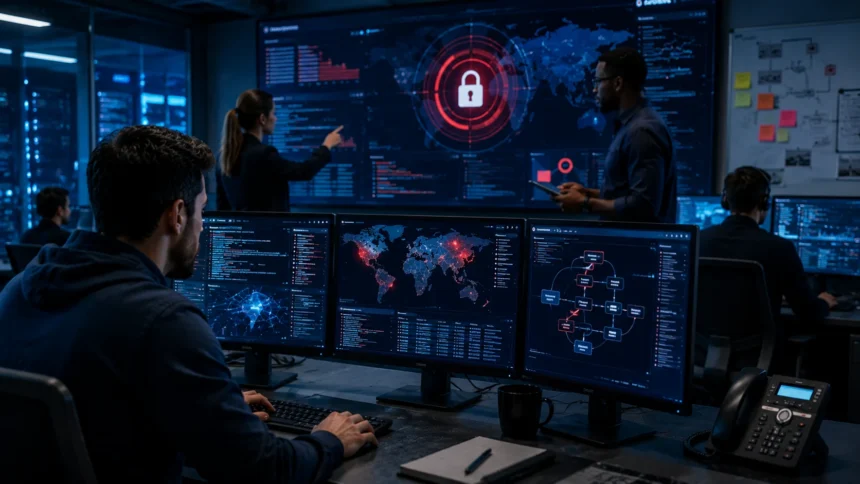
What Is Incident Response in Cybersecurity?
Cybersecurity incidents can happen to organizations of any size, from small businesses to global enterprises. A stolen employee password, malware infection, ransomware attack, data breach, compromised cloud account, or suspicious network connection can quickly disrupt normal operations. The way an organization reacts during those first critical moments can determine whether the incident remains contained or develops into a much larger security and business problem.
Incident response is the structured process organizations use to identify, investigate, contain, remove, and recover from cybersecurity threats. Instead of making decisions under pressure without a plan, security teams follow predefined procedures that help them understand what happened and reduce further damage. A strong response process also preserves evidence, improves communication, and supports business recovery while the technical investigation continues.
Modern incident response involves more than simply removing malware from an infected computer. Security teams may need to analyze logs, isolate compromised devices, disable accounts, block malicious infrastructure, investigate cloud activity, preserve forensic evidence, restore systems, and communicate with management or legal teams. Serious incidents may also involve customers, regulators, insurers, law enforcement, and external cybersecurity specialists.
Understanding what incident response is in cybersecurity helps organizations prepare for threats before an emergency occurs. The goal is not only to stop an active attack but also to understand its cause, determine what was affected, recover safely, and prevent similar incidents from succeeding again. A mature incident response program turns security events into opportunities to strengthen defenses and improve organizational resilience.
What Is Incident Response?
Incident response is a coordinated cybersecurity process used to manage security incidents from initial detection through recovery and post-incident improvement. It provides security teams with a repeatable framework for handling events that threaten the confidentiality, integrity, or availability of systems and information. Without an organized approach, teams may overlook important evidence, make inconsistent decisions, or accidentally allow attackers to continue operating inside the environment.
A cybersecurity incident is generally more serious than an ordinary security event or alert. Security tools generate large numbers of events every day, including failed logins, blocked connections, software changes, and unusual behavior. Incident response begins when available evidence indicates that activity may represent a genuine compromise, policy violation, data exposure, or another situation requiring coordinated investigation and action.
The process usually involves several connected activities, including preparation, detection, analysis, containment, eradication, recovery, and lessons learned. These phases help organizations move logically from understanding the threat to restoring normal business operations. The exact structure may vary between organizations, but successful incident response always depends on clear responsibilities, reliable security data, established procedures, and effective communication.
Incident response is therefore both a technical and organizational capability. Cybersecurity analysts may perform the investigation, but IT administrators, executives, legal professionals, communications teams, cloud engineers, and business leaders may also become involved. Serious incidents can affect operations, customers, finances, reputation, and regulatory responsibilities, so effective response requires coordination beyond the cybersecurity department.
Why Is Incident Response Important?
Cyberattacks can move quickly once an attacker gains access to an environment. A compromised account may be used to access email, steal additional credentials, move between systems, collect sensitive information, and eventually deploy ransomware. The longer malicious activity remains active, the greater the opportunity for the attacker to increase the scope and impact of the compromise.
Incident response helps organizations reduce that exposure by creating a structured way to recognize and contain threats. When analysts know exactly how to escalate suspicious activity and which actions they are authorized to take, valuable time is not wasted deciding what to do. Faster containment can limit data theft, reduce business disruption, and prevent attackers from compromising additional systems or accounts.
A formal response process also improves decision-making during stressful situations. Security incidents often create uncertainty because teams may not immediately know how attackers entered, which systems are affected, or whether sensitive information has been stolen. Defined procedures encourage responders to gather evidence methodically rather than making assumptions that could result in unnecessary disruption or incomplete remediation.
Finally, incident response supports long-term security improvement. Every significant incident reveals something about existing defenses, whether that is a missing detection rule, weak authentication control, unpatched vulnerability, poor network segmentation, or unclear internal procedure. Analyzing these lessons allows organizations to strengthen security so future attacks are detected earlier and handled more effectively.
What Is a Cybersecurity Incident?
A cybersecurity incident is an event that threatens or compromises an organization’s systems, networks, applications, accounts, or information. Examples include unauthorized access, malware infections, ransomware, stolen credentials, data exposure, insider misuse, denial-of-service attacks, or exploitation of a vulnerable application. The defining characteristic is that the event creates meaningful security risk and requires investigation or response.
Not every unusual activity becomes a security incident. A user entering the wrong password once may simply be a normal mistake, while hundreds of failed login attempts across many accounts could indicate a credential attack. Security teams evaluate the context, scope, severity, and available evidence before deciding whether an alert should be formally classified as an incident.
The same security event can also carry different levels of risk depending on the affected asset. Suspicious activity involving a temporary test system may have limited business impact, while similar behavior involving a database containing customer information could require immediate escalation. Incident classification therefore considers both technical activity and the importance of the systems or information involved.
Organizations often establish severity categories such as low, medium, high, or critical to help prioritize response activities. A low-severity incident may require routine investigation, while a critical incident could trigger executive involvement, business continuity plans, external specialists, and legal review. Clear classification ensures that the most dangerous incidents receive the fastest and most appropriate response.
What Is the Incident Response Process?
The incident response process provides a structured sequence of activities for managing cybersecurity incidents. Although specific frameworks may use slightly different terminology, most approaches include preparation, detection, analysis, containment, eradication, recovery, and post-incident review. These stages help responders move systematically from initial suspicion to complete restoration and long-term improvement.
The process usually begins before any attack occurs. Organizations identify important systems, establish response procedures, configure monitoring, assign responsibilities, create communication channels, and prepare technical tools. When suspicious activity is later detected, analysts investigate the evidence to determine whether an actual security incident exists and how serious the situation may be.
Confirmed incidents then move into containment and eradication. Containment limits the attacker’s ability to cause additional harm, while eradication removes malware, unauthorized access, vulnerabilities, or persistence mechanisms. Security teams must balance speed with evidence preservation because aggressive actions taken too early can sometimes destroy information needed to understand how the attack occurred.
Recovery returns affected systems and services to normal operation after the threat has been removed. Monitoring usually continues to ensure attackers have not regained access. Once the immediate emergency is over, teams conduct a structured review to understand what worked, what failed, and which security improvements should be implemented before another incident occurs.
Phase 1: Preparation
Preparation is the foundation of effective incident response because organizations should not wait until a cyberattack begins to decide how they will react. Security teams create response plans, define responsibilities, establish communication procedures, identify critical assets, and determine which people have authority to make containment decisions. These preparations reduce confusion when rapid action becomes necessary.
Technical readiness is equally important. Organizations need reliable logging, endpoint security, network monitoring, identity visibility, secure backups, forensic capabilities, and centralized security platforms where analysts can investigate suspicious activity. If important systems do not generate useful logs, responders may struggle to determine when an attack started or what information the attacker accessed.
Preparation also includes creating incident response playbooks. A phishing incident, ransomware attack, compromised administrator account, and cloud data exposure may require different investigative and containment steps. Playbooks give responders clear guidance for common scenarios while still allowing experienced analysts to adapt when an incident does not fit a predefined pattern.
Regular training and exercises complete the preparation process. Tabletop exercises allow technical teams, executives, legal professionals, communications staff, and other stakeholders to practice their responsibilities without experiencing a real emergency. These exercises often reveal gaps in contact information, decision authority, technical access, backup procedures, or communication plans before those weaknesses become serious problems.
Phase 2: Detection and Identification
Detection begins when a security tool, employee, customer, external partner, or other source reports potentially suspicious activity. Alerts may come from SIEM platforms, endpoint detection tools, firewalls, email security systems, cloud monitoring, identity platforms, or intrusion detection technologies. Employees may also report suspicious emails, unexpected account activity, or unusual behavior on their devices.
Security analysts review the available information to determine whether the event represents a genuine incident. This usually involves examining logs, user activity, network connections, endpoint processes, file changes, authentication records, and threat intelligence. The goal is to gather enough evidence to distinguish malicious activity from harmless technical behavior or a false positive generated by a security tool.
Context is particularly important during identification. A login from a new device may be legitimate if the employee recently received a replacement computer, while the same login may become suspicious if it originates from malicious infrastructure and is followed by unexpected access to sensitive files. Analysts combine several pieces of evidence rather than relying on one event alone.
Once the team confirms that an incident has occurred, it records important details such as affected users, devices, systems, timestamps, suspected attacker activity, and initial severity. Accurate documentation helps other responders understand the current situation and prevents valuable evidence from being lost as the investigation expands across additional technologies or business areas.
Phase 3: Analysis and Investigation
Analysis aims to understand exactly what happened, how the attacker gained access, which systems were affected, and what the attacker attempted to accomplish. Responders examine security logs, endpoint telemetry, authentication events, network traffic, cloud activity, malware indicators, and other evidence to reconstruct the sequence of events surrounding the incident.
Establishing a timeline is one of the most valuable investigative steps. Analysts may determine when initial compromise occurred, when attackers obtained additional privileges, which accounts they used, and when they accessed sensitive systems. A detailed timeline can reveal that activity discovered today actually began several days or weeks earlier, significantly changing the scope of the investigation.
Responders also look for indicators of compromise such as suspicious IP addresses, domains, files, commands, processes, administrator accounts, or unusual login patterns. These indicators can be searched across the rest of the environment to determine whether additional systems have been affected. This helps security teams avoid treating one visible symptom while leaving related compromise undiscovered.
The analysis phase should continuously refine the team’s understanding of severity and scope. New evidence may show that an apparently isolated malware infection is actually part of a broader intrusion involving multiple accounts and systems. Incident responders must therefore remain prepared to expand containment measures when the investigation reveals that the attack is larger than initially believed.
Phase 4: Containment
Containment focuses on preventing attackers from causing additional damage while the investigation continues. Depending on the incident, security teams may isolate infected endpoints, disable compromised user accounts, block malicious IP addresses, revoke authentication sessions, restrict network access, or temporarily disable vulnerable services. The goal is to stop attacker activity without unnecessarily disrupting unrelated business systems.
Short-term containment may prioritize speed. If ransomware is actively spreading, isolating affected devices immediately may be more important than conducting a lengthy investigation first. Similarly, a compromised administrator account may need to be disabled quickly to prevent the attacker from gaining additional privileges or accessing sensitive information while analysts continue gathering evidence.
Longer-term containment creates a stable environment while permanent remediation is prepared. Teams may move affected services to isolated networks, introduce temporary firewall rules, increase monitoring, or limit user permissions. These actions allow the organization to continue essential operations while reducing the attacker’s ability to regain access or expand the compromise.
Containment decisions should consider both cybersecurity risk and business impact. Shutting down a critical system may stop malicious activity but could also interrupt essential operations. Mature incident response teams therefore coordinate with system owners and business leaders when time allows, balancing the urgency of security actions against the consequences of taking important services offline.
Phase 5: Eradication
Eradication removes the root cause and remaining traces of the compromise after the incident has been contained. Simply stopping visible attacker activity is not enough because malware, unauthorized accounts, stolen credentials, scheduled tasks, malicious cloud applications, or other persistence mechanisms may allow the attacker to return after systems appear normal.
Security teams identify and remove malicious files, disable unauthorized accounts, reset compromised passwords, patch exploited vulnerabilities, delete persistence mechanisms, and correct insecure configurations. In some cases, rebuilding a compromised system from a trusted source may be safer than attempting to remove every malicious component individually, especially when administrator-level access was obtained.
Eradication should also address the attacker’s original entry point. If phishing exposed credentials, password resets and stronger authentication may be required. If an unpatched application was exploited, teams need to update the vulnerable software. Removing malware without fixing the weakness that enabled the attack could allow the same attacker or another adversary to compromise the environment again.
Responders must verify that remediation has actually worked. Endpoint scans, log analysis, vulnerability testing, account reviews, and additional threat hunting can help confirm that malicious activity is no longer present. Teams should avoid declaring an incident resolved simply because the most obvious symptoms disappear; hidden persistence can remain after superficial cleanup.
Phase 6: Recovery
Recovery restores affected systems, applications, accounts, and services to normal business operation after the threat has been contained and removed. Teams may restore files from clean backups, rebuild servers, reconnect isolated devices, enable user accounts, or bring previously disabled applications back online. Restoration should happen carefully rather than immediately returning everything to its original state.
Before reconnecting affected systems, responders verify that remediation is complete and that the environment is safe. Updated software, new credentials, improved access controls, and additional security monitoring may be implemented during this stage. Restoring an infected backup or reconnecting a compromised system too early could allow malicious activity to resume.
Security teams usually increase monitoring after recovery because attackers sometimes attempt to regain access after their initial presence has been removed. Analysts may watch previously affected accounts, devices, domains, and network connections more closely for a defined period. This enhanced visibility helps detect any remaining persistence or repeated attack attempts quickly.
Recovery is complete only when systems are stable, business operations have returned to acceptable levels, and security teams have confidence that the threat has been removed. Technical restoration and business recovery are closely connected, so incident responders often collaborate with IT operations, business continuity teams, system owners, and management throughout this stage.
Phase 7: Lessons Learned
The lessons-learned phase begins after the immediate pressure of the incident has passed. The response team reviews what happened, how attackers entered, why existing security controls failed to prevent or detect the activity earlier, and whether the organization’s response process worked as expected. This review should focus on improvement rather than assigning unnecessary blame.
Teams examine the complete incident timeline and identify detection gaps, communication problems, technical weaknesses, or procedural delays. For example, analysts may discover that an important cloud service was not sending logs to the SIEM or that responders lacked permission to isolate endpoints quickly. These findings can become specific actions for strengthening the security program.
Successful elements should also be documented. A detection rule may have identified the attack quickly, a security analyst may have recognized an important pattern, or a backup system may have allowed rapid recovery. Understanding what worked helps organizations preserve effective practices while correcting weaknesses revealed during the incident.
The final incident report usually includes the root cause, affected systems, business impact, response actions, recovery steps, and recommendations for future improvement. Lessons learned should then translate into measurable security changes, such as stronger authentication, improved monitoring, updated playbooks, employee training, or new network controls rather than remaining only as documentation.
What Is an Incident Response Plan?
An incident response plan is a documented set of procedures explaining how an organization will manage cybersecurity incidents. It provides responders with clear guidance regarding responsibilities, communication, escalation, investigation, containment, recovery, and documentation. The plan reduces the need to create procedures from scratch during a stressful and potentially damaging security event.
A strong plan identifies the people and teams responsible for different decisions. It may specify who can isolate systems, who communicates with executives, who contacts external specialists, and who handles regulatory or legal considerations. Clear ownership prevents delays caused by uncertainty over who has authority to approve urgent actions during a serious incident.
The plan should also define incident severity levels and escalation criteria. A minor malware alert might remain within the security operations team, while a widespread ransomware attack could trigger executive leadership, legal teams, communications professionals, and external incident response providers. Predetermined thresholds help organizations scale their response according to the seriousness of the event.
Incident response plans should be reviewed and updated regularly. Organizations change technologies, employees, vendors, cloud services, and business processes over time, meaning an outdated plan can quickly become ineffective. Regular exercises and post-incident reviews help ensure contact information, technical procedures, and response responsibilities remain accurate and practical.
What Is an Incident Response Playbook?
An incident response playbook provides detailed instructions for handling a specific type of security incident. While the overall incident response plan explains the organization’s broad approach, playbooks translate that strategy into concrete steps for scenarios such as phishing, ransomware, credential compromise, malware infections, cloud account attacks, or data exposure.
A phishing playbook might explain how analysts should examine email headers, investigate malicious links, search for similar messages, determine whether users entered credentials, and remove dangerous emails from other mailboxes. A ransomware playbook would include different steps involving endpoint isolation, backup protection, malware analysis, and business continuity coordination.
Playbooks improve consistency by giving analysts a clear starting point during common incidents. Less experienced responders can follow established procedures, while senior analysts can adapt them when unusual circumstances appear. This reduces the risk that important evidence or containment actions will be forgotten during high-pressure investigations.
Effective playbooks are regularly updated based on new attacker techniques, technology changes, and lessons from previous incidents. A playbook should not become a rigid checklist that prevents critical thinking. Instead, it should provide a reliable framework that accelerates response while still allowing analysts to use professional judgment when situations differ from expected patterns.
Who Is Part of an Incident Response Team?
Security analysts are often the first members involved because they detect and investigate suspicious activity. They examine alerts, collect evidence, determine severity, and identify affected systems. During larger incidents, senior incident responders, threat hunters, forensic specialists, or malware analysts may join the investigation to handle more complicated technical work.
IT professionals are also important because containment and recovery frequently require changes to production systems. Network engineers may modify firewall rules, identity administrators may disable accounts, cloud teams may review suspicious access, and system administrators may rebuild compromised servers. Security teams therefore need strong relationships with the people responsible for operating the organization’s technology.
Nontechnical departments can become equally important during serious incidents. Legal teams may assess contractual or regulatory responsibilities, communications professionals may prepare customer or media messaging, and executives may make decisions involving business operations. Human resources may become involved when incidents relate to employee behavior or potential insider threats.
External specialists may also participate. Cyber insurance providers, digital forensics firms, managed security providers, law enforcement, legal counsel, or technology vendors can provide expertise that internal teams lack. Organizations should identify these external contacts during preparation rather than waiting until an emergency to determine who can provide assistance.
What Tools Are Used for Incident Response?
SIEM platforms are widely used because they centralize security logs and allow analysts to search activity across endpoints, identities, applications, networks, and cloud environments. During an investigation, responders can use SIEM data to reconstruct timelines, identify suspicious patterns, and determine whether known malicious indicators appear elsewhere in the organization.
Endpoint Detection and Response tools provide detailed information about computers and servers. Analysts can examine processes, files, command-line activity, network connections, and user behavior while also performing response actions such as isolating a compromised endpoint. EDR becomes particularly valuable when malware or suspicious scripts are involved in an incident.
Other useful technologies include SOAR platforms, firewalls, network monitoring tools, threat intelligence services, vulnerability scanners, identity security systems, email security platforms, digital forensic tools, and cloud security technologies. Each provides a different type of visibility, helping responders investigate the incident from several perspectives rather than relying on one security product.
Tools alone do not create an effective response capability. Analysts need well-configured data sources, appropriate access, clear procedures, and enough technical knowledge to interpret what the tools reveal. An organization can purchase advanced security technology and still respond poorly if responders lack training or cannot quickly access the information and systems needed during an investigation.
What Is Digital Forensics in Incident Response?
Digital forensics is the process of collecting, preserving, examining, and interpreting digital evidence during security investigations. It may involve computers, servers, mobile devices, cloud services, network records, memory captures, or other technical sources. Forensic analysis helps responders understand exactly what attackers did and may provide evidence for legal, regulatory, or disciplinary proceedings.
Evidence preservation is particularly important because careless response actions can destroy valuable information. Restarting a system, deleting malware, or wiping a device may remove memory contents, timestamps, attacker commands, or other evidence that could explain how the incident occurred. Experienced responders therefore consider evidence requirements before taking destructive containment actions when circumstances allow.
Forensic specialists can recover information about files, processes, user actions, malware execution, deleted artifacts, and system changes. Their findings may reveal when attackers first gained access, what tools they used, which information they accessed, and whether they established persistence. This level of detail can significantly improve both containment and lessons learned.
Not every cybersecurity incident requires full forensic analysis. Routine malware alerts may be resolved through standard security tools, while major data breaches, insider threats, or sophisticated intrusions may justify deeper investigation. Organizations should determine when forensic preservation is necessary based on incident severity, legal requirements, business impact, and the type of evidence involved.
How Incident Response Handles Phishing Attacks
Phishing incidents often begin when an employee receives a deceptive email intended to steal credentials, deliver malware, or convince the recipient to perform an unsafe action. Incident responders analyze the sender, message headers, embedded links, attachments, domain reputation, and email content to determine whether the message represents a genuine threat.
The investigation expands beyond the original email because attackers frequently send the same message to many users. Security teams search mail systems for identical or similar messages and determine who received, opened, clicked, or responded to them. Removing malicious messages from additional inboxes can stop the attack from reaching more employees after the first report.
If credentials were entered into a fraudulent login page, responders investigate authentication records for suspicious account activity. They may reset passwords, revoke active sessions, require stronger authentication, and examine cloud applications or email rules for signs of attacker persistence. A phishing email can quickly become a broader identity compromise when stolen credentials are successfully used.
Responders also identify opportunities for prevention after the incident. Email filtering may be improved, malicious domains can be blocked, detection rules can be updated, and targeted employee awareness training may be provided. The goal is not simply to delete one phishing email but to understand how the attack succeeded and reduce the likelihood that similar techniques will work again.
How Incident Response Handles Ransomware
Ransomware incidents demand rapid response because encryption and data theft can spread across interconnected systems quickly. When suspicious encryption activity or ransomware-related behavior is detected, responders immediately investigate which devices, accounts, servers, and network locations are involved. Understanding the initial scope helps determine how aggressively containment needs to proceed.
Containment often includes isolating affected endpoints, disabling compromised accounts, blocking malicious infrastructure, restricting network communication, and protecting backup systems. Teams may temporarily disconnect particularly sensitive environments if there is strong evidence that attackers are moving laterally. Speed is critical because each additional compromised system can increase operational disruption and recovery costs.
Investigators then determine how attackers entered the environment and whether they stole information before encryption began. Modern ransomware incidents may involve phishing, exploited vulnerabilities, stolen credentials, or exposed remote services. Attackers frequently exfiltrate data before deploying ransomware, meaning restoring files alone does not resolve potential privacy or breach concerns.
Recovery requires clean backups, rebuilt systems, new credentials, patched vulnerabilities, and careful monitoring. Major ransomware incidents may involve executives, legal professionals, cyber insurance providers, communications teams, and outside forensic specialists. The incident response team coordinates these technical and organizational activities so restoration does not occur before the underlying compromise has been fully addressed.
How Incident Response Handles a Data Breach
A data breach occurs when sensitive information is accessed, disclosed, stolen, or exposed without authorization. Incident responders begin by determining what information may be involved, who accessed it, how the exposure occurred, and whether attackers still have access. This investigation can involve databases, cloud storage, applications, endpoints, identity systems, and network activity.
Containment depends on the source of the exposure. Teams may revoke stolen credentials, close public cloud storage, patch vulnerable applications, disable malicious accounts, or block unauthorized network connections. If the problem resulted from a configuration error rather than an attacker, the incorrect setting still needs to be fixed immediately to prevent further exposure.
Determining exactly which information was affected can be challenging. Responders analyze logs and forensic evidence to identify accessed files, database queries, downloads, or transfers. Accurate scope matters because customer notification, regulatory obligations, and legal decisions may depend on the type and quantity of information exposed during the incident.
Data breaches usually require close collaboration between cybersecurity, legal, privacy, communications, and management teams. Technical responders establish facts while other departments determine notification and business requirements. A disciplined incident response process helps prevent inaccurate assumptions and ensures important decisions are based on the strongest evidence available.
Incident Response vs Disaster Recovery
Incident response focuses primarily on identifying, containing, and removing cybersecurity threats. Disaster recovery focuses on restoring technology and business services after major disruption. The two processes often overlap during severe cyber incidents, but they address different aspects of organizational resilience and should not be treated as identical functions.
A ransomware attack illustrates the difference clearly. Incident responders investigate how attackers entered, isolate compromised systems, remove malicious access, and determine whether data was stolen. Disaster recovery teams focus on restoring servers, applications, databases, and business services so employees and customers can resume normal operations.
Restoration should not occur independently of incident response. Bringing systems back online before attackers have been removed can recreate the conditions that allowed the incident to spread. Security teams therefore need to confirm that the environment is safe before recovery teams reconnect critical systems or restore data from backups.
Organizations benefit from coordinating incident response, disaster recovery, and business continuity planning. Cyberattacks can create both security compromise and operational disruption, so these functions often need to work together. Clearly defined responsibilities and communication channels make recovery faster while reducing the risk of accidentally reintroducing the original threat.
Incident Response vs Business Continuity
Business continuity focuses on maintaining essential organizational functions during disruptions, while incident response focuses specifically on managing cybersecurity threats. A major cyberattack can trigger both processes because security teams may need to contain compromised systems while business leaders find alternative ways to continue delivering critical services.
During ransomware, for example, incident responders may disconnect infected systems to stop the attack from spreading. Business continuity teams then determine how employees can continue essential work while those systems remain unavailable. Temporary manual processes, backup locations, alternative applications, or other contingency measures may be activated depending on the organization.
The two functions must communicate closely because security containment decisions can have significant operational consequences. Taking a critical server offline may be necessary for security, but business teams need to understand the expected impact and available alternatives. Likewise, attempts to restore operations should not undermine containment by reconnecting compromised resources too soon.
Planning these relationships before an incident makes both processes stronger. Tabletop exercises involving cybersecurity, IT, operations, executives, and business continuity teams help identify conflicting priorities and clarify decision authority. When a real incident occurs, participants can respond according to agreed procedures instead of negotiating basic responsibilities during an emergency.
Incident Response vs SOC
A Security Operations Center, or SOC, continuously monitors security activity and investigates threats, while incident response is the structured process used to manage confirmed cybersecurity incidents. The functions are closely connected because SOC analysts are often the first people to detect suspicious behavior and determine whether formal incident response should begin.
SOC teams generally handle ongoing alert monitoring, triage, threat detection, log analysis, and routine security investigations. When an event becomes serious, it may be escalated to dedicated incident responders who perform deeper investigation, coordinate containment, preserve forensic evidence, and manage recovery activities across multiple teams.
In smaller organizations, SOC analysts and incident responders may be the same people. Large enterprises may maintain separate teams with specialized responsibilities, including threat hunting, digital forensics, malware analysis, and crisis management. The exact structure depends on staffing, risk, technology complexity, and organizational size.
The distinction matters less than having clear responsibilities. Organizations need to know who owns initial detection, who can declare a formal incident, who authorizes containment, and who coordinates broader communication. Strong integration between SOC monitoring and incident response reduces the time required to move from detecting suspicious activity to taking effective action.
Common Challenges in Incident Response
Incomplete visibility is one of the biggest incident response challenges. If important systems are not logging activity or security data is retained for only a short period, analysts may be unable to reconstruct how an attack occurred. This can leave organizations uncertain about initial access, affected systems, and whether sensitive information was stolen.
Communication failures create another major problem. Cyber incidents often involve many teams, and unclear responsibilities can delay decisions. Security analysts may know a device needs isolation but lack authority to disconnect it, while executives may request information before investigators have enough evidence to provide reliable answers. Clear escalation channels reduce these delays.
Evidence preservation can also conflict with immediate containment. Responders may need to shut down a compromised system quickly, but doing so could destroy information stored in memory that would help identify attacker activity. Experienced teams balance these competing priorities according to incident severity, operational risk, and the likelihood that forensic evidence will be required.
Finally, organizations often struggle with outdated plans and insufficient practice. An incident response document can look complete while containing old phone numbers, unavailable vendors, or procedures that no longer match current technology. Regular exercises and updates are necessary to ensure the response capability works in practice rather than existing only as paperwork.
Incident Response Best Practices
Organizations should begin with a clearly documented incident response plan that identifies responsibilities, severity levels, escalation procedures, communication channels, and technical actions. Every responder should understand where the plan is stored and how to access it even if normal corporate systems become unavailable during a major cybersecurity incident.
Reliable logging and monitoring are equally important. Security teams need visibility across endpoints, networks, cloud services, identity platforms, email systems, and critical applications. Logs should be retained long enough to support investigations that may begin days or weeks after the initial compromise occurred, and important data sources should be tested regularly.
Response playbooks should be created for common scenarios such as phishing, ransomware, stolen credentials, malware infections, and data exposure. Teams should then practice those playbooks through tabletop exercises and technical simulations. Practice develops familiarity and reveals gaps in tools, permissions, communication, and decision-making before a real attack places the organization under pressure.
Finally, every meaningful incident should result in improvement. Detection rules, employee training, access controls, security architecture, backup procedures, and response documentation should be updated based on lessons learned. Organizations that continuously learn from incidents become harder to compromise because each attack helps expose weaknesses that can be corrected before adversaries exploit them again.
How to Improve Incident Response Time
Reducing response time begins with better preparation and detection. Security teams should identify critical assets, collect useful telemetry, and create detections for likely attacker behaviors. The faster analysts receive meaningful information, the sooner they can determine whether suspicious activity requires containment rather than spending valuable time locating missing logs.
Automation can help with repetitive investigation tasks. SOAR platforms and other security tools can enrich IP addresses, gather user details, search for related alerts, or collect endpoint information automatically. These actions allow analysts to focus on interpreting evidence and making decisions rather than manually copying information between multiple security platforms.
Clear authority is another important factor. Responders need to know who can disable an account, isolate an endpoint, block network traffic, or shut down a vulnerable service. Waiting for several layers of approval during an active attack can significantly increase damage, so organizations should define emergency decision authority before an incident occurs.
Regular exercises improve speed because responders become familiar with their responsibilities and tools. Teams that have practiced ransomware containment or credential compromise are less likely to hesitate when a similar incident occurs. Faster response is therefore not simply about buying better technology; it results from preparation, automation, clear processes, reliable data, and experienced people working together.
How to Measure Incident Response Effectiveness
Mean Time to Detect measures how quickly an organization identifies a security incident after malicious activity begins. Lower detection times can reduce attacker dwell time and limit opportunities for data theft, lateral movement, or persistence. Monitoring improvements should therefore focus not only on generating more alerts but on recognizing meaningful threats sooner.
Mean Time to Respond measures how quickly security teams take effective action after detecting an incident. A fast detection is valuable only when containment follows promptly. Organizations can examine delays between alert creation, investigation, escalation, containment, and recovery to identify where procedures or decision-making need improvement.
Incident severity and business impact provide additional useful measurements. Teams can review how many incidents affected critical systems, caused downtime, exposed sensitive information, or required executive escalation. Over time, stronger prevention and response should reduce both the frequency and impact of successful security compromises.
Organizations should also measure qualitative improvements such as detection coverage, playbook effectiveness, logging completeness, and lessons-learned completion. No single metric captures incident response maturity. A strong program combines technical performance data with regular reviews to determine whether the organization is becoming faster, more accurate, and more resilient after each incident.
Final Thoughts on Incident Response in Cybersecurity
Incident response is a structured process for identifying, investigating, containing, removing, and recovering from cybersecurity threats. It helps organizations move from uncertainty to controlled action when an attack threatens systems, accounts, applications, or sensitive information. A strong response capability reduces damage while supporting faster and safer restoration of normal business operations.
The process begins long before an actual incident. Preparation, logging, monitoring, communication plans, trained personnel, response playbooks, and security tools create the foundation needed for effective action. When an attack occurs, responders can concentrate on understanding and containing the threat instead of improvising basic procedures under pressure.
Technology such as SIEM, EDR, SOAR, threat intelligence, and forensic tools provides essential visibility, but successful incident response still depends heavily on skilled people and clear decision-making. Analysts need to interpret evidence, understand attacker behavior, communicate accurately, and balance cybersecurity needs against operational consequences throughout the investigation.
Most importantly, incident response should create continuous improvement. Every attack, false positive, investigation, and recovery effort can reveal ways to strengthen security. Organizations that prepare carefully, respond systematically, and learn from each incident are better positioned to detect future threats earlier and prevent individual security events from becoming major business crises.
Frequently Asked Questions
What is incident response in simple terms?
Incident response is the process of finding, investigating, containing, and recovering from cybersecurity attacks. It gives organizations a structured way to limit damage and restore affected systems safely.
What are the main phases of incident response?
The main phases include preparation, detection and analysis, containment, eradication, recovery, and lessons learned. Together, these stages guide organizations from initial discovery through complete recovery and improvement.
Who is responsible for incident response?
Security analysts and incident responders usually lead the technical investigation, while IT, legal, management, communications, and other teams may become involved depending on the severity and business impact.
Why is an incident response plan important?
An incident response plan defines responsibilities and actions before an emergency happens. It reduces confusion, speeds up containment, improves communication, and helps teams respond consistently during serious cybersecurity incidents.
What tools are used in incident response?
Common tools include SIEM, EDR, SOAR, threat intelligence platforms, firewalls, forensic tools, cloud security systems, and network monitoring technologies used to detect, investigate, and contain threats.