

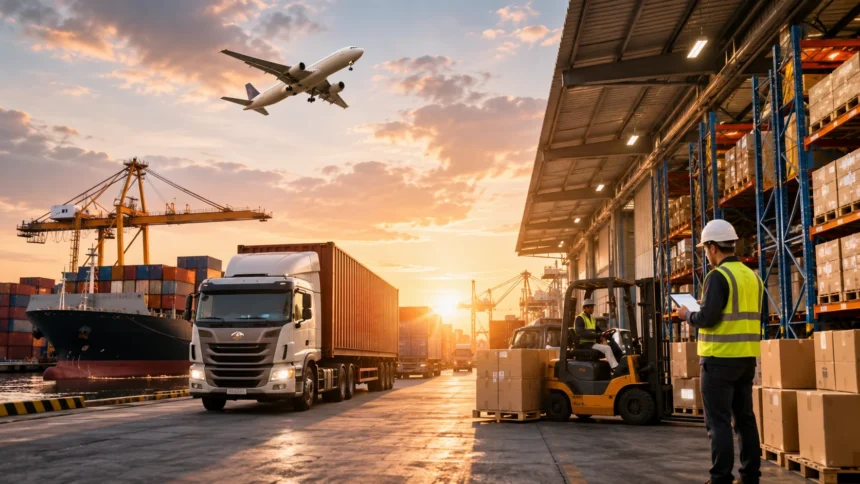
What Is 3PL? How Third-Party Logistics Works
Third-party logistics, commonly shortened to 3PL, is a business model in which a company outsources some or all of its logistics operations to an external provider. Instead of managing warehousing, inventory storage, order fulfillment, transportation, and shipping entirely in-house, a business can rely on a specialized logistics company to handle these activities. This arrangement is widely used by ecommerce retailers, manufacturers, wholesalers, subscription businesses, and growing brands. A 3PL provider supplies the infrastructure, technology, workforce, and logistics expertise needed to move products efficiently. The client continues selling its products while the logistics partner manages much of what happens after an order is placed. This division of responsibilities can make growth considerably easier to manage.
A simple example is an online store that sells products nationwide but does not want to operate its own warehouse. The business sends inventory in bulk to a third-party logistics warehouse, where products are stored until customers place orders. When an order enters the ecommerce system, the 3PL receives the information automatically, picks the correct items, packs them, and hands the parcel to a shipping carrier. Tracking information can then be returned to the customer’s order. The seller does not need to touch every package personally. This allows the business to concentrate more attention on marketing, product development, customer experience, and sales.
The 3PL industry has become especially important as customers expect faster delivery, accurate tracking, easy returns, and reliable order fulfillment. Small businesses may find it difficult to meet these expectations using a garage, office, or small warehouse. Larger organizations can face different challenges involving multiple distribution centers, seasonal order spikes, complex inventory, or international shipping. Third-party logistics companies are designed to solve many of these operational problems at scale. They may operate warehouses in several regions and negotiate carrier relationships across high shipping volumes. Access to this network can allow clients to offer more competitive delivery experiences without building the entire infrastructure themselves.
However, outsourcing logistics does not mean giving up all responsibility for the customer experience. The 3PL becomes an extension of the brand because packaging accuracy, inventory availability, shipping speed, and returns can directly influence customer satisfaction. A poor logistics partner can create late deliveries, inaccurate inventory records, damaged packages, and expensive support problems. Choosing the right provider therefore requires more than comparing storage fees. Businesses should evaluate technology, warehouse locations, service levels, integrations, reporting, scalability, and communication. A successful 3PL relationship depends on operational compatibility as much as price.
This guide explains what 3PL means and how third-party logistics works from the moment inventory reaches a warehouse until an order reaches the customer. It covers warehousing, inventory management, pick-and-pack fulfillment, shipping, returns, costs, benefits, limitations, and common 3PL business models. You will also learn how 3PL differs from in-house fulfillment and fourth-party logistics. Practical examples make the concept easier to understand for businesses considering outsourcing. Whether you operate an ecommerce store or a larger supply chain, understanding 3PL can help you decide which logistics responsibilities should remain internal and which may be better handled by a specialist.
What Is 3PL?
A third-party logistics provider is an external company that manages logistics services on behalf of another business. The services can range from simple product storage to complete fulfillment operations involving inventory management, packing, shipping, returns, and transportation coordination. The word “third-party” refers to the logistics company sitting between the seller and other parts of the supply chain. The seller remains responsible for products and customers, while the 3PL manages selected physical logistics activities. Different providers offer different levels of involvement. Some specialize in ecommerce fulfillment, while others handle freight, distribution, cold storage, or complex B2B supply chains.
The basic 3PL model becomes easier to understand when compared with self-fulfillment. A small ecommerce seller may initially keep inventory at home, print shipping labels, pack boxes, and drive parcels to a carrier. As order volume increases, this routine can consume several hours every day and require increasing amounts of storage space. Moving to a 3PL transfers these repetitive warehouse activities to a company designed specifically for them. Inventory is stored professionally, orders are processed systematically, and shipping can often be handled through established carrier networks. This allows the seller to scale without expanding its own warehouse operation at the same rate.
Third-party logistics can also include business-to-business distribution. A manufacturer may use a 3PL to store pallets of finished goods and deliver them to retailers, distributors, or regional warehouses. In this arrangement, orders may involve cases or pallets rather than individual consumer parcels. The logistics provider might schedule freight appointments, prepare shipping documentation, and coordinate different transportation methods. These operations can be considerably more complex than basic ecommerce fulfillment. However, the underlying principle remains the same: logistics activities are performed by an external specialist on behalf of the product owner.
Technology has become a major component of modern 3PL services. Providers commonly use warehouse management systems to track where products are stored and how inventory moves through the facility. Their software may integrate with ecommerce platforms, marketplaces, enterprise systems, and shipping carriers so orders flow automatically between systems. Business owners can often view stock levels, order status, tracking data, and warehouse performance through an online dashboard. Good system integration reduces manual data entry and makes inventory information more accurate. Technology therefore plays an important role in connecting outsourced physical operations with the company’s sales channels.
A 3PL does not necessarily replace every internal logistics function. Some businesses outsource only overflow warehousing, while others use a provider for specific regions or product categories. A company might operate one warehouse internally and use third-party facilities to reach customers in distant markets. Another business may outsource direct-to-consumer fulfillment while keeping wholesale distribution in-house. The arrangement can be customized according to cost, complexity, and strategic priorities. Understanding which activities create the greatest operational burden helps determine where third-party logistics can provide the most value.
How Does Third-Party Logistics Work?
The 3PL process usually begins when a business sends inventory to the logistics provider’s warehouse. Before arrival, the client may submit information describing the products, quantities, shipment details, and expected delivery date. Warehouse employees receive the shipment and compare the physical inventory with the information provided. Products may be inspected, counted, labeled, and entered into the warehouse management system. Each item is then assigned to an appropriate storage location. Accurate receiving is important because mistakes at this stage can create inventory problems throughout the rest of the fulfillment process.
Once products are received, the 3PL stores them according to size, demand, handling requirements, and warehouse layout. Fast-selling items may be placed in easily accessible pick locations, while bulk stock remains elsewhere in the facility. Some products require shelves or bins, while others are stored by the case or pallet. Specialized items may need temperature control, security, or specific handling procedures. The warehouse management system keeps track of these locations so employees know where inventory can be found. Efficient storage design helps reduce the time required to fulfill each order.
When a customer places an order, the order information is transmitted to the 3PL. Integration with an ecommerce store or order management system often makes this transmission automatic. The warehouse system identifies the products, quantities, shipping method, and customer destination. A worker or automated system then retrieves the required items from their storage locations. This stage is known as picking because products are physically selected from inventory. Accurate picking is essential because sending the wrong item creates returns, customer dissatisfaction, and additional shipping costs.
After picking, the order moves to packing. Warehouse employees verify the items and place them into appropriate packaging according to the client’s requirements. Packaging may include boxes, mailers, protective materials, branded inserts, promotional cards, or custom packing instructions. The package is weighed and measured when necessary so the correct shipping label can be generated. A carrier is selected based on the service level and shipping rules. Once the package leaves the warehouse, tracking information is usually sent back to the business and customer automatically.
The logistics process continues even after delivery because returns are an important part of modern fulfillment. Customers may send products back to the 3PL according to the seller’s return policy. Warehouse employees inspect returned items and determine whether they can be restocked, require refurbishment, or need another disposition. Inventory records are updated accordingly. Some providers can also handle exchanges and return documentation. Effective reverse logistics is important because a poor return experience can damage customer trust even when the original fulfillment process worked perfectly.
Core Services Offered by 3PL Companies
Warehousing is one of the most fundamental services provided by third-party logistics companies. Businesses pay for space according to factors such as pallet positions, bins, shelves, cubic volume, or overall storage requirements. The provider handles day-to-day facility management, including staffing, equipment, security, and warehouse organization. Clients therefore avoid many expenses associated with operating their own buildings. The warehouse may also offer specialized environments for products requiring particular storage conditions. Outsourced warehousing can be especially valuable when demand changes throughout the year and maintaining permanent internal space would be inefficient.
Inventory management is closely connected with warehousing but extends beyond simply storing products. A modern 3PL records inventory movements as products are received, moved, picked, returned, or adjusted. Clients can usually access current stock information through a digital dashboard or integrated business system. Some providers offer low-stock alerts, cycle counting, inventory reporting, and lot or serial-number tracking. Better visibility allows businesses to make more informed purchasing and replenishment decisions. Accurate inventory management reduces the risk of selling products that are no longer available or purchasing stock that is already sitting unnoticed in another location.
Order fulfillment includes picking, packing, and preparing shipments after customer orders are received. This service is especially important for ecommerce businesses because fulfillment can become extremely labor-intensive as sales volume increases. A 3PL may process hundreds or thousands of orders each day using organized workflows that would be difficult for a small business to reproduce internally. Fulfillment agreements can include same-day processing cutoffs, packaging standards, and order-accuracy targets. Some providers also support customized packaging or subscription box assembly. The exact service level should match the experience a business wants customers to receive.
Transportation and shipping services help products move from warehouses to customers, stores, or other distribution points. Many 3PL providers maintain relationships with parcel carriers, freight companies, and regional delivery networks. Because they purchase transportation across significant volumes, they may have access to shipping rates or services that smaller businesses could struggle to negotiate independently. Some providers use technology to select a carrier according to price, destination, speed, and delivery requirements. Freight-focused 3PL companies may also coordinate less-than-truckload, full-truckload, air, ocean, or intermodal transportation. Transportation expertise can become particularly valuable when shipments involve multiple regions.
Additional services can include kitting, labeling, assembly, customization, quality inspection, retail compliance, and returns processing. Kitting involves combining several separate products into one sellable bundle before shipment. Labeling services can prepare products for marketplaces, retailers, or regulatory requirements. Some warehouses can add branded packaging or personalize orders before dispatch. Businesses should identify these value-added requirements before choosing a provider because not every warehouse supports the same processes. A 3PL capable of handling specialized tasks can simplify operations by reducing the number of separate vendors involved in fulfillment.
Benefits of Using a 3PL Provider
One of the largest advantages of 3PL is the ability to scale logistics without building equivalent internal infrastructure. A growing business may suddenly need more storage space, workers, shelving, packing stations, software, and carrier capacity. Creating all of this internally requires capital and operational expertise. A third-party logistics provider already maintains much of that infrastructure and can allocate resources across multiple clients. The business pays for the services it uses rather than developing everything from the beginning. This can make rapid growth easier to handle when order volumes increase faster than internal warehouse capabilities.
Outsourcing can also free internal teams to focus on activities more closely connected with competitive advantage. Founders and managers may initially spend large amounts of time counting inventory, packing boxes, resolving shipping issues, and coordinating deliveries. These tasks are essential, but they may prevent attention from being directed toward product development, customer acquisition, partnerships, and strategic planning. A good 3PL takes responsibility for repetitive logistics execution. The business can then concentrate more heavily on what it sells and how it grows. This division of labor is especially valuable for companies without dedicated supply-chain expertise.
Shipping reach is another potential advantage. A provider with warehouses in multiple regions can position inventory closer to customers and reduce average delivery distance. Orders shipped from a nearby fulfillment center can potentially arrive faster while using less expensive ground services. Distributed inventory can also help businesses offer more competitive delivery promises. However, using multiple warehouses requires careful inventory planning so products are stocked in the right locations. A 3PL with strong analytics can help determine how stock should be distributed according to historical demand. Geographic reach becomes more valuable as a customer base expands.
Logistics expertise can improve operational consistency. Experienced providers understand warehouse layout, packing processes, carrier requirements, inventory controls, and seasonal demand management. They may also have specialized teams dedicated to safety, technology, and transportation. This knowledge can reduce the learning curve for businesses that would otherwise need to develop logistics capabilities internally. However, expertise varies significantly between providers. Companies should evaluate actual performance data and service processes instead of assuming every 3PL offers the same operational quality.
Flexibility is another important benefit. Businesses often experience seasonal peaks, product launches, promotional events, or unexpected demand changes that make fixed warehouse capacity inefficient. A third-party provider may be better positioned to add temporary labor or allocate additional space during these periods. This does not mean capacity is unlimited, so large demand spikes should still be communicated early. Nevertheless, shared infrastructure can provide more flexibility than a small dedicated facility. The ability to adjust logistics operations as demand changes can reduce both operational stress and unnecessary fixed costs.
3PL vs In-House Fulfillment
In-house fulfillment means a business owns or directly operates the people, space, equipment, and processes required to store and ship products. This approach provides substantial control because the company manages everything from inventory placement to packaging standards. Teams can change warehouse processes quickly without negotiating with an external vendor. Custom products and highly specialized customer experiences may be easier to support internally. However, control comes with responsibility for staffing, leases, equipment, technology, safety, and warehouse management. These fixed obligations can become expensive as operations grow.
Third-party fulfillment transfers many of those responsibilities to an external logistics partner. Instead of hiring warehouse employees directly, the business pays the 3PL according to agreed storage, handling, and order fees. This converts some logistics costs from fixed infrastructure into more variable expenses connected with actual activity. The provider manages warehouse staffing and daily operations. Businesses still need internal oversight, but they are less involved in routine physical fulfillment. This model can be particularly attractive when logistics complexity is increasing faster than internal expertise.
Cost comparisons should include more than the obvious warehouse rent. In-house operations also require utilities, insurance, management salaries, packing labor, software, equipment maintenance, supplies, and training. Shipping rates should be included as well because carrier agreements can affect total fulfillment cost significantly. A 3PL proposal may appear expensive until these hidden internal costs are calculated properly. The opposite can also occur when high-volume businesses achieve sufficient scale to operate their own facilities efficiently. The right decision depends on complete cost analysis rather than one fee.
Customer experience should also influence the decision. In-house fulfillment can provide exceptional customization because the company directly controls every package. A brand may include handwritten notes, unusual gift wrapping, or highly specialized quality inspections. Some 3PL providers support this type of customization, while others operate standardized high-volume workflows. Businesses should decide which aspects of fulfillment are essential to their brand. If custom packaging is a major differentiator, provider capability needs careful evaluation before outsourcing.
Many companies eventually use a hybrid model instead of choosing only one approach. They might fulfill high-touch products internally while using a 3PL for standard ecommerce orders. Another business may operate its main warehouse while outsourcing distant regions to shorten delivery times. Hybrid fulfillment allows companies to preserve control where it matters while using external infrastructure where scale is beneficial. The arrangement can change as the business grows. Logistics strategy should support current operational needs rather than follow a rigid assumption that one model is always superior.
3PL vs 4PL: What Is the Difference?
The difference between 3PL and 4PL relates mainly to scope and strategic responsibility. A 3PL typically performs specific logistics operations such as warehousing, fulfillment, or transportation. A fourth-party logistics provider, commonly called a 4PL, takes a broader role in coordinating an entire logistics network. The 4PL may manage several 3PL companies, transportation providers, technology systems, and supply-chain partners on behalf of the client. Instead of operating only one warehouse function, it may oversee how multiple logistics components work together. This makes 4PL more strategic and integrated in many arrangements.
A simple 3PL relationship might involve an ecommerce business outsourcing fulfillment to one warehouse provider. The client still decides how inventory is purchased, where it is positioned, and which other logistics partners are used. With a 4PL arrangement, an external organization may manage several fulfillment centers and transportation providers as one coordinated network. The 4PL acts as a central point of responsibility for broader supply-chain performance. It may analyze costs, carrier performance, inventory placement, and operational risks across multiple providers. This level of oversight becomes more relevant as supply chains become complex.
Technology often plays a major role in 4PL operations because the provider needs visibility across several systems and locations. A 4PL may integrate data from warehouses, carriers, suppliers, and customer orders into one control platform. This centralized view can help identify delays, inventory imbalances, and transportation inefficiencies. A typical 3PL may provide excellent visibility within its own warehouses but have less responsibility for the client’s entire network. The distinction is therefore not simply about company size. It concerns how much of the logistics strategy and coordination is being outsourced.
Small and mid-sized ecommerce businesses usually begin with 3PL rather than 4PL because their supply chains do not yet require a separate orchestration layer. One capable fulfillment provider may be sufficient for storage, shipping, and returns. Large enterprises operating across countries and using many logistics vendors can face a different challenge. Their problem may be coordinating the providers rather than finding warehouse capacity alone. A 4PL can potentially simplify this complexity by managing multiple relationships centrally. However, the additional management layer also comes with costs and reduced direct control.
The terms 3PL and 4PL are sometimes used differently across the logistics industry, so businesses should focus on actual responsibilities rather than labels alone. Ask which functions the provider will perform, which vendors it will manage, what technology is included, and who remains accountable for strategic decisions. A company calling itself a 4PL may offer services similar to another company’s managed 3PL solution. Clear contracts and operating models matter more than terminology. Understanding the practical scope of service prevents confusion when comparing logistics providers.
How Much Does 3PL Cost?
Third-party logistics pricing normally contains several separate fees rather than one simple monthly price. Common charges include receiving inventory, storing products, picking orders, packing orders, packaging materials, shipping, and processing returns. Some providers also charge account-management, technology, integration, or minimum monthly fees. Complex services such as kitting and custom labeling can add additional costs. Understanding the complete pricing structure is essential before comparing providers. A low storage rate may be offset by high fulfillment or receiving charges.
Storage fees can be calculated using pallets, bins, shelves, cubic volume, or another measurement. Products that are large but inexpensive can become costly to store because they consume significant warehouse space. Slow-moving inventory also creates problems because storage fees continue accumulating even when products are not generating revenue. Businesses should therefore consider inventory turnover alongside the warehouse rate. Some providers increase storage charges for products that remain in the facility for extended periods. Efficient inventory planning can reduce unnecessary 3PL costs.
Pick-and-pack pricing is typically connected with the number of orders and items handled. A provider might charge a base fee for the first item in an order and an additional fee for every extra item. Orders requiring special packaging, gift wrapping, inserts, or assembly may cost more. High-volume businesses may negotiate different rate structures according to predictable order levels. Ask whether pricing changes during peak periods. Understanding how real order profiles translate into fees is more useful than comparing generic published rates.
Shipping can become one of the largest components of total fulfillment expense. Package dimensions, weight, destination, delivery speed, and carrier service all influence transportation cost. Some 3PL providers pass negotiated carrier rates to clients, while others incorporate different pricing structures. Businesses should request examples using representative orders rather than assuming advertised shipping discounts will apply equally to every package. Dimensional weight can make lightweight but bulky products unexpectedly expensive. Packaging optimization can therefore reduce both material and transportation costs.
The cheapest provider is not always the lowest-cost option overall. Fulfillment errors, slow processing, inventory discrepancies, and poor customer service can create expenses that are difficult to see on a rate card. Late orders can increase refunds and support contacts, while inaccurate inventory can lead to overselling. Evaluate total operational value rather than choosing entirely on price. A slightly more expensive 3PL with better accuracy and delivery performance may create stronger customer retention. Cost analysis should include both direct fees and the business consequences of service quality.
How to Choose the Right 3PL Provider
Begin by identifying exactly what you need the provider to handle. Consider current order volume, product sizes, customer locations, sales channels, return rates, and expected growth. Make a list of specialized requirements such as temperature control, lot tracking, subscription kitting, retail compliance, or international shipping. This prevents conversations from becoming focused entirely on basic storage and fulfillment. A provider that performs exceptionally for apparel may not be appropriate for bulky furniture or regulated products. Operational fit should always come before brand recognition.
Warehouse location should be evaluated according to where your customers actually live. A fulfillment center close to headquarters is convenient for your staff but may be poorly positioned for the majority of orders. Review historical customer data to understand geographic demand. Providers with multiple facilities can reduce shipping zones if inventory is distributed strategically. However, splitting stock among several warehouses increases inventory-planning complexity. The best network balances delivery speed, transportation cost, and the amount of duplicate stock required.
Technology integration is equally important because the 3PL must communicate reliably with your sales and inventory systems. Confirm compatibility with your ecommerce platform, marketplaces, enterprise software, or order management tools. Ask how quickly orders synchronize and how inventory adjustments are communicated. Reporting should provide enough detail to monitor fulfillment performance without requiring constant support requests. Good technology should reduce manual work rather than create additional spreadsheets. Test demonstrations using realistic workflows whenever possible.
Service levels and operational performance deserve close attention. Ask potential providers about order accuracy, processing cutoffs, inventory accuracy, receiving time, return processing, and support response times. Understand what happens when service targets are missed. References from businesses with similar products and volume can provide useful insight. Visit the warehouse when practical or request a detailed operational tour. The quality of physical processes matters just as much as the sales presentation.
Finally, examine the contract carefully before committing inventory. Understand minimums, setup fees, long-term storage charges, termination requirements, insurance responsibilities, liability limitations, and procedures for removing stock. Ask how pricing can change over time and whether seasonal surcharges apply. Data ownership and integration costs should also be clarified. Switching 3PL providers can be disruptive, so careful evaluation before signing is worthwhile. A strong partnership should offer transparent pricing, reliable communication, scalable capacity, and processes that align with your customer expectations.
When Should a Business Use a 3PL?
A business may begin considering 3PL when fulfillment work starts consuming too much time. Founders who spend evenings printing labels and packing orders may eventually reach a point where logistics interferes with growth activities. Hiring internal warehouse staff is one solution, but outsourcing can provide faster access to an established operation. Order volume does not need to reach millions before 3PL becomes useful. The correct threshold depends on product complexity, margins, space availability, and internal capabilities. Time should be considered a cost alongside money.
Limited storage space creates another common reason to outsource. Products can gradually take over offices, garages, shops, or small warehouses as inventory grows. Renting a larger facility brings new commitments involving leases, insurance, equipment, and labor. A 3PL allows businesses to purchase warehouse capacity as a service rather than taking on an entire building. This can be particularly attractive when demand is uncertain. The provider’s shared infrastructure makes it easier to increase or decrease space according to inventory levels.
Shipping problems can also signal that a business has outgrown self-fulfillment. Customers may begin complaining about slow dispatch, missing tracking information, damaged packages, or inconsistent delivery. These issues often appear when order volume exceeds the capacity of a small team. A professional warehouse can create standardized processes that improve consistency. However, outsourcing will not automatically solve every problem. The client must provide accurate product information, inventory forecasts, and clear operating instructions for the relationship to succeed.
Geographic expansion is another situation where 3PL can provide significant value. A company serving one region successfully may struggle with shipping times and costs as customers spread across a larger country. Using additional fulfillment centers can position inventory closer to demand without requiring the company to build each facility independently. International expansion can create even more complicated logistics involving customs, local carriers, and regional regulations. Providers with relevant experience may help reduce some of this complexity. Geographic capability should still be verified carefully rather than assumed.
Not every business needs a 3PL, particularly when order volume is low and fulfillment remains inexpensive and easy to manage internally. Companies selling highly customized products may prefer retaining direct control for longer. Businesses with unusual handling requirements may also find that available providers do not match their needs economically. Outsourcing should solve a specific operational problem rather than be adopted simply because competitors use it. Compare current costs, growth plans, customer expectations, and internal capacity. A 3PL becomes most valuable when logistics is limiting the company’s ability to scale efficiently.
Final Thoughts on Third-Party Logistics
Third-party logistics allows businesses to outsource important supply-chain activities to specialized providers rather than managing every physical operation internally. A 3PL may store products, track inventory, fulfill customer orders, coordinate shipping, and process returns. More specialized providers can also handle kitting, labeling, freight, retail distribution, and other value-added services. The exact arrangement depends on what the client chooses to outsource. This flexibility makes 3PL useful across ecommerce, manufacturing, wholesale, retail, and many other industries. The basic goal is to make logistics more scalable and efficient.
The typical process begins when inventory arrives at the 3PL warehouse. Products are received, counted, entered into the warehouse system, and placed into storage locations. Customer orders then flow electronically into the fulfillment operation, where items are picked, packed, labeled, and handed to carriers. Inventory levels update as orders move through the system. Returns can flow back through the same network. A well-integrated 3PL therefore becomes closely connected with both physical inventory and digital order information.
The benefits can be significant when the relationship is a good fit. Businesses may reduce their need for warehouse infrastructure, gain access to logistics expertise, improve geographic coverage, and manage seasonal growth more easily. Employees can spend less time handling routine fulfillment and more time on activities such as product development and customer acquisition. However, outsourcing also creates dependency on an external company’s performance. Poor accuracy or communication can damage the customer experience. Provider selection should therefore be treated as a strategic decision rather than a simple purchasing exercise.
Cost should be evaluated across the complete logistics operation. Storage, receiving, fulfillment, shipping, packaging, returns, technology, and special services can all contribute to the final price. Compare these expenses with the true cost of performing the same work internally, including labor and management time. Consider service quality alongside direct fees. The least expensive warehouse can become costly if mistakes generate returns, refunds, and dissatisfied customers. Total value matters more than one attractive line on a rate sheet.
Ultimately, the right 3PL can become an important growth partner for a business whose logistics needs are becoming more complicated. The provider should understand your products, customers, technology, and service expectations well enough to operate as an extension of your brand. Establish clear performance metrics and communicate demand changes early. Review inventory, shipping, and fulfillment data regularly rather than completely disconnecting from the operation after outsourcing. Third-party logistics works best when specialization and collaboration are combined. When those elements are present, companies can scale physical fulfillment without allowing logistics to overwhelm the rest of the business.
Frequently Asked Questions
What does 3PL mean?
3PL stands for third-party logistics. It describes an arrangement where a business outsources logistics activities such as warehousing, inventory management, order fulfillment, shipping, or returns to an external specialist.
How does a 3PL work?
A business sends inventory to a 3PL warehouse, where products are stored until orders are received. The provider then picks, packs, and ships orders while updating inventory and tracking information through connected systems.
Is 3PL only for ecommerce businesses?
No, 3PL services are used by ecommerce companies, manufacturers, wholesalers, retailers, and many other businesses. Providers can handle individual consumer orders, pallet shipments, freight transportation, or specialized distribution depending on their capabilities.
What is the difference between 3PL and 4PL?
A 3PL generally performs logistics operations such as warehousing or transportation, while a 4PL often coordinates a broader supply-chain network containing several logistics providers. The 4PL usually has a more strategic management role.
When should a company use a 3PL?
A company may benefit from 3PL when storage space is limited, order fulfillment consumes too much internal time, shipping requirements become complex, or growth requires additional logistics capacity. The decision should be based on cost, service needs, scalability, and customer expectations.