

IoT Protocols Explained: Types, Uses & Examples
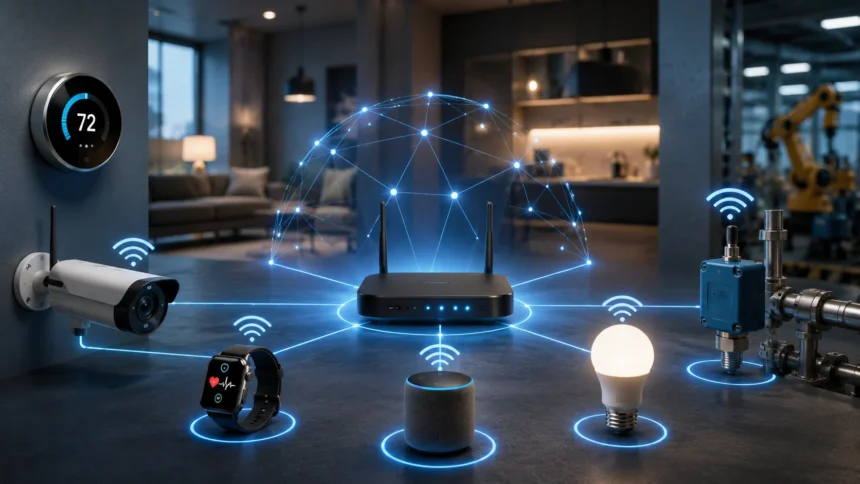
Internet of Things devices need a reliable way to communicate before a smart thermostat can report temperature, a factory sensor can warn about equipment failure, or a connected lock can receive a remote command. IoT protocols provide the rules that determine how devices discover one another, establish connections, exchange data, confirm messages, and protect communication. Different protocols solve different problems, so there is no single communication standard used by every IoT device. Some protocols are designed for tiny battery-powered sensors sending only a few bytes, while others support cameras, industrial equipment, cloud applications, and high-bandwidth devices. Understanding IoT protocols helps developers, businesses, and technology users understand how connected-device ecosystems actually work.
Common IoT protocols and technologies include MQTT, CoAP, HTTP/HTTPS, AMQP, WebSockets, Wi-Fi, Bluetooth Low Energy, Zigbee, Thread, and LoRaWAN. These names do not all operate at the same networking layer, which is an important distinction often overlooked in beginner explanations. MQTT and CoAP primarily define how applications exchange information, while Wi-Fi, Bluetooth LE, Thread, Zigbee, and LoRaWAN provide different forms of network connectivity. One IoT system can therefore use several protocols simultaneously rather than choosing only one. This guide explains the major IoT protocol types, how they work, practical examples, security considerations, and how to select the right communication technologies for an IoT project.
What Are IoT Protocols?
An IoT protocol is a set of communication rules that allows connected devices, gateways, applications, and cloud services to exchange information in an understandable and predictable way. The rules may determine how devices address one another, how messages are formatted, how connections are created, and what happens when information is lost. Protocols can also define authentication, encryption, message acknowledgments, device discovery, and power-saving behavior. Without common rules, two devices could transmit electrical or radio signals but still have no shared way to interpret their meaning. Protocols therefore provide the structure that transforms basic connectivity into useful machine-to-machine communication.
The term IoT protocol is frequently used broadly because an IoT system contains several networking layers. At the physical and link layers, technologies such as Wi-Fi, Bluetooth LE, or IEEE 802.15.4 determine how information travels through radio signals and local connections. Network and transport layers can involve technologies such as IPv6, TCP, or UDP, while application protocols such as MQTT and CoAP determine how IoT applications exchange useful messages. A smart sensor may therefore use an IEEE 802.15.4 radio, Thread networking, IPv6 addressing, UDP transport, and an application protocol simultaneously. Asking which protocol an IoT product uses may therefore produce several correct answers depending on which layer is being discussed.
Different IoT environments require different communication characteristics. A battery-powered soil sensor located in a field may need extremely low energy consumption and long transmission range but only send a small measurement every hour. A security camera has very different requirements because it may continuously transmit large amounts of video data and can often rely on mains power. Industrial control systems may prioritize predictable latency and reliability, while wearable devices require short-range communication that consumes little battery power. These conflicting requirements explain why the IoT industry has developed many communication protocols instead of standardizing every device around one universal technology.
IoT protocols can also be categorized according to their communication model. Some use publish/subscribe messaging, where devices publish information to topics and interested applications subscribe to those topics. Others use a request/response model, where one endpoint asks for a particular resource and another responds with the requested information. Persistent bidirectional connections can be useful when both sides need to send updates immediately, while store-and-forward messaging can help systems tolerate temporary connectivity problems. MQTT is a prominent publish/subscribe protocol, while CoAP uses a web-style request/response model designed for constrained environments.
The best IoT protocol is therefore the protocol that matches the requirements of the device and system rather than whichever technology appears most popular. Developers need to consider battery life, bandwidth, communication range, latency, reliability, security, network topology, hardware availability, deployment scale, and cloud integration. Cost also matters because a protocol requiring expensive gateways or cellular subscriptions may be unsuitable for thousands of inexpensive sensors. Interoperability becomes especially important when products from several manufacturers must work together. Successful IoT architectures usually begin by understanding these requirements and then selecting complementary technologies for each networking layer.
How IoT Communication Works
A typical IoT communication process begins with a physical device that senses, measures, or controls something in the real world. A temperature sensor might take periodic measurements, while a smart electricity meter records energy use and an industrial controller monitors machine vibration. A microcontroller or embedded computer converts the collected information into digital data that software can process. The device then needs a communication interface, such as Wi-Fi, Bluetooth LE, Thread, Zigbee, Ethernet, cellular connectivity, or LoRaWAN, to move that information elsewhere. The communication protocol determines how the resulting data is packaged, transmitted, interpreted, and potentially acknowledged by another system.
Some IoT devices communicate directly with cloud platforms, while others send information through a local IoT gateway. A gateway can connect devices using one local technology and then forward information through Ethernet, Wi-Fi, cellular, or another internet connection. This architecture is useful when tiny sensors lack the power, processing capability, or network support needed for direct internet connectivity. Gateways can also filter data, translate protocols, perform local analytics, and continue controlling equipment when cloud connectivity disappears. In a smart building, for example, hundreds of low-power sensors might communicate locally while one or more gateways connect their information with a central management platform.
Application protocols sit above the underlying connection and determine how useful IoT data moves between endpoints. With MQTT, a sensor could publish the value 23.4°C to a topic such as building/floor2/temperature, while monitoring applications subscribe to that topic. OASIS defines MQTT as a lightweight client/server publish-subscribe messaging transport and highlights its suitability for machine-to-machine and IoT environments where small code footprints or limited bandwidth matter. MQTT also defines multiple Quality of Service levels so developers can choose different delivery guarantees according to the importance of each message.
Another system might use CoAP to expose sensor measurements as resources that applications request in a way conceptually similar to the web. The IETF designed the Constrained Application Protocol specifically for constrained nodes and low-power or lossy networks, including devices with limited memory and processing capability. CoAP provides request/response communication, resource discovery, URI support, multicast capabilities, and relatively low protocol overhead. It commonly operates over UDP rather than relying on a permanent TCP connection. These characteristics can make CoAP attractive for embedded devices where reducing message size, processing requirements, and network traffic is particularly important.
After information reaches a server or cloud application, software can store it, analyze it, trigger alerts, visualize trends, or send commands back toward physical devices. A temperature measurement could update a dashboard and automatically trigger air conditioning if a predefined limit is reached. An industrial vibration sensor could feed predictive-maintenance software that identifies unusual equipment behavior before a breakdown occurs. IoT communication is therefore rarely only about moving data in one direction. Useful systems often contain a continuous loop of sensing, communication, processing, decision-making, and control, supported by several networking protocols working together.
MQTT, CoAP, HTTP, WebSockets and AMQP
MQTT, or Message Queuing Telemetry Transport, is one of the best-known application protocols associated with IoT. It uses a broker-based publish/subscribe model in which clients publish messages to named topics while other clients subscribe to topics they want to receive. Devices do not need direct knowledge of every recipient because the broker coordinates message distribution, which helps decouple different parts of the system. MQTT is lightweight and was specifically designed to work well where network bandwidth or device resources may be limited. OASIS MQTT 5.0 defines three Quality of Service levels: at most once, at least once, and exactly once delivery.
CoAP, or Constrained Application Protocol, was designed by the IETF for constrained devices and low-power, lossy networks. Instead of MQTT’s broker-based publish/subscribe architecture, CoAP follows a REST-like resource model that resembles concepts used by HTTP. Devices can interact with resources using methods and URIs while maintaining far lower overhead than a typical web application stack. CoAP commonly uses UDP and provides optional reliability mechanisms rather than depending on TCP for every exchange. RFC 7252 also highlights service discovery, multicast support, asynchronous exchanges, and straightforward mapping to HTTP as important CoAP capabilities.
HTTP and HTTPS can also be used in IoT systems, particularly when devices have sufficient processing power, memory, bandwidth, and energy. HTTP is familiar to web developers and integrates naturally with REST APIs, web servers, cloud platforms, and existing enterprise infrastructure. A smart appliance might send a request to a cloud API or retrieve configuration through HTTPS in much the same way a conventional web application communicates with a server. The disadvantage is that traditional HTTP exchanges can introduce more overhead than protocols designed specifically for constrained embedded systems. Nevertheless, its enormous ecosystem and familiar development model make HTTP practical for gateways, powerful devices, configuration systems, and many cloud-facing IoT applications.
WebSocket is useful when an application needs ongoing two-way communication between a client and server rather than repeated request/response polling. After an initial handshake, a WebSocket connection allows either endpoint to send messages independently across a persistent connection. The IETF standardized WebSocket specifically to support two-way communication over one TCP connection and reduce the need for repeated HTTP polling techniques. In IoT, this can be useful for live dashboards, device-control interfaces, monitoring consoles, and applications where updates should appear as soon as events occur. WebSocket is generally more relevant to real-time application communication than to extremely constrained battery sensors transmitting only occasional measurements.
AMQP, or Advanced Message Queuing Protocol, is an open messaging protocol frequently associated with reliable enterprise messaging systems. OASIS describes AMQP as an open internet protocol for business messaging, and its standardized model supports interoperable message exchange between systems. Compared with MQTT, AMQP is typically associated with richer enterprise messaging requirements rather than the smallest resource-constrained IoT endpoints. An IoT architecture might therefore use MQTT between devices and an edge platform while using AMQP deeper within enterprise or cloud infrastructure. The right choice depends on delivery requirements, architecture, software ecosystem, scalability, operational complexity, and how much processing capacity each endpoint can provide.
Wi-Fi, Bluetooth LE, Zigbee, Thread and LoRaWAN
Wi-Fi is widely used for IoT devices that need direct IP connectivity and have access to sufficient power. Smart televisions, security cameras, appliances, speakers, and home gateways frequently use Wi-Fi because existing routers already provide local networking and internet access. Its high data capacity makes it far more suitable for video or large software downloads than many low-power sensor technologies. However, conventional Wi-Fi can consume more energy than protocols specifically optimized for small battery devices, making it less attractive for sensors expected to operate for years without charging. Range also depends heavily on buildings, interference, access-point placement, frequency, and hardware design.
Bluetooth Low Energy, commonly called Bluetooth LE or BLE, was designed to support devices that need short-range wireless communication with relatively low energy consumption. Wearables, medical accessories, beacons, trackers, smart locks, fitness equipment, and smartphone-connected sensors frequently use it because nearly every modern phone can act as a Bluetooth interface. Bluetooth SIG documentation describes a complete Bluetooth LE protocol stack that includes physical, link, security, attribute, and generic access layers. Devices can advertise information without maintaining a continuous connection, which can be useful for energy-efficient discovery and beacon applications. Bluetooth LE is particularly attractive when a nearby smartphone can serve as the user interface or internet gateway.
Zigbee is commonly used for low-power wireless networking in smart-home and building-automation environments. It is associated with IEEE 802.15.4 radios and supports mesh networking, allowing suitable powered devices to help relay messages through the network rather than requiring every endpoint to communicate directly with one central access point. Smart lights, switches, motion sensors, plugs, and environmental sensors are familiar Zigbee use cases. Mesh communication can extend coverage through a building when enough suitable routing devices are available. However, Zigbee networks commonly use a coordinator or hub, and interoperability depends on compatible device profiles, software implementations, and ecosystem support rather than simply sharing the same radio technology.
Thread is a low-power, secure, IPv6-based mesh networking protocol designed specifically for connected-home and building devices. Thread uses IEEE 802.15.4 at the lower networking layers and allows devices to communicate using standard IP networking rather than depending on a proprietary application gateway. Thread Group describes it as a low-energy wireless mesh with network-layer security and direct IPv6-based connectivity. Thread Border Routers connect the low-power mesh with other IP networks, allowing Thread devices to coexist alongside Wi-Fi and Ethernet systems. Thread has also become an important networking foundation for Matter smart-home devices, although Thread itself is a networking technology rather than the Matter application layer.
LoRaWAN targets a very different type of IoT requirement: long-range, low-power communication for devices sending relatively small amounts of data. It is commonly considered for utility metering, agriculture, environmental monitoring, asset tracking, smart-city infrastructure, and remote sensors where Wi-Fi coverage may be unavailable. The LoRa Alliance describes LoRaWAN as a network protocol optimized for battery-powered end devices that may be fixed or mobile. LoRaWAN trades high bandwidth for long range and energy efficiency, so it is not intended for applications such as continuous video streaming. Its strengths become most obvious when thousands of distributed sensors need to send occasional measurements over substantial distances while conserving battery power.
Comparing Popular IoT Protocols
MQTT and CoAP are often compared because both can serve constrained IoT applications, but their communication models are significantly different. MQTT normally uses a central broker and a publish/subscribe model, making it convenient when one sensor measurement needs to reach several independent applications. CoAP resembles lightweight web communication and allows endpoints to interact with addressable resources using request/response semantics. MQTT normally depends on a reliable connection transport, while basic CoAP was designed around UDP with its own optional reliability mechanisms. Neither protocol is universally better, because the appropriate choice depends on messaging patterns, infrastructure, device limitations, multicast requirements, and how applications consume information.
MQTT and HTTP represent another common design choice. HTTP integrates naturally with REST APIs and existing web infrastructure, making it easy for developers to connect sufficiently capable devices to cloud services. MQTT can reduce repeated protocol overhead and provides built-in publish/subscribe messaging that fits continuous telemetry particularly well. A device reporting measurements every few seconds may benefit from maintaining an MQTT connection rather than repeatedly building independent web requests. Conversely, a device that only downloads configuration occasionally may work perfectly well with HTTPS. Developers should therefore compare actual communication patterns instead of assuming that an IoT-specific protocol is automatically superior to standard web technologies.
Bluetooth LE, Zigbee, and Thread are frequently considered for low-power devices, but their architectures and ecosystem expectations differ. Bluetooth LE is particularly useful for direct communication with smartphones, tablets, wearables, accessories, and nearby sensors. Zigbee has a long history in low-power home and building automation and commonly uses mesh networking through an ecosystem hub or coordinator. Thread also uses low-power mesh networking but carries IPv6 and integrates low-power devices into conventional IP architecture through Border Routers. Thread Group specifically emphasizes IP-based communication, low energy consumption, mesh resilience, and integration with existing networks as major design characteristics.
Wi-Fi and LoRaWAN illustrate how dramatically IoT communication requirements can differ. Wi-Fi is appropriate when devices need relatively high throughput and local infrastructure can provide both network coverage and sufficient electrical power. LoRaWAN is more appropriate when devices are geographically distributed, send modest amounts of information, and must conserve battery power over long periods. A security camera transmitting video would generally be unsuitable for LoRaWAN because the technology is not designed for continuous high-bandwidth streams. A remote agricultural moisture sensor, however, may have little reason to use high-bandwidth Wi-Fi if it only sends a few measurements periodically. The application’s data volume and range requirements therefore strongly influence protocol selection.
Real IoT systems commonly combine these technologies rather than choosing one winner. A smart-building sensor might communicate through Thread or Zigbee to local infrastructure, while a gateway forwards processed information to a cloud platform using MQTT or HTTPS. A wearable could communicate with a phone through Bluetooth LE, after which the phone sends information to internet services over Wi-Fi or cellular connectivity. Industrial IoT platforms may combine local field protocols with Ethernet and cloud messaging systems. Thinking in terms of protocol stacks and communication layers is therefore more accurate than expecting one technology to handle every part of an IoT architecture.
Real-World IoT Protocol Examples
A smart-home temperature sensor provides a simple example of how several protocols can work together. A battery-powered sensor might use Thread to communicate with other low-power devices throughout the house while a Thread Border Router connects that mesh with the home’s broader IP network. Because Thread is IPv6-based, compatible higher-level application protocols can operate across the network without requiring translation into an entirely proprietary addressing system. Thread Group describes Border Routers as devices that forward packets between the Thread mesh and surrounding Wi-Fi or Ethernet infrastructure. The home’s application layer can then provide automation rules, remote control, dashboards, and cloud integration.
An agricultural monitoring system may use LoRaWAN because sensors can be spread across fields, irrigation infrastructure, or remote locations where conventional Wi-Fi coverage is impractical. Soil-moisture sensors might wake periodically, take a measurement, transmit a small message, and return to a low-power state. Gateways receive transmissions from multiple devices and forward the information toward a network server and agricultural-management platform. Because LoRaWAN is optimized for battery-powered endpoints, the architecture fits devices that prioritize longevity and range over high data throughput. Farmers can then use the collected information to understand environmental conditions and improve irrigation decisions without running network cables to every sensor.
A factory can use MQTT to collect telemetry from machines and edge controllers. One device could publish motor temperature to factory/line1/motor7/temp, while another publishes vibration information to a different topic. Maintenance software subscribes to both topics and looks for values that indicate abnormal behavior, while a dashboard subscribes to the same data for visualization. MQTT’s publish/subscribe architecture allows these consumers to receive information without each machine establishing custom direct connections with every application. Its Quality of Service options also allow system designers to select different message-delivery guarantees according to business requirements.
A wearable heart-rate sensor can illustrate Bluetooth Low Energy communication. The wearable collects measurements using its onboard sensor and makes data available through Bluetooth LE services and characteristics to a nearby smartphone. The phone becomes the richer computing platform, presenting information to the user and potentially sending selected data to an online service. This arrangement allows the wearable to remain relatively small and energy efficient because it does not need a powerful Wi-Fi radio and full cloud networking stack active continuously. Bluetooth LE defines multiple protocol layers, including the Generic Attribute Profile commonly used for structured exchange of device information.
A live building-management dashboard offers a good WebSocket example. Sensors may originally send information through MQTT, CoAP, or another backend protocol, while a web application needs immediate updates whenever new readings arrive. Instead of asking the server every few seconds whether something changed, the browser can maintain a WebSocket connection. The server can then push new temperature readings, alarms, occupancy information, or equipment states as soon as they become available. WebSocket provides full two-way communication over a persistent connection after the opening handshake, making it suitable for responsive real-time interfaces. This example also demonstrates how different protocols can handle different stages of one IoT application.
IoT Protocol Security
Security should be considered when selecting and implementing every IoT protocol because connected devices can create access points into physical environments, business systems, and sensitive data. A sensor may appear harmless, but compromised devices can sometimes become entry points for attackers or be recruited into larger malicious networks. Strong security therefore requires more than choosing a protocol whose specification includes encryption features. Device identity, authentication, key management, secure software updates, access control, network segmentation, logging, and vulnerability management all influence the real security of the deployment. Protocol-level protections are essential components, but they operate within a much larger cybersecurity architecture.
Encryption helps prevent unauthorized observers from reading data as it moves through a network. MQTT deployments commonly protect connections using TLS when operating over TCP, while secure WebSocket connections use the wss scheme and TLS. RFC 6455 states that wss protects WebSocket traffic through TLS, providing properties such as confidentiality, integrity, and endpoint authentication. CoAP has developed several security approaches for constrained environments, and the base RFC has been supplemented by later standards addressing secure communication. Developers should follow current security recommendations for the exact protocol version and platform rather than copying obsolete configuration examples.
Authentication answers a different question from encryption: not merely whether outsiders can read a message, but whether the communicating endpoint is genuinely authorized. An IoT platform may authenticate devices using certificates, cryptographic keys, tokens, passwords, or hardware-backed identities. Large deployments need scalable ways to create, provision, rotate, revoke, and protect these credentials throughout the device lifecycle. Shipping thousands of products with one shared password is fundamentally weaker than giving individual devices separate identities. If one device becomes compromised, administrators should ideally be able to revoke that device without replacing credentials across the entire fleet.
Wireless-network security is also critical because attackers do not necessarily need physical access to interact with radio-based systems. Thread was designed with network-layer security as one of its built-in characteristics, while Bluetooth LE contains its own security-management mechanisms. However, even strong wireless standards can be weakened by poor commissioning processes, outdated software, exposed credentials, or insecure application layers. Organizations should therefore test complete products rather than assuming certification for one communications technology automatically secures every part of the device. Security is an end-to-end property involving hardware, firmware, networking, cloud systems, mobile applications, and operational practices.
Software updates are particularly important because IoT devices can remain deployed for many years. Vulnerabilities may be discovered long after installation, meaning manufacturers need a secure method for distributing authenticated firmware updates. Devices should ideally verify that updates come from a trusted source before installing them and protect against unauthorized rollback where necessary. Organizations also need an inventory showing which devices exist, what software versions they run, and whether security support is still available. Protocol choice influences communication security, but long-term device maintenance often determines whether an initially secure product remains safe throughout its useful life.
How to Choose the Right IoT Protocol
Start by identifying the amount and frequency of data the device needs to transmit. A sensor sending a 20-byte reading every fifteen minutes has very different networking requirements from a security camera continuously streaming high-resolution video. Low-volume telemetry may work well with MQTT, CoAP, LoRaWAN, Thread, Zigbee, or Bluetooth LE depending on other requirements. High-bandwidth applications typically require technologies such as Wi-Fi, Ethernet, cellular broadband, or specialized high-capacity networking. Estimating actual message size, frequency, and direction before selecting hardware can prevent unnecessary cost and power consumption. Designing around imagined maximum requirements often produces devices that are more complicated and expensive than necessary.
Next, consider communication range and deployment environment. Bluetooth LE can work very well when a phone or gateway is nearby, while a mesh protocol can help distribute communication across rooms and buildings. Thread is designed around low-power IPv6 mesh connectivity and can extend coverage as suitable routing devices participate in the network. LoRaWAN becomes attractive when endpoints are spread over much longer distances and exchange comparatively small amounts of information. Walls, machinery, interference, outdoor terrain, antenna design, and regional radio regulations also affect real coverage, so theoretical range claims should be validated through testing at the intended deployment site.
Power consumption is especially important for battery-operated IoT products. A mains-powered smart television can tolerate networking choices that would quickly drain a small coin-cell sensor. Bluetooth LE, Thread, Zigbee, and LoRaWAN are commonly considered when energy efficiency is a major requirement, although actual battery life still depends on radio configuration, message frequency, processor activity, sensors, sleep behavior, and environmental conditions. Thread specifically emphasizes a low-energy footprint using IEEE 802.15.4 technology. Engineers should calculate a complete power budget rather than judging battery life from the name of the wireless protocol alone.
Architecture and interoperability should also influence the decision. If devices need direct integration with standard IP infrastructure, an IP-based technology such as Thread can simplify certain parts of the architecture. If smartphones must communicate directly with the product, Bluetooth LE offers an enormous existing ecosystem of compatible client devices. If cloud telemetry will be consumed by multiple independent services, MQTT’s publish/subscribe design can provide a natural messaging model. If the organization already operates REST APIs and devices have sufficient resources, HTTPS may minimize development complexity. Choosing technologies that fit existing skills and infrastructure can be more valuable than selecting a theoretically optimal protocol that introduces unfamiliar operational requirements.
Finally, evaluate security, hardware support, certification requirements, cost, scalability, and long-term ecosystem health before committing to a protocol. A prototype involving ten devices can behave very differently from a production deployment involving one hundred thousand endpoints. Gateway costs, network subscriptions, cloud messaging charges, firmware-management requirements, radio certification, and replacement procedures should all be considered. LoRa Alliance, Thread Group, Bluetooth SIG, and similar standards organizations provide certification or implementation resources designed to improve interoperability within their ecosystems. The best IoT protocol decision balances technical performance with how realistically the organization can deploy, secure, monitor, and maintain the system for years.
Frequently Asked Questions About IoT Protocols
What is an IoT protocol?
An IoT protocol is a set of rules that allows connected devices, gateways, applications, or cloud platforms to communicate. Different protocols can control connectivity, addressing, message delivery, security, and how device data is interpreted.
Which protocol is most commonly used in IoT?
There is no single protocol used by all IoT devices. MQTT is widely associated with IoT messaging, while Wi-Fi, Bluetooth LE, Zigbee, Thread, LoRaWAN, CoAP, HTTP, and other technologies are used according to range, power, bandwidth, and application requirements.
What is the difference between MQTT and CoAP?
MQTT primarily uses a broker-based publish/subscribe messaging model, while CoAP uses a lightweight REST-style request/response model designed for constrained devices and networks. MQTT commonly runs over reliable connection-oriented transport, whereas basic CoAP is designed around UDP.
Is Wi-Fi an IoT protocol?
Wi-Fi is better described as a wireless networking technology rather than an IoT-specific application protocol. IoT devices can use Wi-Fi for connectivity while using higher-layer protocols such as MQTT, HTTPS, or WebSocket to exchange application data.
Which IoT protocol is best for long-range sensors?
LoRaWAN is one important option for long-range, low-power devices that transmit relatively small amounts of data, such as environmental, agricultural, metering, or remote-monitoring sensors. The best technology still depends on coverage, latency, message size, local regulations, infrastructure, cost, and battery-life requirements.