
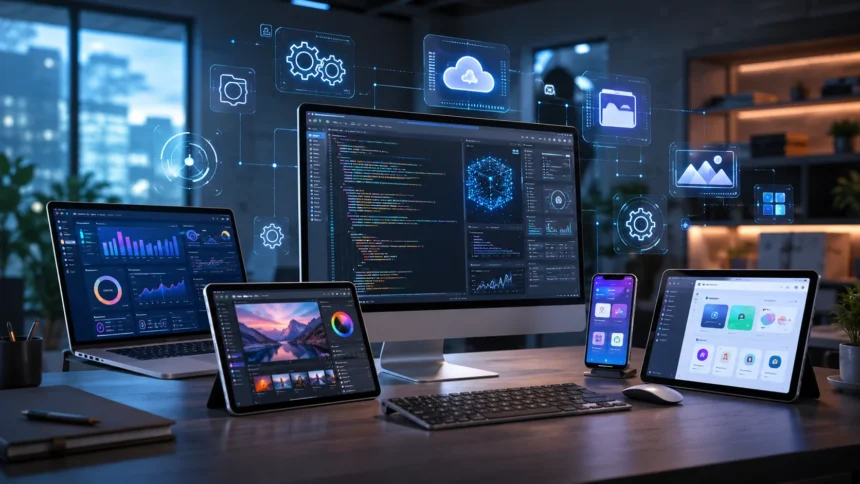
Software Meaning: Definition, Types & Examples
Software is the invisible technology that tells computers, smartphones, servers, machines, and digital devices what to do. While hardware refers to the physical components you can touch, software consists of programs, instructions, data, and supporting files that make those components useful. Operating systems, mobile apps, web browsers, games, business platforms, security tools, and cloud applications are all examples of software. Almost every digital activity depends on some form of software working behind the scenes. As businesses become more automated and connected, software increasingly influences communication, productivity, customer service, manufacturing, finance, healthcare, and entertainment. Understanding software meaning therefore provides a foundation for understanding modern technology itself.
Software has evolved considerably from the relatively simple programs used on early computers. Modern applications may combine millions of lines of code with databases, cloud infrastructure, artificial intelligence, APIs, security systems, and interfaces designed for many different devices. Some software runs locally on a computer, while other applications depend heavily on remote cloud servers. Many products now use subscription models that provide continuous updates instead of requiring customers to purchase a completely new version every few years. Developers also increasingly build software from reusable libraries and services rather than creating every component from scratch. These changes make modern software more capable, connected, and continuously evolving.
This guide explains software meaning, definition, types, examples, uses, development, licensing, and security in practical language. It covers system software, application software, programming software, middleware, drivers, utilities, mobile apps, cloud software, and embedded systems. You will also learn how software works with hardware, how developers create programs, and why updates are important. Real-world examples show how businesses and individuals use different software categories every day. The article also explores newer trends such as software as a service, artificial intelligence, automation, low-code development, and cloud-native applications. Whether you are studying computer basics or trying to understand business technology, these concepts provide a useful starting point.
What Is Software?
Software is a collection of instructions, programs, procedures, and related data that tells a computer or digital device how to perform tasks. Unlike hardware, software has no physical form that a user can directly touch. It exists as digital code and information stored on computers, servers, phones, memory devices, or cloud infrastructure. When someone opens a spreadsheet, sends an email, edits a photograph, or watches a video, software translates that request into operations the hardware can execute. Without software, even powerful processors and storage devices would have no practical instructions telling them what actions to perform. Software therefore acts as the logical layer that turns electronic components into functional technology.
The difference between hardware and software is one of the easiest ways to understand the concept. Hardware includes physical components such as processors, keyboards, screens, memory modules, storage drives, and network cards. Software includes the operating system and applications that use those physical resources. A laptop is hardware, while Windows, macOS, a web browser, and a word processor are software. The two depend heavily on each other because software needs hardware to execute, while most hardware needs software instructions to perform useful tasks. This relationship is comparable to a machine and its operating instructions. Neither side alone provides the complete experience users expect from a modern digital system.
Software can perform very simple or extraordinarily complex tasks. A small program might convert temperatures between Celsius and Fahrenheit, while a global banking platform could process millions of financial transactions while enforcing security, regulatory, and reliability requirements. Software may automate calculations, store information, control machines, communicate across networks, display interfaces, analyze data, or coordinate other programs. Some programs are designed for one specialized task, while others provide broad platforms used by many applications. The variety of software reflects the enormous range of problems computers are asked to solve. However, every software system ultimately relies on instructions and data being processed according to defined logic.
Most software is written in one or more programming languages that allow developers to express instructions in a structured format. Languages such as Python, JavaScript, Java, C++, C#, Go, Swift, and Rust support different types of applications and development goals. The source code written by programmers is converted into instructions that computers can execute directly or interpret through another software environment. Developers also use frameworks, libraries, databases, APIs, and development tools to create applications more efficiently. Modern software development is therefore rarely about writing every instruction from the beginning. Teams combine existing technologies with custom logic to produce systems suited to specific user and business requirements.
Software can also be classified according to how users obtain and access it. Some programs are installed directly on local devices, while web applications run largely through browsers and remote servers. Cloud software can deliver functionality over the internet through subscription services, while embedded software operates inside equipment such as cars, appliances, industrial machines, and medical devices. Open-source software makes source code available under defined licenses, whereas proprietary software normally keeps source code under the control of its owner. These different models show why the word software describes a broad category rather than one particular kind of computer program.
How Does Software Work?
Software works by giving hardware a structured series of instructions to execute. When a user performs an action, such as clicking a button or opening a file, the application interprets that input and determines what operations are required. It may request information from storage, perform calculations, communicate with a server, or display new content on the screen. The operating system helps coordinate these activities by managing processors, memory, files, devices, and network connections. Software therefore operates through several layers rather than communicating with every hardware component independently. This layered architecture allows programmers to create sophisticated applications without controlling each electrical operation manually.
The operating system plays a particularly important role because it acts as an intermediary between applications and hardware. When a program needs to save a file, it usually asks the operating system to perform the storage operation rather than directly controlling the physical drive. Similarly, applications rely on system services for networking, printing, memory allocation, security permissions, and other common functions. This arrangement improves consistency and reduces development complexity. Windows, Linux, macOS, Android, and iOS all provide platforms on which other software can run. Applications are usually designed for particular operating systems or created using technologies capable of supporting several platforms.
Memory and processing power determine how software executes while it is running. Programs are generally loaded from persistent storage into system memory so the processor can access instructions and data quickly. The central processing unit performs calculations and executes instructions, while graphics processors may handle visual rendering or specialized computational workloads. The operating system allocates resources between many programs so several applications can operate at approximately the same time. If software requests more memory or processing capacity than the device can provide comfortably, performance may slow down. Efficient software design therefore considers both functionality and resource consumption rather than assuming unlimited computing capacity.
Modern software frequently communicates with other systems through networks and application programming interfaces, commonly called APIs. A weather application might request current forecast information from an external service, while an ecommerce platform can connect with payment processors, inventory systems, delivery companies, and marketing tools. APIs define how these different software systems exchange information. This allows developers to combine specialized services instead of building every capability internally. However, connected software also creates dependencies because a failure in one external service can affect another application. Reliable software architecture therefore includes error handling, monitoring, security controls, and backup approaches for important external integrations.
Data is another essential component of how software operates. Applications may store usernames, documents, settings, transactions, images, messages, or business records inside databases and file systems. Software retrieves this information when users need it and updates it when changes occur. Databases can organize enormous quantities of information so applications can search and process records efficiently. Security controls determine which users or systems are allowed to view or modify particular data. Backups and recovery procedures protect important information from deletion, corruption, or technical failures. Modern software is therefore not simply a collection of instructions; it is typically a complete system involving code, data, infrastructure, interfaces, and security mechanisms.
Main Types of Software
The most common way to classify software is by dividing it into system software and application software. System software manages the computer itself and creates the environment in which other programs can run. Operating systems, device drivers, firmware, and many utility programs belong to this broad category. Application software is designed to help users perform specific tasks such as writing documents, managing finances, editing videos, browsing websites, or communicating with colleagues. These categories can overlap because modern software products often perform several roles. Nevertheless, the distinction remains useful because it separates technology that manages the computing platform from programs focused primarily on user activities.
Programming software forms another important category because developers need specialized tools to create other software. Code editors, integrated development environments, compilers, interpreters, debuggers, version-control tools, and software development kits all support programming work. An integrated development environment, or IDE, can combine code editing, testing, debugging, and project-management capabilities in one application. Compilers translate source code into executable instructions, while interpreters execute certain programming languages more dynamically. Debugging tools help developers understand why programs are behaving incorrectly. Programming software may not be used directly by ordinary consumers, but it is fundamental to creating the applications and systems those consumers rely on.
Utility software performs maintenance, optimization, security, or management tasks. Antivirus tools, backup applications, file-compression utilities, storage-management tools, diagnostic programs, and system-monitoring software are common examples. Some utilities come bundled with operating systems, while others are provided by independent software companies. Their purpose is generally to support the health, security, or usability of a computer rather than provide a primary business or creative function. Enterprise utilities can be significantly more advanced, managing thousands of endpoints or monitoring entire networks. Utility software demonstrates how programs can support other technology without necessarily being the main application a user works with every day.
Middleware allows different applications, services, or systems to communicate and work together. It may handle messaging, authentication, transactions, API management, data conversion, or integration between different software environments. Businesses often depend on middleware because their technology environments contain systems from several vendors that need to exchange information reliably. An ecommerce platform, for example, may need middleware to connect customer orders with inventory, payment, shipping, and enterprise resource planning systems. Users may never see the middleware directly, yet it can be essential to the workflow. As organizations adopt more cloud services, software integrations and middleware platforms have become increasingly important parts of modern IT architecture.
Embedded software runs inside devices that people may not immediately think of as computers. Cars, smart televisions, washing machines, routers, cameras, industrial robots, fitness trackers, medical equipment, and many household appliances contain embedded programs. These applications usually perform specialized tasks and interact closely with the physical hardware around them. Some embedded systems operate with very limited memory and processing resources, while modern vehicles can contain extremely sophisticated software environments. Reliability is especially important when software controls equipment associated with safety or critical infrastructure. Embedded software shows how extensively programming has moved beyond traditional desktops and smartphones into ordinary physical products.
System Software and Its Role
System software manages the fundamental operation of a computer and provides services required by application programs. The operating system is the most important example because it coordinates hardware resources, files, memory, processes, users, and security. Without an operating system, most modern applications would need to manage hardware directly, making software development far more complicated. Windows, macOS, Linux, Android, and iOS are widely known operating system families. Servers may use specialized operating systems optimized for performance, security, and remote management. Although users interact with operating systems daily, many important system functions operate quietly in the background without requiring direct attention.
Operating systems also provide the user environment through which people launch applications and manage files or settings. Desktop operating systems commonly offer windows, icons, taskbars, menus, and graphical controls, while server systems may rely more heavily on command-line administration. Mobile operating systems manage touch interfaces, applications, wireless connections, notifications, sensors, cameras, and battery usage. The system also determines how software permissions work and which applications can access sensitive resources. Security updates to operating systems are therefore extremely important because vulnerabilities at this layer can potentially affect many programs and users. Keeping system software supported and updated is a fundamental part of maintaining secure devices.
Device drivers are another important form of system software. A driver allows the operating system to communicate correctly with particular hardware such as printers, graphics cards, network adapters, audio devices, storage controllers, and cameras. Without the appropriate driver, the operating system may not understand how to use the hardware’s full capabilities. Manufacturers commonly provide drivers designed for specific operating systems and product models. Updated drivers can fix bugs, improve performance, or add compatibility with newer software. However, poorly designed or incompatible drivers can cause crashes and other system problems because they operate relatively close to the hardware and operating system.
Firmware is software stored inside hardware devices to provide low-level control. Computers use firmware during startup, while routers, printers, storage devices, cameras, and industrial equipment contain firmware tailored to their internal components. Firmware can sometimes be updated to fix security weaknesses or improve functionality. Because it operates at a low level, compromised firmware can create serious security concerns. Organizations therefore need appropriate update and vendor-management practices for important devices rather than focusing exclusively on visible applications. Firmware demonstrates that the boundary between hardware and software is not always obvious. Physical devices frequently depend on permanently or semi-permanently stored software to function correctly.
System utilities complete many routine management tasks required for healthy computing environments. Disk tools can check storage health, backup programs protect information, monitoring applications report resource usage, and security tools identify potentially malicious behavior. Enterprise organizations may also use endpoint-management software to apply policies, install updates, inventory equipment, and remotely support large numbers of computers. These utilities improve manageability without replacing the operating system itself. Together, operating systems, drivers, firmware, and management tools form the foundation on which most application software depends. If this foundation becomes unstable or insecure, even well-designed applications can experience performance problems, failures, or security exposure.
Application Software and Common Categories
Application software is designed to help users perform specific personal, professional, educational, or creative tasks. Word processors, spreadsheets, web browsers, media players, design tools, accounting programs, email applications, and games all belong to this category. Unlike system software, which primarily manages the computing environment, applications focus on outcomes users directly want to achieve. A business might use accounting software to prepare financial reports, while a designer uses graphics software to create marketing materials. The range of applications has expanded enormously as computers have entered almost every industry. Today, specialized software exists for professions ranging from engineering and medicine to hospitality, construction, law, and agriculture.
Productivity software helps individuals and teams create, organize, and communicate information. Common examples include word processors, spreadsheets, presentation tools, calendars, note-taking applications, and collaboration platforms. Businesses use these programs to write reports, analyze data, schedule meetings, build presentations, and coordinate projects. Modern productivity tools frequently operate through cloud services so several users can work on the same document simultaneously. Version histories and online sharing have reduced the need to email multiple copies of files between colleagues. Integration between calendars, email, document storage, and communication platforms has also created broader digital workplaces rather than isolated applications. These tools are among the most widely used forms of business software.
Business application software supports operational and management activities such as customer relationships, finance, inventory, human resources, sales, and supply chains. Customer relationship management systems help organizations manage customer interactions and sales pipelines, while enterprise resource planning platforms can connect finance, procurement, manufacturing, and inventory information. Human resource software may support recruiting, payroll, benefits, performance, and workforce data. Ecommerce platforms manage product catalogs, orders, and online transactions. These systems can become central to business operations, making reliability and data quality critical. Many organizations customize or integrate business applications so information can move between departments without repeated manual entry.
Creative and multimedia software supports activities involving images, audio, video, animation, publishing, and design. Photographers use image-editing applications, while filmmakers rely on video-editing and production software. Musicians may use digital audio workstations for recording, arranging, mixing, and mastering sound. Architects and engineers use computer-aided design software to create detailed technical models. Modern creative applications increasingly incorporate AI-assisted tools for removing backgrounds, generating variations, improving audio, or accelerating repetitive editing tasks. These features can increase productivity, but professional judgment remains important because automatically generated results may not always match technical or creative requirements. Creative software therefore combines automation with direct human control.
Entertainment and communication applications represent another major category. Streaming services, games, social platforms, messaging applications, video-conferencing software, and media players are used by billions of people globally. Smartphones have made these applications constantly accessible and have blurred traditional distinctions between communication, entertainment, and productivity. A messaging platform may support family conversations and international business collaboration at the same time. Video platforms can provide entertainment, education, marketing, and live events through one software environment. Application software continues evolving because user expectations, hardware capabilities, network speeds, and business models change quickly. Successful applications therefore require ongoing development rather than being treated as completely finished products after their first release.
Programming Software and Software Development
Programming software provides the tools developers use to design, write, test, debug, and maintain computer programs. One of the most basic tools is a code editor, which provides a text-based environment for writing source code. More advanced integrated development environments combine editing with debugging, testing, project organization, and code-navigation features. Developers may also use command-line tools, database clients, API testing software, and visual interface designers depending on the project. Programming environments often support extensions that add capabilities for particular frameworks or languages. These tools make software creation more efficient by reducing repetitive work and helping developers detect mistakes before programs reach users.
Compilers and interpreters are essential because computers cannot directly understand most source code written by humans. A compiler translates an entire program or significant portion of it into machine-level instructions or another executable form before the application runs. An interpreter processes code during execution, although modern programming environments can use combinations of compilation and interpretation. The exact approach depends on the language and runtime environment. Developers usually do not need to think about every machine instruction generated from their code, which allows them to work at a much higher level of abstraction. Programming languages make complicated computing operations easier to express and maintain.
Version control software helps development teams manage changes to source code over time. Instead of developers manually creating separate copies such as “final,” “final2,” and “final-new,” a version-control system records structured revisions and makes collaboration easier. Git is one of the most widely used version-control technologies and supports branches that allow developers to work on features or fixes independently before combining changes. Code repositories can also support reviews, automated testing, issue tracking, and deployment workflows. Version control reduces the risk of losing valuable work and provides historical context when developers need to understand why a particular change was introduced.
Testing software and development practices help teams identify defects before applications reach customers. Automated tests can verify individual functions, integrations, user interfaces, performance, and security requirements. Manual testing remains valuable when human judgment or real-world interaction is difficult to automate. Developers also use debuggers and logging tools to investigate unexpected behavior. Continuous integration systems can automatically build and test code whenever developers submit changes, providing early feedback about problems. These practices improve software quality because defects are generally easier and less expensive to correct before they affect production users. Testing does not guarantee perfect software, but it substantially reduces avoidable failures.
Modern development increasingly relies on cloud platforms, open-source libraries, APIs, containers, and automated deployment systems. Development teams can access databases, authentication, payments, machine learning, and communication capabilities through existing services rather than building each component themselves. This can dramatically accelerate software development but also creates dependencies that must be managed carefully. Vulnerabilities or outages in third-party components can affect applications that rely on them. Developers therefore need processes for updating dependencies and reviewing security risks. Software engineering today involves not only writing original code but also designing reliable systems from many interconnected technologies and services.
Examples of Software in Everyday Life
A web browser is one of the most familiar examples of software because it allows users to access websites and web applications. Browsers interpret web technologies such as HTML, CSS, and JavaScript and display them as interactive pages. They also manage downloads, browsing history, tabs, extensions, security certificates, and various privacy settings. Popular browsers run on computers, smartphones, and tablets. Although browsing may appear simple to users, modern browsers are extremely sophisticated programs responsible for securely executing content from many different websites. Regular browser updates are important because security vulnerabilities could otherwise expose users to malicious web content or compromised websites.
A smartphone contains many layers of software working together. The mobile operating system manages the device’s processor, memory, battery, wireless connections, cameras, sensors, and applications. Individual apps provide functions such as messaging, navigation, banking, photography, shopping, entertainment, and health tracking. Background services handle notifications, synchronization, location, and security. Firmware controls lower-level hardware functions. Users may therefore interact with dozens of software systems during one ordinary day without consciously thinking about the technology involved. Smartphones demonstrate how tightly integrated software has become with everyday communication and personal activities. Most device features would be impossible without multiple software layers coordinating the hardware.
Businesses rely on enterprise software to manage information and operations at scale. A retail company may use ecommerce software, payment systems, customer relationship management, accounting platforms, inventory tools, marketing applications, and warehouse software simultaneously. A manufacturer may use enterprise resource planning, computer-aided design, industrial-control software, maintenance systems, and data analytics platforms. These systems often exchange information through APIs or middleware. When integrations are designed effectively, data can move automatically from one process to another without repeated manual entry. Poor integration, however, can create duplicated information and operational delays. Enterprise software therefore needs both functional capabilities and a coherent architecture connecting different systems.
Vehicles provide another increasingly important software example. Modern cars use software to manage engine performance, battery systems, braking assistance, navigation, entertainment, sensors, driver assistance, climate control, and numerous electronic functions. Electric vehicles and advanced driver-assistance systems have increased the amount and importance of vehicle software even further. Some manufacturers can distribute approved software updates remotely instead of requiring every change to be installed at a dealership. This creates opportunities to improve functionality after purchase, but it also makes cybersecurity and software quality increasingly important to automotive safety. A software defect in a car can have consequences very different from a minor error in a simple desktop application.
Cloud software is another major everyday example because people increasingly use applications without installing traditional server infrastructure themselves. Email platforms, online document editors, project-management systems, customer-support tools, and file-storage services can be accessed through browsers or connected applications. The provider operates much of the underlying infrastructure and updates the service centrally. This model has made sophisticated business software available to smaller companies without requiring large internal technology departments. However, users become more dependent on internet connectivity, provider availability, and subscription terms. Cloud software demonstrates how the software industry is shifting from distributing standalone programs toward continuously delivered online services.
Software Licensing, Updates, and Security
Software licenses define the legal conditions under which users can install, modify, distribute, or access a program. Proprietary software is generally controlled by a company or individual that restricts access to its source code and grants users specific usage rights. Open-source software makes source code available under licenses that permit varying levels of inspection, modification, and redistribution. Freeware can usually be used without direct payment but may still remain proprietary. Commercial applications increasingly use subscription licensing, where customers pay monthly or annually for continued access. Businesses should understand software terms carefully because unauthorized copying or incorrect licensing can create legal, financial, and operational problems.
Software updates are important because applications rarely remain unchanged after release. Developers release updates to correct bugs, address security vulnerabilities, improve performance, support new hardware, and introduce features. Operating systems and security-sensitive applications should generally receive particular attention because unpatched weaknesses can be exploited by attackers. Organizations often use centralized patch-management systems to coordinate updates across large numbers of devices. However, important updates may need testing before deployment to ensure compatibility with business-critical software. Effective update management balances security with operational stability. Ignoring updates indefinitely can expose systems, while deploying every change without appropriate testing can occasionally create unexpected disruptions.
Cybersecurity is increasingly central to software development because applications often store sensitive information and connect to external networks. Secure coding practices help developers reduce vulnerabilities involving authentication, authorization, data validation, encryption, and unsafe software dependencies. Security testing can identify weaknesses before deployment, while monitoring helps detect suspicious behavior after applications are running. Developers should also minimize unnecessary permissions and protect secrets such as API keys or database credentials. No software can realistically be guaranteed free of every vulnerability, which is why responsible vendors need processes for receiving security reports and releasing fixes. Security should therefore be treated as an ongoing software lifecycle responsibility.
Malware is itself a type of software, but it is designed to perform harmful or unauthorized actions. Viruses, ransomware, spyware, trojans, and certain forms of botnet software are common malware categories. Attackers may use malicious programs to steal information, encrypt data, monitor users, or control compromised devices. Security software can detect many known threats, but prevention also depends on secure configurations, user awareness, updates, backups, and appropriate access controls. Downloading applications from unknown sources increases risk because users may unintentionally install manipulated or counterfeit programs. Trusted distribution channels and digital signatures can provide greater confidence that software has not been modified without authorization.
Software lifecycle management becomes especially important for organizations using hundreds or thousands of applications and devices. Teams need to know which software versions are installed, who owns each system, which licenses are active, and when products will stop receiving vendor support. Unsupported software can create serious risks because newly discovered vulnerabilities may never receive patches. Application inventories help security and IT teams prioritize updates and replace obsolete systems. Businesses should also remove unused software because every unnecessary application adds potential maintenance and security responsibilities. Good software management extends far beyond installation; it involves maintaining, securing, licensing, monitoring, and eventually retiring applications throughout their useful life.
The Future of Software and Emerging Trends
Cloud computing continues to change how software is developed and delivered. Instead of purchasing physical installation media or manually maintaining application servers, businesses increasingly access complete applications through software-as-a-service platforms. Developers also build custom software using cloud databases, storage, computing, and managed services. This allows teams to provision resources quickly and scale applications according to demand. Cloud-native architecture can make systems more flexible, but it also introduces cost, security, and vendor-management considerations. Organizations need visibility into resource consumption and clear responsibility for cloud configuration. The future of software will likely remain strongly connected with distributed cloud services rather than returning entirely to local standalone programs.
Artificial intelligence is another major development shaping modern software. Applications increasingly include generative assistants, recommendation systems, natural-language search, automated analysis, computer vision, and predictive capabilities. Developers can also use AI tools to assist with code generation, documentation, testing, and debugging. These capabilities can accelerate routine tasks, but generated results still require appropriate validation. AI systems can produce inaccurate outputs or behave unpredictably when used outside their intended context. Organizations therefore need governance around data, privacy, security, and human oversight. AI is becoming a feature integrated into many existing software categories rather than remaining a separate specialized technology used only by research teams.
Low-code and no-code development platforms are making software creation accessible to more business users. These platforms allow people to create forms, workflows, dashboards, and applications using visual tools rather than writing every component manually. Employees can automate repetitive processes or build departmental tools without waiting for a large software-development project. Professional developers still remain important because complex systems require architecture, security, integrations, testing, and maintainability that visual tools cannot always handle adequately. Low-code development is therefore best viewed as an additional software creation method rather than a complete replacement for programming. It can be especially useful for rapid internal applications and workflow automation.
Software is also becoming more interconnected through APIs and platform ecosystems. Businesses increasingly expect their accounting, customer management, marketing, logistics, analytics, and collaboration tools to exchange information automatically. This creates more efficient workflows but can also make failures spread between systems. Integration monitoring and API security are therefore becoming increasingly important. Organizations may need dedicated integration platforms or middleware to manage connections at scale. Software purchasing decisions should consider integration capabilities rather than evaluating features in isolation. An excellent application can still create operational problems if it cannot exchange information reliably with other critical business systems.
The broader future of software will emphasize continuous improvement rather than fixed releases. Modern applications are often updated frequently as developers respond to security issues, customer feedback, new technologies, and competitive pressure. DevOps practices connect development and operations so teams can release changes more reliably and observe how software performs after deployment. Automated testing and monitoring allow problems to be detected earlier, while user analytics can reveal where applications create friction. This ongoing model means software products are rarely truly finished. Successful programs continue evolving throughout their useful life while developers balance innovation with reliability, security, accessibility, and compatibility.
Conclusion
Software is the collection of digital instructions, programs, and related data that tells computers and other electronic devices how to perform tasks. It is the logical counterpart to physical hardware and makes modern computing useful. Operating systems manage devices, applications help users accomplish specific goals, programming tools support development, and embedded software controls increasingly sophisticated physical equipment. These categories demonstrate how broad the software ecosystem has become. From a small calculator app to a global enterprise platform, every program relies on structured instructions being executed by computing hardware. Understanding this relationship provides a useful foundation for learning about almost every other area of modern technology.
System software provides the environment in which most other programs operate. Operating systems manage hardware resources, device drivers support communication with individual components, firmware controls lower-level device behavior, and utilities help maintain system performance or security. Application software then uses this foundation to deliver functions users directly need. Productivity tools, business platforms, creative applications, entertainment services, and communication software all fall into this broad category. Programming software allows developers to create these systems through code editors, compilers, debuggers, testing tools, and version control. Each software layer performs a different role, yet all of them work together to create the digital experiences people use every day.
Software examples are now present almost everywhere. Smartphones depend on operating systems and mobile apps, businesses use enterprise platforms to manage customers and finances, and vehicles rely on software to control numerous electronic functions. Cloud applications allow organizations to access sophisticated technology without maintaining all underlying infrastructure themselves. Embedded software operates inside appliances, medical equipment, industrial machines, and network devices. This widespread use means software reliability and security increasingly affect not only digital convenience but also physical operations and critical business processes. As software becomes more deeply integrated into society, organizations need stronger practices for development, testing, updates, security, and lifecycle management.
Licensing and maintenance are important because using software involves more than installing an application once. Organizations need appropriate legal rights, secure configurations, supported versions, and regular updates. Security vulnerabilities can appear after release, making patching and monitoring essential throughout the product lifecycle. Businesses should know which applications they operate and when older systems are approaching end of support. Removing unused software can also reduce unnecessary security exposure. Whether software is proprietary, open source, locally installed, or cloud-based, responsible management requires continued attention. A program that works today still needs maintenance if it is expected to remain dependable tomorrow.
Ultimately, the simplest software definition is that software tells hardware what to do. Yet modern software extends far beyond individual computer programs into connected ecosystems involving cloud infrastructure, data, artificial intelligence, APIs, automation, and embedded devices. These systems increasingly shape how people work, communicate, travel, learn, shop, and access services. New development methods will continue changing how software is built, but the fundamental purpose remains consistent: translate human or organizational requirements into instructions that computing systems can execute. Understanding software meaning, types, and examples therefore provides one of the most important foundations for understanding the digital world.
Frequently Asked Questions
What is software in simple terms?
Software is a collection of instructions and programs that tells a computer or digital device what to do. Examples include operating systems, mobile apps, web browsers, games, accounting platforms, and security tools.
What are the main types of software?
The main software categories include system software, application software, programming software, utility software, middleware, and embedded software. These categories can overlap depending on how a particular program is designed and used.
What is the difference between hardware and software?
Hardware refers to physical computer components such as processors, monitors, keyboards, memory, and storage drives. Software refers to the digital programs and instructions that operate on that hardware.
What are some common software examples?
Common examples include Windows, Linux, web browsers, word processors, spreadsheet applications, messaging apps, accounting platforms, design software, mobile applications, and cloud-based business tools. Embedded software inside cars, routers, and appliances is another important example.
Why is software important?
Software makes computer hardware useful by providing instructions for performing tasks. It supports communication, automation, entertainment, data processing, business operations, manufacturing, transportation, and countless other activities across modern life.