

What Causes Earthquakes? Understand Why the Ground Shakes
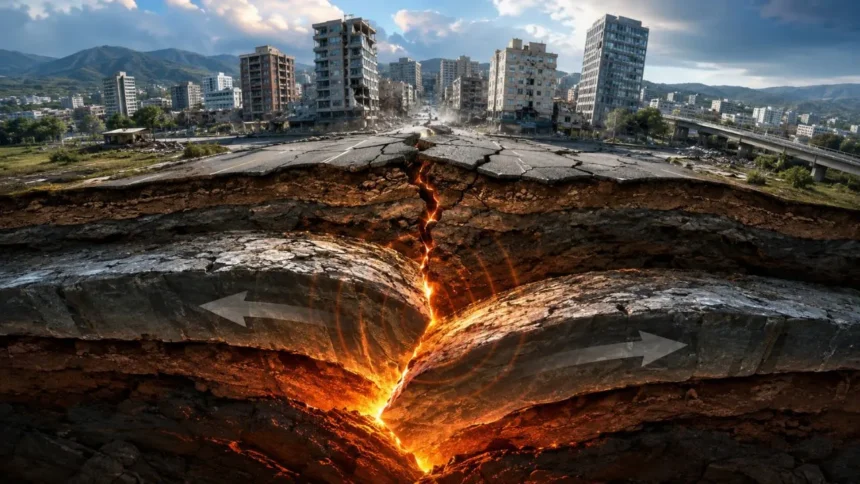
Earthquakes happen when energy stored inside the Earth is suddenly released. This release sends vibrations called seismic waves through the ground, causing the shaking people feel at the surface. Most earthquakes begin when rocks break or slip along a fault after pressure has built up over a long period.
The main answer to what causes earthquakes is the movement of tectonic plates. Earth’s outer shell is divided into large sections that move slowly over the softer material beneath them. Where these plates meet, separate or slide past one another, stress can build until the surrounding rocks can no longer remain locked together.
Earthquakes can also occur near volcanoes, beneath reservoirs, around mining operations or after fluids are injected deep underground. These events may have different immediate triggers, but they still involve a sudden movement that releases energy. Natural plate movement remains responsible for the world’s largest and most destructive earthquakes.
This article explains tectonic plates, fault lines, elastic rebound, seismic waves and the different types of earthquakes. It also covers earthquake depth, magnitude, aftershocks, volcanic activity, human-induced seismicity and prediction. Understanding these processes can help communities prepare for shaking even though scientists cannot identify the exact time of most future earthquakes.
The Structure of the Earth
Earth is made of several main layers, including the crust, mantle, outer core and inner core. The crust is the thin outer surface where people live, while the mantle extends much deeper beneath it. Heat from Earth’s interior helps drive slow movement within the mantle over geological time.
The crust and the rigid upper part of the mantle form a layer called the lithosphere. This layer is broken into tectonic plates of different sizes. Some plates carry continents, some carry ocean floors and others contain parts of both land and ocean.
Beneath the lithosphere is a warmer and more flexible region called the asthenosphere. Tectonic plates move over this softer layer at rates usually measured in centimetres per year. The movement is extremely slow from a human perspective, but it can produce major geological changes over millions of years.
Earthquakes mainly occur in the brittle upper parts of the planet, where rock can fracture under pressure. Deeper material behaves differently because intense heat and pressure can make rock deform more gradually. However, some earthquakes still begin hundreds of kilometres below the surface in particular plate-boundary environments.
How Tectonic Plates Cause Earthquakes
Tectonic plates are constantly moving, but their edges do not always move smoothly. Rough surfaces, uneven rocks and friction can cause neighbouring plates to become locked together. The wider plate continues moving, which gradually increases stress in the rocks around the locked area.
Eventually, the accumulated force becomes stronger than the friction holding the rocks in place. The fault suddenly slips, and the stored energy spreads outward as seismic waves. This rapid release can move the ground within seconds, even though the stress may have developed for decades or centuries.
The amount of energy released depends on factors such as the size of the fault area, the distance the rocks move and the strength of the surrounding material. A short movement on a small fault may create a minor earthquake, while a long rupture across a major plate boundary can produce a powerful event.
Plate movement does not stop after one earthquake. Stress continues developing as the plates keep moving, which is why the same regions can experience earthquakes repeatedly. However, the timing and strength of individual events vary because each fault has a different shape, history and pattern of stress accumulation.
What Are Fault Lines?
A fault is a fracture or zone of fractures where blocks of rock can move relative to one another. Fault lines seen at the surface represent only part of a much larger structure extending underground. Many faults remain hidden beneath soil, water, sediment or developed areas.
Some faults are active, meaning they have moved during recent geological time and may move again. Others are considered inactive because no recent movement has been identified. However, classifying a fault can be difficult when its history is poorly preserved or has not been studied in detail.
Faults are commonly grouped according to the direction of movement. Normal faults form when the crust is pulled apart, reverse or thrust faults develop under compression, and strike-slip faults occur when blocks slide horizontally past one another.
Not every fault movement produces severe surface damage. The effect depends on the earthquake’s magnitude, depth, distance from communities and local ground conditions. A moderate earthquake close to a densely populated area may cause more harm than a larger event located deep underground or far from buildings.
Elastic Rebound and Stored Energy
The elastic rebound theory explains how rocks can bend under stress before suddenly breaking or slipping. Tectonic forces slowly deform the rocks on both sides of a locked fault. The rock may store energy in a way that is similar to a stretched elastic band.
As stress increases, the rock continues changing shape while friction prevents the fault from moving. Once the stress exceeds the strength of the rock or the resistance along the fault, sudden movement occurs. The rocks then rebound toward a less distorted position.
The released energy travels through the Earth as seismic waves. Some waves move through the planet’s interior, while others travel near the surface. Surface waves often create the strongest rolling or side-to-side movement experienced during damaging earthquakes.
After the rupture, the fault does not necessarily return to its original position. The blocks of rock may remain permanently displaced by centimetres or metres. This movement can shift roads, rivers, fences and coastlines, especially when a large earthquake reaches or comes close to the surface.
Types of Plate Boundaries
Convergent boundaries form where two tectonic plates move toward one another. One plate may sink beneath another in a process called subduction, or two continental plates may collide and build mountains. These boundaries can produce powerful earthquakes because large areas may remain locked while enormous pressure develops.
Divergent boundaries occur where plates move apart. Magma rises into the opening and creates new crust, particularly along mid-ocean ridges. Earthquakes at these boundaries are usually shallow and often smaller than the largest events produced by major subduction zones.
Transform boundaries develop where plates slide horizontally past one another. Friction can lock sections of the boundary while the surrounding plates continue moving. When the locked area breaks free, strong shallow earthquakes can occur near the fault.
Some earthquakes also happen inside tectonic plates rather than directly along their boundaries. These intraplate earthquakes may reactivate ancient weaknesses in the crust. They are less frequent, but they can still be damaging because communities located away from plate edges may be less prepared.
Different Types of Earthquakes
Tectonic earthquakes are caused by movement along faults and account for most major earthquakes. They can occur at plate boundaries or within plates. Their strength ranges from tiny events detected only by instruments to massive ruptures affecting several countries and ocean basins.
Volcanic earthquakes happen when magma, gases or fluids move beneath a volcano. They may occur before, during or after an eruption. Most are relatively small, but their patterns can help scientists understand changes occurring inside a volcanic system.
Collapse earthquakes can occur when underground cavities fail. They may be associated with natural caves, mines or other hollow spaces. These events are usually local and smaller than major tectonic earthquakes, although they may still create dangerous conditions near the collapse.
Human-induced earthquakes result from activities that change pressure or stress underground. Possible triggers include mining, reservoir filling, geothermal projects and deep fluid injection. Most induced events are small, but some have been strong enough to damage buildings and raise public concern.
How Volcanic Activity Causes Earthquakes
Magma moving upward can push against surrounding rock and create new fractures. Each fracture may generate a small earthquake. A growing number of similar events can indicate that magma or volcanic fluids are moving through cracks beneath the surface.
Volcanic earthquakes can also occur when pressure changes inside a magma chamber. Gas expansion, fluid movement and the opening of underground pathways may produce different seismic signals. Scientists study the location, depth and waveform of these events to understand what may be happening below a volcano.
An earthquake near a volcano does not always mean an eruption is about to occur. Tectonic faults can exist in volcanic regions, and magma may move without reaching the surface. Researchers therefore combine seismic information with ground deformation, gas measurements and temperature changes.
Large tectonic earthquakes may sometimes affect volcanic systems by changing stress in nearby rocks. However, they do not automatically trigger eruptions. Whether a volcano responds depends on its internal condition, magma supply and the location of the earthquake relative to the volcanic system.
Human Activities and Induced Earthquakes
Certain human activities can alter underground pressure and make existing faults more likely to slip. Deep wastewater injection is one example because added fluid may reduce friction along faults. The water does not need to create a new fault; it can affect a weakness already present in the rock.
Hydraulic fracturing can produce many very small seismic events as rock is intentionally fractured. Larger induced earthquakes are more often connected with wastewater disposal, although the relationship varies by region. Depth, injection volume, pressure and local fault conditions influence the risk.
Large reservoirs may also change the load on the crust and allow water to enter underground fractures. This process, called reservoir-induced seismicity, has been observed near some dams. Mining, quarry blasting and underground extraction can produce additional forms of local seismic activity.
Induced earthquakes show that changing subsurface conditions can influence fault behaviour. Monitoring networks, pressure limits and careful site selection can reduce risk. Scientists and regulators study local geology before and during projects to identify unexpected seismic patterns and adjust operations when necessary.
Hypocentre and Epicentre
The point inside the Earth where an earthquake rupture begins is called the hypocentre or focus. It may be located only a few kilometres below the surface or hundreds of kilometres deep. The rupture can then spread away from this starting point along a fault.
The epicentre is the point on the Earth’s surface directly above the hypocentre. News reports often use the epicentre to describe an earthquake’s location because it can be shown easily on a map. However, the strongest shaking does not always occur exactly at that point.
Damage depends on the full rupture area, not only the epicentre. A large fault may break across a long distance, producing intense shaking in locations far from where the rupture first started. Local soil, rock and building quality also affect the severity of damage.
Shallow earthquakes generally create stronger surface shaking near the source because the seismic waves travel a shorter distance before reaching the ground above. Deep earthquakes may be felt across wider regions, but their energy often weakens before reaching the surface.
How Seismic Waves Move
Primary waves, called P-waves, are the fastest seismic waves and usually arrive first. They compress and expand material in the same direction they travel. P-waves can move through solid rock, liquid and gas, allowing them to pass through several layers of the Earth.
Secondary waves, called S-waves, arrive after P-waves and move material from side to side or up and down. They travel only through solids and cannot pass through liquid. Their behaviour helped scientists discover important information about the Earth’s internal structure.
Surface waves move along the Earth’s exterior and often cause the strongest shaking during an earthquake. Love waves produce horizontal side-to-side movement, while Rayleigh waves create a rolling motion. These waves can damage buildings, roads, bridges and underground utilities.
Seismometers record the arrival and strength of different seismic waves. By comparing their timing at several stations, scientists can calculate an earthquake’s location and depth. The recorded signals also help researchers estimate magnitude and study how the rupture developed.
Earthquake Magnitude and Intensity
Magnitude measures the energy released by an earthquake. Modern seismologists commonly use the moment magnitude scale for moderate and large events. It considers the fault area, rock movement and strength of the material rather than relying only on wave size at one station.
Magnitude scales are logarithmic, which means each whole-number increase represents a major increase in wave amplitude and released energy. A magnitude 7 earthquake is therefore not simply slightly stronger than a magnitude 6 event. It releases substantially more energy.
Intensity describes the effects of an earthquake at a particular location. It considers what people feel and the damage to buildings, roads and natural features. The same earthquake can produce high intensity near the rupture and much lower intensity farther away.
Magnitude is one value for the complete earthquake, while intensity varies from place to place. Soft sediment may amplify shaking, and poorly constructed buildings may suffer greater damage. Distance, depth, ground type and structural design all shape the final impact.
Why Some Regions Have More Earthquakes
Most earthquakes occur near tectonic plate boundaries because these areas experience frequent stress and movement. The Pacific Ring of Fire is especially active because several oceanic plates interact with surrounding continental and island plates. This region also contains many active volcanoes.
Subduction zones can produce the world’s largest earthquakes. A huge section of the boundary may remain locked before suddenly moving. If the ocean floor shifts vertically, it can also displace seawater and generate a tsunami that travels far beyond the earthquake zone.
Transform faults create another important group of high-risk regions. Communities built near major strike-slip faults may experience strong shallow shaking. Because these faults can pass through populated areas, even a rupture of moderate length may create serious damage.
Areas far from plate boundaries are not completely safe. Ancient faults can reactivate when stresses within a plate change. These earthquakes are harder to anticipate because they occur less frequently and may affect regions where building codes and public awareness are limited.
Foreshocks, Mainshocks and Aftershocks
A mainshock is the largest earthquake in a sequence. Smaller earthquakes occurring before it may later be called foreshocks. However, an earthquake cannot be confidently labelled a foreshock when it happens because scientists do not know whether a larger event will follow.
Aftershocks are smaller earthquakes that occur after the mainshock as the crust adjusts to changed stress. They usually happen near the original rupture area. Some aftershocks can be strong enough to damage buildings already weakened by the first earthquake.
Aftershock frequency generally decreases over time, but the sequence may continue for weeks, months or longer. Larger mainshocks usually produce more numerous and longer-lasting aftershock sequences. The exact pattern depends on the fault, depth and regional geology.
People should remain cautious after major shaking because additional events may occur without warning. Damaged buildings, unstable slopes and broken utility lines can become more dangerous during an aftershock. Official safety instructions should continue to be followed even after the initial shaking stops.
Can Earthquakes Be Predicted?
Scientists cannot currently predict the exact time, location and magnitude of a major earthquake with reliable accuracy. A true prediction would need to identify all three elements before the event occurs. No tested method has consistently achieved this standard.
Researchers can estimate long-term earthquake probabilities by studying faults, historical records and plate movement. These forecasts may show that a region has a certain chance of experiencing strong shaking within several decades. They support building codes, insurance planning and emergency preparation.
Animals, weather changes and unusual physical sensations are sometimes claimed to predict earthquakes. However, these signs have not provided a dependable warning system. Many reported signals occur without an earthquake, while major earthquakes often happen without any recognised unusual behaviour.
Earthquake early-warning systems are different from prediction. They detect an earthquake after it begins and send alerts before the strongest waves reach locations farther away. The warning may last only seconds, but it can help people take cover and allow automated systems to slow trains or shut down equipment.
How to Stay Safer During an Earthquake
During strong shaking, drop to your hands and knees so you are less likely to be knocked down. Cover your head and neck beneath a sturdy table or desk when possible. Hold on to the shelter until the shaking stops and be prepared for it to move.
Stay away from windows, glass, tall furniture and objects that may fall. Do not run outside while the ground is moving because falling bricks, signs and building materials may create additional danger. If you are already outside, move toward an open area away from structures and power lines.
After the shaking ends, check for injuries, fire and damaged utility lines. Leave a seriously damaged building carefully and avoid using elevators. Follow official alerts because aftershocks, landslides, fires or tsunamis may create further risks.
Preparation should begin before an earthquake happens. Secure heavy furniture, store emergency supplies and identify safe locations in each room. Families should create a communication plan, while businesses and schools should practise earthquake procedures suited to their buildings and local hazards.
FAQs
What is the main cause of earthquakes?
Most earthquakes are caused by tectonic plates moving and releasing built-up stress along faults. The sudden movement sends seismic waves through the ground.
Can weather cause an earthquake?
Normal weather does not cause tectonic earthquakes. Heavy rain or pressure changes may influence very shallow ground conditions, but they do not explain most damaging seismic events.
Why do earthquakes happen at fault lines?
Faults are weak zones where blocks of rock can become locked while tectonic forces continue acting. When the stored stress exceeds friction, the fault slips suddenly.
Can humans cause earthquakes?
Yes. Fluid injection, mining, reservoir filling and geothermal activity can trigger earthquakes by changing underground pressure or stress. Most induced earthquakes are relatively small.
Why are aftershocks dangerous?
Aftershocks can cause additional damage to buildings, slopes and infrastructure weakened by the mainshock. Some may be strong enough to create new collapses and injuries.
What Causes Earthquakes? Final Takeaways
The main answer to what causes earthquakes is the sudden movement of rock along a fault. Tectonic plates move continuously, but friction may lock their edges together. Stress then builds until the rocks slip and release stored energy as seismic waves.
Different plate boundaries produce different earthquake patterns. Subduction zones can create extremely powerful events, transform faults often generate damaging shallow earthquakes and divergent boundaries produce frequent movement where plates separate. Earthquakes can also occur within plates.
Volcanic activity and certain human operations can trigger additional earthquakes by changing pressure or stress underground. However, these events account for a smaller share of global seismic activity than natural tectonic movement. Each earthquake reflects a specific combination of faults, forces and local geology.
Scientists can identify hazardous regions and estimate long-term probabilities, but they cannot reliably predict the exact time of a major earthquake. Strong construction, emergency planning and early-warning technology therefore remain essential. Understanding earthquake causes helps communities prepare for shaking before the next event begins.