

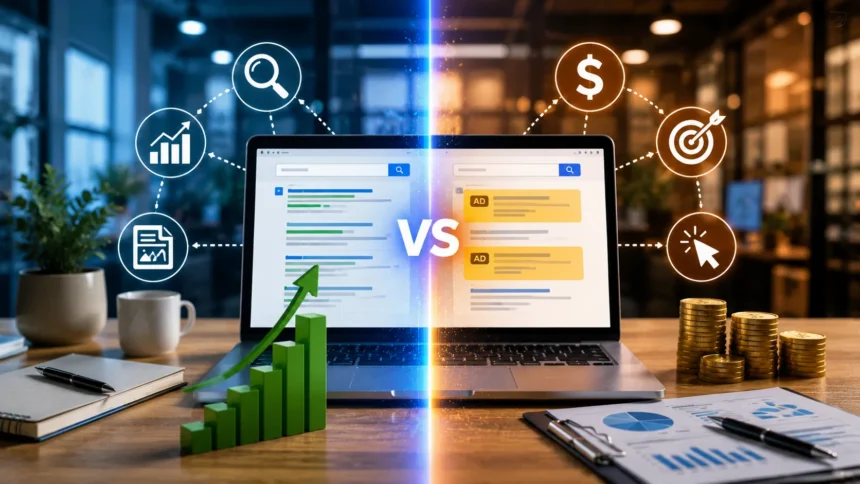
SEO vs SEM: What’s the Difference & Which Is Better?
SEO vs SEM: Understanding the Basic Difference
SEO and SEM are two search marketing strategies designed to help businesses become more visible when people search online, but they achieve that visibility in different ways. SEO, or search engine optimization, focuses mainly on earning organic visibility through helpful content, technically accessible pages, authority, and a strong user experience. SEM, or search engine marketing, commonly refers to using paid search advertising to appear prominently for selected keywords. With SEO, businesses generally do not pay a search engine every time someone clicks an organic listing. With SEM campaigns, advertisers commonly pay for clicks or other advertising outcomes. Both approaches can generate valuable website traffic when they are aligned with customer intent.
The easiest way to understand SEO vs SEM is to think about long-term visibility compared with immediate paid exposure. SEO usually requires time because search engines need to discover, crawl, understand, evaluate, and rank pages against competing results. SEM can begin generating visibility much faster once a paid search campaign is approved and active. A new company that needs leads this week may therefore find paid search useful while its organic rankings are still developing. An established business may rely more heavily on SEO because years of useful content and authority can continue attracting visitors. Neither approach is automatically superior because the right choice depends on goals, competition, budget, and timeframe.
SEO and SEM can also appear together on the same search engine results page. A person searching for a commercial service may see sponsored listings near organic search results, local results, videos, shopping elements, or other search features. A business with strong search marketing can potentially appear in more than one area of that results page. The paid listing can provide immediate exposure while an organic result strengthens brand familiarity and credibility. Search behavior is also becoming more complex as search engines present richer answers and more interactive result formats. Businesses therefore need to think about overall search visibility rather than assuming one blue organic link is the only opportunity available.
Another important difference concerns control. SEM gives advertisers relatively direct control over keywords, audience settings, advertising copy, landing pages, budgets, and campaign timing. If a business wants to advertise a specific service tomorrow, it can potentially create a campaign specifically around that offer. SEO provides less direct control over exactly where and when a page will rank because search engines decide organic visibility according to their systems and competing content. Businesses can optimize pages and improve their chances, but they cannot purchase a guaranteed organic ranking. Paid search therefore provides greater short-term control, while SEO focuses on earning durable visibility through relevance and quality.
The question “Is SEO or SEM better?” does not have one universal answer. SEO can be highly valuable for businesses seeking sustainable organic traffic, brand authority, and lower dependence on continuous advertising spending. SEM can be more appropriate when a company needs immediate visibility, wants to test an offer, or competes for high-intent commercial searches. Many successful businesses use both because the strengths of one strategy can compensate for the limitations of the other. Understanding the difference between SEO and SEM is therefore more useful than treating the two as rivals. The best search marketing strategy usually begins with the customer’s search intent and then chooses the channel most likely to reach that customer effectively.
What Is SEO and How Does It Work?
SEO stands for search engine optimization, which is the process of improving a website so search engines can understand its content and users can find it through unpaid search results. The purpose of SEO is not simply to attract as many visitors as possible, but to attract people whose searches are genuinely connected with the information, products, or services a website provides. Search engines evaluate many signals when deciding which pages deserve visibility for a query. These can involve relevance, usefulness, page quality, links, technical accessibility, user experience, and context. Good SEO therefore combines content strategy, technical optimization, and authority building rather than relying on one isolated tactic.
Keyword research remains an important part of SEO, although modern optimization goes far beyond repeatedly inserting exact phrases into a page. Search marketers study what potential customers are searching for, what those searches mean, and what kind of content would best satisfy the underlying intent. A query such as “how does payroll software work” usually has a different purpose from “best payroll software for small business.” The first visitor may primarily want information, while the second appears closer to evaluating a purchase. SEO content should reflect these differences rather than creating one generic page for every related keyword. Search intent helps businesses connect content with the stage of the customer journey.
On-page SEO focuses on improving the information and structure users and search engines encounter directly on a webpage. Relevant titles, descriptive headings, useful content, logical internal linking, clear URLs, image optimization, and well-written metadata all contribute to page quality. Content should answer the user’s main question efficiently while providing enough depth to satisfy important follow-up questions. Pages should avoid unnecessary repetition, misleading headings, and content created only to manipulate rankings. Modern SEO is increasingly people-first because search visibility is difficult to sustain when visitors consistently find a page unhelpful. The strongest optimization often feels natural because it improves understanding rather than interrupting it.
Technical SEO deals with the systems that allow search engines to crawl, render, index, and understand a website correctly. Important considerations include site architecture, mobile usability, page performance, redirects, canonicalization, structured data, XML sitemaps, crawl accessibility, and index management. A website can have excellent writing but still struggle if important pages cannot be discovered or technical errors create confusing duplicate versions. Large websites require particularly careful technical management because thousands of URLs can create crawl and indexing problems. Technical SEO also supports users by making websites faster, easier to navigate, and more reliable. It is therefore an important foundation rather than a separate exercise performed only for search engines.
Off-page SEO focuses largely on signals that develop outside the website, including links, brand mentions, citations, digital PR, and broader online authority. Links from relevant and trustworthy websites can help search engines understand that a page or domain has earned recognition from other sources. However, link quality matters much more than simply collecting large numbers of backlinks. Manipulative, irrelevant, or low-quality links can create risk instead of sustainable authority. Businesses can build stronger off-page visibility through genuinely useful resources, industry relationships, original insights, expert contributions, and PR-worthy work. Effective SEO brings these on-page, technical, and off-page elements together into a long-term organic growth strategy.
What Is SEM and How Does Paid Search Work?
SEM stands for search engine marketing, although the term has been used in different ways throughout the history of digital marketing. In modern everyday usage, marketers frequently use SEM to describe paid search advertising, particularly campaigns that place sponsored listings on search engine results pages. Advertisers select keywords or targeting themes connected with their products and services and create ads designed to attract relevant searchers. The advertiser can choose a landing page that matches the offer being promoted. When the campaign enters the advertising auction, several factors can influence whether the ad appears. SEM therefore combines targeting, bidding, ad quality, landing-page experience, and campaign optimization.
Pay-per-click advertising, commonly called PPC, is one of the most familiar SEM models. In a PPC campaign, an advertiser generally pays when someone clicks the sponsored listing rather than paying simply because the advertisement exists. Cost per click can vary dramatically based on industry, competition, location, keyword value, and campaign quality. Commercial searches in fields where one customer is extremely valuable may cost much more than low-intent informational queries. Businesses therefore need to evaluate whether the potential revenue from conversions justifies acquisition costs. Successful paid search management focuses on profitable outcomes rather than celebrating clicks without considering what those visitors actually do.
Keyword targeting helps advertisers connect their campaigns with people showing relevant search intent. A local plumber, for example, may want advertisements to appear when nearby users search for emergency plumbing services rather than when someone searches for the history of plumbing. Paid search platforms provide controls that help marketers refine which searches can trigger ads and which should be excluded. Negative keywords can be particularly useful because they prevent budget from being spent on clearly irrelevant searches. Modern advertising systems may also use automated matching and machine learning to expand targeting beyond strict keyword lists. This makes monitoring search terms and conversion quality increasingly important.
Ad copy and landing pages strongly influence SEM performance because visibility alone does not guarantee meaningful results. The advertisement should communicate a clear reason for the searcher to click while accurately representing what the landing page provides. Once visitors arrive, the page should continue the same message and make the desired action easy to complete. A company advertising “same-day air conditioner repair,” for example, should not send people to a generic homepage that makes the service difficult to find. Strong message alignment can improve conversion rates and campaign efficiency. Search advertising performs best when keyword intent, ad promise, and landing-page experience work as one connected journey.
One of SEM’s major advantages is the amount of measurable campaign data available to marketers. Advertisers can monitor impressions, clicks, click-through rate, cost per click, conversions, conversion rate, acquisition cost, revenue, and other performance indicators. Campaigns can then be adjusted according to which keywords, locations, devices, audiences, or advertisements generate valuable outcomes. However, abundant data does not automatically create good decisions because optimization requires reliable conversion tracking and commercial understanding. A low-cost keyword may still be poor if it generates unqualified leads. Effective SEM therefore means buying profitable visibility rather than simply buying traffic.
SEO vs SEM: Key Differences That Matter
The most obvious difference between SEO and SEM is how businesses acquire visibility. SEO attempts to earn organic rankings through relevance, website quality, authority, and technical accessibility, while SEM purchases advertising opportunities within search results. Organic clicks generally do not create a direct charge from the search engine each time someone visits. Paid search clicks usually consume campaign budget according to the advertising model being used. However, describing SEO as free would be misleading because content, technical work, research, tools, outreach, and professional expertise all require resources. The more useful distinction is that SEO invests in building organic assets, while SEM spends budget to participate in paid advertising opportunities.
Speed is another major difference between SEO and SEM. A properly configured paid campaign can potentially begin generating impressions, clicks, and conversions soon after launch. SEO usually takes longer because rankings must be earned against pages that may already have strong relevance and authority. New websites can face an especially difficult period while search engines gather signals and the site develops content depth. This makes SEM attractive for product launches, seasonal promotions, urgent lead generation, and market testing. SEO becomes especially valuable when the company can invest patiently in visibility that may continue producing results over a much longer period.
Control also differs significantly between organic and paid search. SEM allows advertisers to pause campaigns, change daily budgets, modify geographic targeting, adjust bids, test new advertisements, and send visitors to specific landing pages. SEO teams cannot simply choose an organic ranking position or turn a top ranking on at a particular hour. Search engines may update their systems, competitors can improve their pages, and search result layouts can change over time. SEO therefore requires adaptability and continuous improvement rather than complete control. SEM offers greater tactical control, although advertisers still compete in auctions and cannot guarantee every impression or conversion.
Trust and user behavior create another distinction, although preferences vary significantly between searchers. Some people deliberately choose organic results because they perceive them as more informational or less promotional. Others click sponsored listings readily when the advertisement closely matches an immediate need. A person searching “emergency locksmith near me” may care much more about fast availability than whether the listing is paid or organic. Someone researching a complex business problem may spend considerably more time comparing guides, reviews, and educational resources. This means neither traffic source is automatically higher quality. Search intent and landing-page relevance often matter more than whether the visitor came through SEO or SEM.
Finally, the two channels differ in what happens when active investment slows down. If paid advertising is paused, the paid traffic generated by those advertisements generally stops almost immediately. Strong SEO pages may continue receiving organic traffic after the original optimization work has been completed, although they still require maintenance as competition and search behavior evolve. This can make SEO resemble a compounding digital asset when successful content builds visibility over time. SEM behaves more like an adjustable demand-generation engine that produces exposure while budget is active. Businesses often benefit from understanding these economic differences when deciding how to divide search marketing resources.
SEO vs SEM Costs, Timelines, and Long-Term ROI
SEO costs are usually connected with the work required to improve organic search performance rather than a fee for every organic click. Expenses may include keyword research, content creation, technical audits, website development, digital PR, link acquisition, SEO tools, analytics, and professional strategy. A small local business may require a relatively focused program, while a large ecommerce or enterprise website can need specialists across several disciplines. SEO spending can therefore vary widely. Businesses should avoid evaluating SEO solely by its monthly fee because the more useful question is whether organic search generates profitable leads, sales, or other business outcomes. Organic traffic has value only when it supports meaningful goals.
SEM costs are easier to see directly because advertisers can monitor exactly how much campaign budget is being spent. However, the true cost of paid search extends beyond media spend. Businesses may also pay for campaign management, landing-page development, tracking software, creative testing, analytics, and conversion optimization. Competition can make certain keywords expensive, especially when many companies are willing to pay aggressively for high-value customers. A campaign with a high cost per click can still be profitable if each conversion creates substantial lifetime value. Conversely, cheap clicks are not useful when visitors rarely become customers. Paid search decisions should therefore focus on return rather than minimum click cost.
The timeline for SEO results depends on competition, website history, technical condition, content quality, authority, and the difficulty of the target queries. Some improvements may produce noticeable changes relatively quickly, particularly when fixing technical problems on an established website. New content targeting competitive commercial keywords may require considerably more time to gain strong visibility. This uncertainty can make SEO frustrating for businesses expecting immediate returns. A serious SEO strategy should therefore include realistic milestones such as improved indexation, stronger keyword visibility, increased qualified impressions, higher organic clicks, and eventually conversions. Rankings alone should not be treated as the final business objective.
SEM provides much faster feedback, which can be valuable for both marketing and business strategy. An advertiser can test whether searchers respond to a particular value proposition, product category, price point, or landing page without waiting months for organic rankings. Campaign data may reveal that one keyword generates many clicks but few qualified customers, while another converts exceptionally well despite lower search volume. This information can guide future paid campaigns and even influence SEO priorities. However, early results should still be interpreted carefully because limited data can produce misleading conclusions. Paid search becomes more useful as conversion tracking and testing become more reliable.
Long-term ROI depends on the economics of the specific business rather than a universal rule that SEO always beats SEM. Strong SEO can produce substantial returns when pages continue generating organic leads over months or years, reducing dependence on paying for every visit. SEM can produce excellent returns when campaigns reliably acquire customers for less than those customers are worth. Mature businesses often compare marginal returns across both channels instead of choosing one based on ideology. They may increase paid search when profitable demand is available while continuing to invest in organic assets. The best financial strategy is the combination that produces sustainable customer acquisition at an acceptable overall cost.
Advantages and Limitations of SEO and SEM
One major advantage of SEO is its ability to create durable visibility around topics customers repeatedly search for. A comprehensive guide, useful service page, or strong category page can continue attracting organic visitors long after publication if it remains relevant and competitive. SEO can also strengthen overall brand credibility by helping a company appear throughout the research journey rather than only at the final purchase stage. Someone may first discover a brand through an informational article and return later when ready to buy. This creates opportunities beyond immediate lead generation. The limitation is that building this visibility requires time and cannot be guaranteed for every keyword.
SEO also supports broader website quality because good optimization often requires improvements that benefit users directly. Faster pages, logical site architecture, useful internal linking, accessible content, clearer navigation, and better information all contribute to a stronger web experience. Search optimization can therefore improve more than rankings when it is approached correctly. However, SEO becomes ineffective when teams focus excessively on algorithms and forget why people search in the first place. Publishing hundreds of thin pages simply because keywords exist can create clutter instead of value. Sustainable SEO requires prioritizing useful content and commercial relevance rather than treating search volume as the only reason to create a page.
SEM’s greatest advantage is speed and precision. A business can target high-intent searches, define geographic areas, control spending, and direct users to purpose-built landing pages without waiting to establish organic rankings. This is particularly useful for new companies, competitive services, temporary promotions, and products that need immediate market feedback. Campaigns can also be paused quickly when demand changes or inventory becomes unavailable. The limitation is that paid visibility depends on continued spending. If customer acquisition is profitable this can be completely acceptable, but businesses should understand that the traffic does not become permanently owned simply because the campaign has operated successfully for several months.
Another SEM advantage is experimentation. Paid search allows marketers to test headlines, offers, landing pages, search themes, audiences, and conversion paths with relatively direct feedback. A company considering a new service can measure whether people actually search for it and whether those visitors convert before investing heavily in a complete organic content program. This testing capability can reduce uncertainty in marketing decisions. However, campaigns can also waste money quickly when targeting is broad, conversion tracking is unreliable, or landing pages are weak. Automated advertising tools still require commercial oversight. Machine learning can optimize toward the wrong outcome if the campaign sends poor-quality conversion signals.
Both SEO and SEM also face competition that can increase difficulty over time. A profitable keyword attracts organic competitors seeking rankings and advertisers willing to bid for paid visibility. Search result layouts evolve, new features appear, and user behavior changes as search technology becomes more interactive. Businesses should therefore avoid building their entire acquisition strategy around one ranking or one advertising campaign. The most resilient search strategies develop multiple useful pages, strong brand recognition, conversion-focused landing experiences, and diversified keyword coverage. SEO and SEM work best as evolving systems rather than one-time projects. Continuous learning becomes a competitive advantage in both organic and paid search.
Which Is Better: SEO or SEM?
SEO is usually the stronger priority when the main goal is building long-term organic visibility around topics that customers search consistently. Businesses with educational buying journeys can benefit particularly strongly because potential customers may conduct several searches before contacting a provider or purchasing a product. SEO allows a company to appear throughout those stages with helpful guides, comparison pages, category pages, product information, and service content. Over time, a strong content library can become a valuable customer-acquisition asset. This makes SEO attractive for businesses prepared to invest patiently. However, the strategy still needs conversion-focused pages so increased traffic eventually contributes to revenue rather than becoming an isolated vanity metric.
SEM may be the better immediate choice when speed is critical. A new business with no organic visibility cannot necessarily wait for competitive rankings before generating customers. Paid search can place its offer in front of relevant users while the SEO foundation is being developed. SEM is also useful for short-lived promotions because spending months ranking organically for an offer that lasts only several weeks may make little sense. Seasonal campaigns, event registrations, limited product launches, and urgent local services can therefore benefit from paid search. The company still needs appropriate margins because rapid traffic is valuable only when customer acquisition remains economically sustainable.
Business economics should strongly influence the decision. Companies selling high-value services may be able to afford expensive paid search clicks because one new client can generate substantial revenue. Businesses with low margins may struggle if advertising costs consume too much of each sale. SEO may reduce direct dependence on per-click costs, but building competitive organic visibility also requires meaningful investment. The correct comparison is therefore not “free SEO versus expensive advertising.” Businesses should calculate customer acquisition cost, conversion rate, customer lifetime value, and expected return across both channels. The better channel is the one that creates profitable growth under realistic financial assumptions.
Competition also changes the answer. Some organic search results are dominated by extremely authoritative websites, making first-page SEO visibility difficult for a new business in the short term. Paid search can provide access to those queries much sooner if campaign economics are viable. In other markets, advertising costs may be extremely high while organic competition remains manageable with specialized expertise and strong content. Keyword-level analysis is therefore more useful than deciding that one entire channel is always easier. Businesses can discover that SEO works best for one set of search intents while SEM performs better for another. Channel decisions should be made around opportunities rather than broad assumptions.
For most growth-focused businesses, the strongest answer is eventually both SEO and SEM. SEO develops organic assets, educational visibility, authority, and compounding search traffic, while SEM provides immediate targeting, controlled experimentation, and fast access to commercial demand. Paid campaign data can reveal high-converting keywords that deserve stronger organic investment. SEO content can educate visitors who first discovered the brand through paid search. Remarketing and other advertising strategies can then reconnect with people who originally entered through organic channels. Instead of asking which channel should completely replace the other, businesses can ask what role each should play at each stage of customer acquisition.
How to Combine SEO and SEM for Better Search Marketing
A combined strategy begins with shared keyword and search-intent research. SEO teams and paid search teams sometimes operate separately, creating unnecessary duplication and missing valuable insights. Both channels are trying to understand what potential customers search for, which queries indicate buying intent, and which messages generate meaningful engagement. SEM data can reveal which commercial phrases produce actual leads or sales rather than merely high search volume. SEO teams can use these insights when prioritizing service pages, product categories, and comparison content. Organic search data can similarly uncover emerging queries that advertisers might test. Shared information makes both channels more efficient.
Businesses can also use SEM while waiting for SEO results to mature. Imagine a new company launching a specialized B2B service with no existing organic authority. The team can create a strong service landing page, run paid campaigns around high-intent keywords, and begin collecting conversion information immediately. At the same time, SEO efforts can improve that service page and build supporting educational content, internal links, and external authority. As organic visibility grows, the company can decide whether to reduce, maintain, or expand paid spending based on profitability. This avoids the common problem of expecting a new website to generate immediate organic leads before it has developed competitive strength.
Paid search is also useful for validating SEO opportunities before investing heavily in content. Suppose keyword research suggests that a particular service receives substantial search interest, but the company is unsure whether those searchers match its ideal customer profile. A controlled SEM campaign can direct relevant users to a landing page and measure inquiries, sales, or qualified conversations. If the keyword converts strongly, the company gains additional evidence that long-term organic optimization may be worthwhile. If traffic produces poor-fit leads, the team can investigate intent before creating dozens of related pages. Paid testing therefore turns real customer behavior into strategic SEO input.
SEO can also improve SEM performance indirectly through better landing pages and stronger site experiences. Content developed for organic search can explain services, answer objections, demonstrate expertise, and support visitors who need additional information before converting. A paid visitor who arrives on a service page may explore case studies, guides, FAQs, pricing information, or product comparisons before submitting an inquiry. Strong organic content therefore supports the broader conversion journey even when the initial click came from advertising. Similarly, technical improvements made through SEO can improve mobile usability and page speed for every visitor. The two channels often share more infrastructure than separate reporting dashboards suggest.
The final step is measuring SEO and SEM against shared business outcomes rather than allowing each team to optimize isolated metrics. SEO should not celebrate traffic increases if those visitors never become valuable customers, while SEM should not celebrate high click volume when acquisition costs are unsustainable. Build reporting around qualified leads, sales, revenue, customer acquisition cost, conversion rates, and other outcomes connected with business growth. Then examine how organic and paid search contribute at different stages of the journey. Some customers may interact with both channels before converting. A unified search strategy recognizes those interactions and allocates investment according to profitable demand rather than channel competition.
Frequently Asked Questions
What is the main difference between SEO and SEM?
SEO focuses primarily on earning organic visibility in search results, while SEM commonly refers to paid search advertising. SEO typically requires longer-term optimization, whereas SEM can provide paid visibility much more quickly.
Is SEO free compared with SEM?
Organic clicks do not normally involve paying a search engine for each click, but SEO itself is not free. Businesses still invest in content, technical work, tools, strategy, link building, digital PR, and professional expertise.
Is SEM the same as PPC?
The terms are often closely associated because modern SEM commonly refers to paid search campaigns, while PPC describes an advertising payment model in which advertisers pay for clicks. PPC can also exist on platforms outside traditional search engines.
Which produces results faster, SEO or SEM?
SEM usually produces visibility faster because an approved paid campaign can begin appearing relatively quickly. SEO generally takes more time because organic visibility must be earned through relevance, technical quality, authority, and competition.
Which is better for a new website?
A new website can benefit from using SEM for immediate visibility while simultaneously building an SEO foundation for long-term growth. The right balance depends on available budget, competition, margins, and customer acquisition goals.
Does SEO provide better ROI than SEM?
SEO can produce strong long-term returns when successful pages continue attracting qualified organic traffic, but SEM can also generate excellent ROI when paid campaigns acquire profitable customers. Neither channel automatically has a higher return for every business.
Can SEO and SEM target the same keywords?
Yes. A business can optimize organically and run paid search ads around the same high-value query. Appearing through multiple search placements can increase visibility when the economics and search intent justify the investment.
Should small businesses use SEO or paid search?
Small businesses should choose based on urgency, competition, budget, and customer value. Local businesses often benefit from combining targeted paid campaigns with ongoing local and organic SEO.
What happens when you stop paying for SEM?
Paid search visibility generally stops when the campaign or budget is paused. Organic SEO rankings may continue generating traffic, although they still require monitoring and improvement as competitors and search results change.
Is it better to use SEO and SEM together?
For many businesses, yes. SEM can provide immediate traffic and keyword testing, while SEO builds longer-term organic visibility and reduces dependence on paid acquisition alone.