

How to Make Long Flights More Comfortable
Long flights can turn an exciting trip into an exhausting experience before you even reach your destination. Sitting in a confined airplane seat for eight, ten, or even fifteen hours can leave you feeling stiff, dehydrated, restless, and desperate for proper sleep. Fortunately, learning how to make long flights more comfortable can dramatically improve the way you feel both in the air and after landing. Small decisions involving your seat, clothing, hydration, movement, food, sleep, and entertainment can make a surprisingly large difference. The goal is not to make economy class feel like a luxury hotel, but to create an environment where your body and mind can handle extended air travel more comfortably.
Modern travelers also have more options than ever for improving the long-haul flight experience. Noise-canceling headphones, supportive travel pillows, reusable water bottles, compression socks, offline entertainment, and thoughtfully designed travel clothing can all make flying easier when used appropriately. However, comfort is not simply about buying more travel accessories or packing every gadget you can find. Your habits before and during the flight often matter just as much as what you bring onboard. By preparing strategically and understanding what your body needs during extended periods of sitting, you can arrive feeling more rested, organized, and ready to enjoy your destination.
Choose Your Seat Carefully Before the Flight
Your seat can influence almost every part of your long-haul flight experience, so choosing one deserves more attention than many travelers give it. An aisle seat is usually convenient if you like getting up regularly, stretching your legs, or visiting the restroom without disturbing anyone. A window seat may be better for travelers who want to sleep because you can lean toward the wall and avoid being asked to move whenever another passenger needs the aisle. Middle seats generally provide the least personal space, although preferences vary between travelers. Checking the aircraft layout before selecting your seat can therefore be one of the simplest ways to improve airplane comfort before boarding even begins.
Seat location within the cabin matters as well, especially when you are trying to sleep or minimize disruptions. Seats close to lavatories and galleys may experience more foot traffic, conversations, lights, and movement throughout the journey. Sitting farther away from these busy areas can potentially create a calmer environment, although aircraft configurations differ significantly. Travelers who dislike turbulence sometimes prefer seats around the wings because movement may feel less pronounced there compared with the rear of the aircraft. Whatever your preference, consider what normally bothers you most while flying and choose your seat accordingly rather than simply accepting whichever seat the airline automatically assigns.
Extra-legroom seats can be worthwhile on particularly long journeys if the additional cost fits your travel budget. Even a relatively small increase in space can make changing your leg position easier and reduce the feeling of being confined for many hours. Exit-row and bulkhead seats sometimes provide additional room, but they can also come with restrictions or disadvantages depending on the aircraft. Some seats may have fixed armrests, limited under-seat storage, or specific safety requirements that passengers must meet. Before paying for an upgrade, compare exactly what the airline provides so you understand whether you are purchasing genuine additional comfort or simply a preferred location within the same cabin.
Reclining ability should also be considered when selecting a seat for an overnight flight. Some seats located directly in front of exit rows, partitions, or at the back of certain cabins may have limited or completely restricted recline. Spending an entire overnight journey in an upright position can make sleeping considerably harder, especially if you already struggle to sleep on airplanes. Aircraft-specific seat maps and information provided during booking can help you identify potential limitations before making your selection. If sleeping is your main priority, look for a seat that allows normal recline while still considering proximity to bathrooms, galleys, and other potentially disruptive areas.
Finally, choose your seat according to your personal flying habits rather than following universal advice about the supposedly “best” airplane seat. Someone who sleeps for most of the journey may love a window seat, while a restless traveler might feel trapped there after only two hours. Similarly, extra legroom may be valuable to one passenger but less important to someone who prioritizes being far from busy cabin areas. Think about previous flights and identify exactly what made you uncomfortable, whether it was restricted movement, noise, interruptions, or difficulty sleeping. Using those experiences to guide future seat selection can make long flights noticeably more comfortable without requiring major changes to your travel routine.
Dress for Comfort Without Overpacking Your Carry-On
Comfortable clothing is one of the easiest ways to improve a long flight because your body can experience significant temperature changes throughout the journey. Airport terminals may feel warm while airplane cabins can become surprisingly cool once the aircraft reaches cruising altitude. Wearing breathable layers allows you to adjust your clothing instead of spending hours feeling too hot or cold. A soft T-shirt or breathable base layer combined with a lightweight sweater, cardigan, or hoodie usually provides useful flexibility. Avoid clothing that feels restrictive around your waist, legs, or shoulders because even minor discomfort can become irritating after several hours of sitting in the same confined space.
Your choice of pants can make a particularly noticeable difference during long-haul travel. Soft trousers, relaxed-fit pants, leggings, or other flexible clothing generally allow easier movement than stiff or tightly fitted garments. You do not necessarily need to dress as though you are going to bed, especially if you prefer looking polished while traveling. Instead, look for clothing that combines presentability with enough stretch and room to change positions comfortably. Natural or moisture-managing fabrics can also help you feel fresher during a long journey. The best flight outfit is ultimately something you can comfortably sit, walk, stretch, and potentially sleep in for many consecutive hours.
Footwear deserves similar attention because feet can feel uncomfortable after prolonged sitting. Choose shoes that are comfortable for walking through large terminals but are not excessively tight around your feet. Slip-on or easily removable shoes can make security screening and in-seat adjustments more convenient where removal is appropriate. However, always keep hygiene and fellow passengers in mind if you decide to remove your shoes during the flight. Wearing clean, comfortable socks can help keep your feet warm when the cabin temperature drops. Some travelers also use properly fitted compression socks on longer journeys, particularly when they have been advised that these are appropriate for their individual circumstances.
Your carry-on should contain useful comfort items without becoming so overloaded that accessing anything becomes frustrating. A travel pillow, eye mask, headphones, charging cable, moisturizer, lip balm, tissues, medication, and a few basic toiletries can cover many common needs. Keeping these items in a smaller organizer or personal bag makes them easier to reach without repeatedly opening an overhead suitcase. Remember that a large bag placed underneath the seat in front of you can reduce valuable legroom for the entire flight. Packing strategically therefore improves comfort twice: you have the essentials you need while preserving as much space around your legs as possible.
It can also be useful to pack a small “flight comfort kit” rather than scattering essential items throughout different compartments. Place your eye mask, earplugs, headphones, charging cable, lip balm, tissues, and other frequently used items together so they are immediately accessible after takeoff. This reduces the need to repeatedly stand up, search through luggage, or disturb neighboring passengers. Keep important medications in your carry-on rather than checked baggage and follow relevant airline and security requirements for liquids or other restricted items. Efficient organization might sound like a small detail, but on a twelve-hour flight, reducing unnecessary inconvenience can significantly improve your overall travel experience.
Stay Hydrated and Eat in a Way That Supports Comfort
Airplane cabins typically have low humidity, which can leave your mouth, nose, skin, and eyes feeling dry during extended journeys. Drinking water regularly is therefore one of the simplest habits for staying comfortable on a long flight. Rather than waiting until you feel extremely thirsty, take small amounts periodically throughout the journey. Bringing an empty reusable bottle through airport security and filling it afterward can help you keep water accessible, subject to airport rules. Cabin crew also provide drinks during scheduled service, but having your own supply means you do not need to depend entirely on beverage rounds whenever you become thirsty.
Coffee and tea can still be part of your travel routine, but timing matters if you are hoping to sleep during the flight. Consuming a large amount of caffeine shortly before your planned sleeping period can make it harder to relax, particularly if you are sensitive to its effects. Alcohol may initially make some people feel sleepy, yet it can interfere with sleep quality and contribute to dehydration. If your priority is arriving rested, water should generally remain your primary drink throughout the journey. You can still enjoy other beverages in moderation while paying attention to how your own body responds to caffeine, alcohol, and changes in your usual eating schedule.
Heavy meals can sometimes make an already uncomfortable flight feel worse, particularly when you are sitting for hours afterward. Eating a balanced meal before boarding can prevent you from becoming excessively hungry while reducing dependence on whatever food happens to be served onboard. During the flight, choose portions that leave you satisfied rather than overly full. Foods containing protein, complex carbohydrates, fruit, vegetables, or other familiar ingredients may feel easier to manage than unusually rich meals. Everyone responds differently to airplane food, so consider your normal digestion and avoid experimenting with foods that commonly cause you bloating, heartburn, or stomach discomfort.
Packing a few healthy travel snacks can also make long flights easier, especially when meal schedules do not match your normal routine. Depending on destination and security rules, practical options may include nuts, crackers, protein bars, dried fruit, or other portable foods that do not create strong odors or significant mess. Having your own snacks gives you greater control over when and how much you eat. It can also be particularly helpful during delays, overnight connections, or periods when cabin service is unavailable. Always check customs and agricultural restrictions before carrying uneaten food into another country, as rules concerning fruit, meat, dairy, seeds, and other products can vary considerably.
Hydration also involves managing the dryness you experience externally during long-haul flights. Lip balm and a simple moisturizer can help if your lips or skin become uncomfortable in the dry cabin environment. Contact lens wearers may find that their eyes feel increasingly dry over time, so some travelers prefer wearing glasses for at least part of the journey. Avoid introducing unfamiliar skincare products during a flight because irritation is the last thing you want while trapped several kilometers above the ground. Keeping your routine simple—water, familiar food, basic skincare, and sensible caffeine consumption—can help you feel noticeably fresher when you eventually step off the aircraft.
Move Regularly and Reduce the Discomfort of Sitting
One of the biggest challenges of long-distance flying is remaining seated for extended periods. Your back, hips, neck, knees, and legs may gradually become stiff because airplane seats limit the number of positions you can comfortably use. When conditions allow and the seatbelt sign is switched off, getting up periodically to walk through the cabin can provide a welcome change of position. Even a short trip to the restroom or a brief walk along the aisle gives your muscles an opportunity to move. You do not need an elaborate onboard exercise routine; simply avoiding complete immobility for the entire journey can make the flight feel more manageable.
You can also perform small movements while remaining in your seat. Moving your ankles, flexing your feet, gently raising your heels, adjusting your posture, and changing leg positions periodically can prevent you from remaining completely still. Shoulder rolls and gentle neck movements may help when your upper body starts feeling stiff, provided they are comfortable for you. Avoid movements that intrude into another passenger’s space or interfere with cabin service. The objective is not to conduct a full workout at 35,000 feet but to introduce regular, gentle movement into an environment where your body would otherwise remain largely inactive for hours.
Posture can significantly affect how your back and neck feel by the end of a long flight. Try to sit with your back supported rather than gradually sliding forward into an awkward position for several hours. If the seat provides adjustable head support, position it so your head does not repeatedly fall sideways whenever you start sleeping. Some passengers find that a small lumbar cushion or strategically positioned travel pillow provides additional lower-back support. Experiment before traveling whenever possible because a pillow that looks comfortable online may not work with your body or airplane seat. Effective support should reduce strain rather than forcing your spine into an unnatural position.
It is also important to keep the area around your legs as clear as reasonably possible. A heavily packed personal bag under the seat can force your feet into a restricted position and make an already narrow economy seat feel even smaller. Store items you will not need regularly in the overhead compartment when permitted, while keeping essential items accessible in a compact bag. Avoid crossing your legs in the same position for long periods simply because it feels comfortable initially. Changing positions regularly can help prevent one area from becoming excessively stiff. Small adjustments become increasingly valuable as the hours pass, particularly during flights lasting ten hours or longer.
Travelers with certain medical conditions or individual risk factors may need specific advice about prolonged sitting, movement, or compression garments before a long journey. If you have concerns about circulation, previous blood clots, recent surgery, pregnancy, mobility limitations, or another health issue, personalized medical guidance is more useful than relying on generic travel tips. Airline assistance may also be available for passengers who have difficulty walking long distances through terminals or boarding independently. Planning these needs in advance can reduce physical stress considerably. For most travelers, however, the basic principle remains straightforward: comfortable long-haul travel involves regular movement rather than spending the entire flight completely motionless.
Create a Better Environment for Sleeping on the Plane
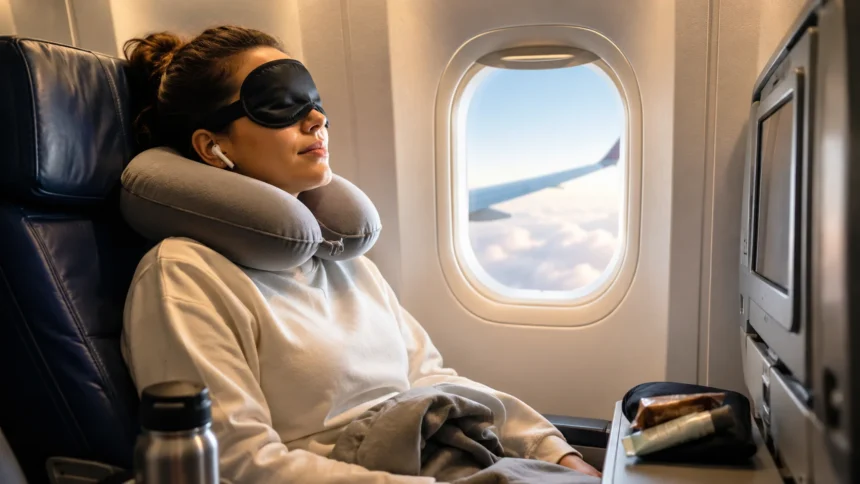
Sleeping on an airplane is difficult because your body is attempting to rest in an environment filled with noise, light, movement, announcements, and limited personal space. Instead of expecting perfect sleep, focus on creating conditions that give your body the best possible chance to relax. An eye mask can reduce exposure to cabin lights, entertainment screens, and neighboring reading lights. Earplugs or noise-canceling headphones can reduce persistent engine noise and surrounding conversations. Combining these simple tools creates a stronger signal that it is time to rest, even when the physical environment remains far from your normal bedroom.
A supportive travel pillow for long flights can be helpful, but the right design depends on your sleeping style. Traditional U-shaped pillows work well for some passengers, while others prefer wraparound designs or pillows that provide more support beneath the chin. The important factor is whether the pillow prevents your head from repeatedly dropping into uncomfortable positions as you fall asleep. Test your travel pillow before leaving home instead of discovering halfway across the Atlantic that it pushes your neck forward. A compact pillow that genuinely supports your head is more useful than a bulky accessory that occupies valuable luggage space but never feels comfortable.
Consider adjusting your sleep schedule according to your destination, particularly when crossing several time zones. Once onboard, setting your phone or watch to destination time can help you mentally transition toward the new schedule. If it is nighttime at your destination, you may choose to prioritize sleep even when you do not feel extremely tired yet. If you will arrive in the evening, staying awake for more of the journey may sometimes make adapting easier. Jet lag is influenced by multiple factors, and there is no universal schedule that works perfectly for every itinerary, so think about arrival time when deciding when to sleep.
Your pre-sleep routine can also influence how easily you settle down. Visit the restroom, brush your teeth if desired, adjust your clothing, organize your blanket, and put away unnecessary electronics before trying to rest. This creates a miniature version of the routine you might follow before sleeping at home and reduces reasons to get up again shortly afterward. Recline your seat carefully when permitted, being considerate of the passenger behind you and following cabin crew instructions during meals, takeoff, and landing. Fastening your seatbelt visibly over your blanket may also help cabin crew see that you are secured without needing to wake you unnecessarily.
Avoid placing excessive pressure on yourself to achieve eight uninterrupted hours of sleep during an overnight flight. Many passengers sleep in shorter periods because cabin announcements, turbulence, meal services, and normal movement repeatedly interrupt rest. Even if you cannot sleep deeply, closing your eyes, reducing screen exposure, and spending some time quietly resting can make the journey feel less exhausting. If you wake up, drink some water, change your position, stretch when appropriate, and try again rather than constantly checking how many hours remain. Treating airplane sleep as an opportunity for rest rather than a performance goal can make the experience considerably less frustrating.
Manage Entertainment, Technology, and Mental Fatigue
Long flights can feel much longer when you spend every minute watching the remaining-flight-time display. Preparing several forms of entertainment gives you options when boredom starts affecting your mood. Download movies, television episodes, podcasts, audiobooks, music, books, games, or articles before leaving home because onboard internet may be unavailable, slow, or expensive. Do not rely entirely on the airline’s entertainment system, even when the carrier advertises a large selection. Technical problems occasionally occur, and personal offline content provides a useful backup. Variety matters because something that seems entertaining during the first hour may feel completely uninteresting after you have been sitting for eight hours.
Noise-canceling headphones are particularly useful on long-haul flights because they can reduce the constant background sound of the aircraft. Even when you are not watching anything, lowering repetitive cabin noise may make reading, resting, or simply sitting quietly more pleasant. If you prefer smaller equipment, good-quality earplugs or earbuds can be easier to pack. Remember to download entertainment directly to your device rather than assuming streaming services will work offline automatically. Some apps also require you to open downloaded content periodically to maintain authorization, so checking everything before leaving for the airport can prevent an unpleasant surprise after takeoff.
Battery management becomes increasingly important on longer journeys. Many modern aircraft provide USB ports or power outlets, but availability and reliability vary between airlines, aircraft, cabins, and individual seats. Charge your phone, tablet, e-reader, headphones, and other essential electronics fully before boarding whenever possible. Carry an airline-compliant power bank if needed and follow all rules regarding lithium batteries, including requirements about where they can be stored. Keeping charging cables somewhere accessible prevents you from digging through an overhead suitcase midway through the journey. A fully charged device can provide entertainment, travel documents, translation tools, maps, and important information once you land.
Screen fatigue can become another source of discomfort if you watch movies or scroll continuously for ten hours. Alternate screen-based entertainment with reading, music, podcasts, sleep, conversation, meals, or periods of simply resting your eyes. Lowering screen brightness in a dark cabin may also make viewing more comfortable while being considerate of nearby passengers. If you are trying to sleep, reducing stimulating content shortly beforehand can make it easier to transition into rest mode. Long flights become more manageable when they are divided into smaller activities rather than treated as one enormous block of time that must somehow be endured.
Mental preparation can be surprisingly powerful when trying to make a long flight more comfortable. Instead of repeatedly thinking about how many hours remain, divide the journey into manageable sections such as boarding, a movie, dinner, sleep, breakfast, and arrival preparation. Each activity gives the flight a sense of progression and prevents you from focusing entirely on the total duration. If you feel restless, change what you are doing rather than forcing yourself to finish another movie or book chapter. Long-haul flying is inherently restrictive, but having control over your entertainment, routine, and attention can make the experience psychologically easier and help the hours pass more naturally.
Prepare Before Boarding and Make Arrival Easier
A comfortable long flight begins several hours before the aircraft leaves the ground. Getting adequate rest before traveling is preferable to deliberately exhausting yourself in the hope that you will automatically sleep throughout the journey. Sleep deprivation can make airport delays, crowds, security procedures, and minor inconveniences feel considerably more stressful. Give yourself enough time to reach the airport, complete formalities, use the restroom, fill your water bottle, and organize your belongings without rushing. Beginning the journey in a calm state cannot eliminate the physical limitations of air travel, but it can prevent unnecessary stress from making those limitations feel significantly worse.
Eating before boarding can also help you control your routine instead of depending completely on airline meal timing. Choose a meal that you know sits comfortably with you, particularly if you have a sensitive stomach when traveling. Extremely heavy meals immediately before a long period of sitting may leave some passengers feeling sluggish or uncomfortable. At the same time, boarding hungry can make delays or late meal service unnecessarily frustrating. Keep a suitable snack accessible as a backup, especially when traveling with dietary restrictions. A little preparation gives you greater control over one of the most unpredictable parts of long-distance flying: when and what you will be able to eat.
Use your time in the terminal to move around because you will soon spend many hours with limited freedom of movement. Walking through the terminal, gently stretching, and avoiding unnecessary extended sitting can provide a useful contrast to the journey ahead. Take care of practical needs as well, including restroom visits, device charging, water refills, and downloading any final entertainment. Check your boarding gate periodically because airport gates can change, particularly at large international hubs. Organizing these tasks before boarding means that once you reach your seat, you can settle in instead of realizing that your headphones are uncharged or your water bottle is empty.
Think beyond the flight itself when planning comfortable long-distance travel because arrival can be one of the most tiring parts of the journey. Keep your passport, immigration documents, accommodation details, transportation information, and other essentials somewhere easily accessible. Download your hotel address and important maps for offline use in case your mobile data does not work immediately after landing. If possible, know roughly how you will travel from the airport to your accommodation before departure. Making complicated transportation decisions while sleep-deprived and carrying luggage can be stressful, so completing this research beforehand helps create a smoother transition from the aircraft to your destination.
Once you land, resist the temptation to judge your entire trip based on how tired you feel during the first few hours. Long flights naturally disrupt normal routines, particularly when crossing multiple time zones. Drink water, eat according to your destination schedule when practical, get some daylight, and incorporate gentle movement after spending many hours sitting. If you arrive during the day, gradually transitioning toward local time may help you establish a normal routine. Ultimately, knowing how to make long flights more comfortable involves thinking about the complete travel experience—from choosing your seat and packing intelligently to managing sleep, hydration, movement, entertainment, and your first hours after arrival.
Frequently Asked Questions About Long Flights
What should I bring to make a long flight more comfortable?
A useful long-flight kit may include a supportive travel pillow, eye mask, headphones or earplugs, comfortable socks, reusable water bottle, charging cables, basic toiletries, medication, and downloaded entertainment. Keep frequently used items in a compact personal bag so you can reach them easily without repeatedly accessing the overhead compartment.
How often should I move during a long-haul flight?
There is no single movement schedule that is appropriate for every passenger, but avoiding prolonged complete immobility is sensible during long journeys. When the seatbelt sign is off and conditions permit, change positions, move your feet and ankles, and periodically walk around the cabin without interfering with crew or other passengers.
What is the best seat for a long flight?
The best seat depends on your priorities: window seats can be convenient for uninterrupted sleep, while aisle seats provide easier access for walking and restroom visits. Extra-legroom seats can offer additional comfort if your budget allows, but check the specific aircraft layout and seat restrictions before paying an additional fee.
How can I sleep more comfortably on an airplane?
Reduce light and noise with an eye mask, earplugs, or noise-canceling headphones, and use a pillow that supports your preferred sleeping position. Try aligning your rest period with your destination schedule when practical, but remember that quiet rest can still be valuable even if you cannot achieve continuous sleep.
How can I feel less exhausted after a long flight?
Hydrate during the journey, move periodically, avoid relying on excessive caffeine or alcohol, and plan your arrival so you can transition toward the local schedule. Daylight, gentle activity, sensible meals, and a manageable first day can make the transition easier after a demanding long-haul journey.